




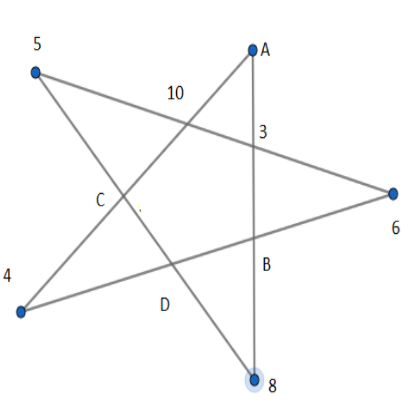
Find the value of D. \[\]
Answer
 Verified
644.7k+ views
Hint: We observe the side 5, 10, 3, 6. We see that the sum of all the values on that side is 24. We use the fact that in a magic pentagram the sum of values on all sides or a line is equal. We take different sides, which have unknown A and C form linear equations. We assume different values A starting with A=1 and check if the obtained value of D satisfies the side with 4, D, B, 3.\[\]
Complete step-by-step solution
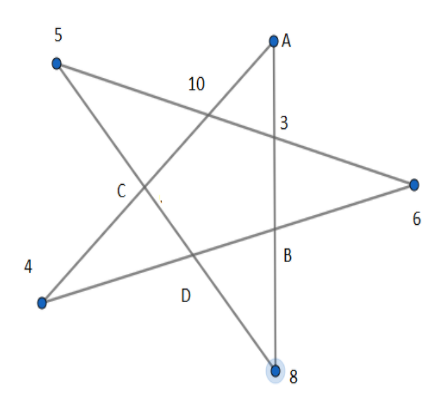
We see that the given figure is a five-pointed star whose vertices and points of intersection of sides are represented by a given and unknown numerical value. One such unknown is D whose value we are asked to determine.
We can guess the different rules for vertices, edges and points of intersection. \[\]
We know that in such problems involving magical pentagram we have to use addition operation on all the positive integral values on sides and sum on all sides will be equal. Let us see the side with values 5, 10, 3, 6. The sum of all values on that edge is
\[5+10+3+6=24\]
We similarly take the side with values A, 3, B,8. As sum on all the sides are equal we have
\[\begin{align}
& A+3+8+B=24 \\
& \Rightarrow A+B=24-11=13....(1) \\
\end{align}\]
We take the side with values A, 10, C, 4 and get,
\[\begin{align}
& A+10+C+4=24 \\
& \Rightarrow A+C=24-14=10....(2) \\
\end{align}\]
We take the side with values 5, C, D, 8 and get,
\[\begin{align}
& 5+C+D+8=24 \\
& \Rightarrow C+D=24-13=11....(3) \\
\end{align}\]
Let us check 4, D, B, 6 and get ,
\[\begin{align}
& 4+D+B+6=24 \\
& \Rightarrow D+B=14...\left( 4 \right) \\
\end{align}\]
Let assume $A=1$ and we obtain from equation (1), (2) , (3)
\[B=12,C=9,D=2\]
We put the value in (4) and check the satisfaction as
\[B+D=12+2=14\]
So we have one value for D is 2. Let us assume $A=2$ we obtain from equation (1), (2), (3),
\[B=11,C=8,D=3\]
We put the value in (4) and check the satisfaction as
\[B+D=11+3=14\]
Similarly we can take $A=3,4,...,9$ since $C+D=10$ and find the corresponding value of D. The possible values of D are
\[D=2,3,4,5.6,7,8,9,10\]
All of these values of D are going to satisfy the line 4, D, B, 6 because we are going to get 9 solutions for the quadruple $\left( A,B,C,D \right)$ which are
\[\begin{align}
& \left( 1,12,9,2 \right),\left( 2,11,8,3 \right),\left( 3,10,7,4 \right),\left( 4,9,6,5 \right),\left( 5,8,5,6 \right),\left( 6,7,4,7 \right) \\
& \left( 7,6,3,8 \right),\left( 8,5,2,9 \right),\left( 9,4,1,10 \right) \\
\end{align}\]
Note: The problems of such type are called magic pentagram puzzles. If all the values on the vertices and points of intersection are primes then it is called a prime magical pentagram puzzle. Another such puzzle with additions is a magical square where the sum of rows and columns are equal.
Complete step-by-step solution
We see that the given figure is a five-pointed star whose vertices and points of intersection of sides are represented by a given and unknown numerical value. One such unknown is D whose value we are asked to determine.
We can guess the different rules for vertices, edges and points of intersection. \[\]
We know that in such problems involving magical pentagram we have to use addition operation on all the positive integral values on sides and sum on all sides will be equal. Let us see the side with values 5, 10, 3, 6. The sum of all values on that edge is
\[5+10+3+6=24\]
We similarly take the side with values A, 3, B,8. As sum on all the sides are equal we have
\[\begin{align}
& A+3+8+B=24 \\
& \Rightarrow A+B=24-11=13....(1) \\
\end{align}\]
We take the side with values A, 10, C, 4 and get,
\[\begin{align}
& A+10+C+4=24 \\
& \Rightarrow A+C=24-14=10....(2) \\
\end{align}\]
We take the side with values 5, C, D, 8 and get,
\[\begin{align}
& 5+C+D+8=24 \\
& \Rightarrow C+D=24-13=11....(3) \\
\end{align}\]
Let us check 4, D, B, 6 and get ,
\[\begin{align}
& 4+D+B+6=24 \\
& \Rightarrow D+B=14...\left( 4 \right) \\
\end{align}\]
Let assume $A=1$ and we obtain from equation (1), (2) , (3)
\[B=12,C=9,D=2\]
We put the value in (4) and check the satisfaction as
\[B+D=12+2=14\]
So we have one value for D is 2. Let us assume $A=2$ we obtain from equation (1), (2), (3),
\[B=11,C=8,D=3\]
We put the value in (4) and check the satisfaction as
\[B+D=11+3=14\]
Similarly we can take $A=3,4,...,9$ since $C+D=10$ and find the corresponding value of D. The possible values of D are
\[D=2,3,4,5.6,7,8,9,10\]
All of these values of D are going to satisfy the line 4, D, B, 6 because we are going to get 9 solutions for the quadruple $\left( A,B,C,D \right)$ which are
\[\begin{align}
& \left( 1,12,9,2 \right),\left( 2,11,8,3 \right),\left( 3,10,7,4 \right),\left( 4,9,6,5 \right),\left( 5,8,5,6 \right),\left( 6,7,4,7 \right) \\
& \left( 7,6,3,8 \right),\left( 8,5,2,9 \right),\left( 9,4,1,10 \right) \\
\end{align}\]
Note: The problems of such type are called magic pentagram puzzles. If all the values on the vertices and points of intersection are primes then it is called a prime magical pentagram puzzle. Another such puzzle with additions is a magical square where the sum of rows and columns are equal.
Recently Updated Pages
Write any three differences between metals and nonmetals class 10 social science CBSE

Amit standing on a horizontal plane finds a bird flying class 10 maths CBSE
Two circles of radii 5 cm and 3 cm intersect at two class 10 maths CBSE
Solve the following i John and Jivanti together have class 10 maths CBSE
What is the relation between orthocenter circumcentre class 10 maths CBSE
Two plane mirrors are inclined at 70circ A ray incident class 10 physics CBSE
Trending doubts
Explain the Treaty of Vienna of 1815 class 10 social science CBSE
1 GB equals how many MB?
10 examples of evaporation in daily life with explanations
What is the full form of POSCO class 10 social science CBSE
Which is the hottest planet in the Solar system A Earth class 10 social science CBSE
Name any four life processes in living things class 10 biology CBSE