




Find the surface area of a cuboid with dimensions \[4\times 2.5\times 2\] (in inches)
(a) \[46\,i{{n}^{2}}\]
(b) \[12\,i{{n}^{2}}\]
(c) \[26\,i{{n}^{2}}\]
(d) \[14\,i{{n}^{2}}\]
Answer
 Verified
640.8k+ views
Hint: General notation of dimensions of cuboid is \[l\times b\times h\]. Total surface area of a cuboid is the sum of the areas of all its 6 rectangular faces that is \[\text{A=}2(lb+bh+lh)\].
Complete step-by-step answer:
Before proceeding with the question we should understand the definition of cuboid.
A cuboid is also a polyhedron having six faces, eight vertices and twelve edges. The faces of the cuboid are parallel and equal in dimensions. But not all the faces of a cuboid are equal in dimensions. A cuboid is a closed 3-dimensional geometrical figure bounded by six rectangular plane regions.
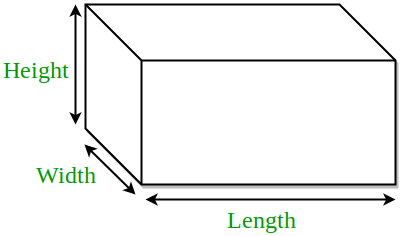
Total surface area of a cuboid is sum of the areas of all its 6 rectangular faces.
\[\text{A=}2(lb+bh+lh).......(1)\] where l is length, b is breadth and h is height
General notation of dimensions of cuboid is \[l\times b\times h\]. So from the information mentioned in the question, length is 4 inch, breadth is 2.5 inch and height is 2 inch.
So from equation (1) we get the surface area of a cuboid as,
\[\text{A=}2(4\times 2.5+2.5\times 2+4\times 2).......(2)\]
Now simplifying equation (2) by first multiplying each terms we get,
\[\text{A=}2(10+5+8).......(3)\]
Adding all the terms in equation (3) and multiplying it by 2 we get,
\[\text{A=}2\times 23=46\,i{{n}^{2}}\]
Hence the surface area of a cuboid is \[46\,i{{n}^{2}}\]. So the correct answer is option (a).
Note: Here in this type of questions we have to keep in my mind the general notation of the dimensions of a cuboid. Also we have to remember the formula of the total surface area of the cuboid to solve this problem. Here when we write the final answer we have to mention the unit or else marks will get deducted by the invigilator.
Complete step-by-step answer:
Before proceeding with the question we should understand the definition of cuboid.
A cuboid is also a polyhedron having six faces, eight vertices and twelve edges. The faces of the cuboid are parallel and equal in dimensions. But not all the faces of a cuboid are equal in dimensions. A cuboid is a closed 3-dimensional geometrical figure bounded by six rectangular plane regions.
Total surface area of a cuboid is sum of the areas of all its 6 rectangular faces.
\[\text{A=}2(lb+bh+lh).......(1)\] where l is length, b is breadth and h is height
General notation of dimensions of cuboid is \[l\times b\times h\]. So from the information mentioned in the question, length is 4 inch, breadth is 2.5 inch and height is 2 inch.
So from equation (1) we get the surface area of a cuboid as,
\[\text{A=}2(4\times 2.5+2.5\times 2+4\times 2).......(2)\]
Now simplifying equation (2) by first multiplying each terms we get,
\[\text{A=}2(10+5+8).......(3)\]
Adding all the terms in equation (3) and multiplying it by 2 we get,
\[\text{A=}2\times 23=46\,i{{n}^{2}}\]
Hence the surface area of a cuboid is \[46\,i{{n}^{2}}\]. So the correct answer is option (a).
Note: Here in this type of questions we have to keep in my mind the general notation of the dimensions of a cuboid. Also we have to remember the formula of the total surface area of the cuboid to solve this problem. Here when we write the final answer we have to mention the unit or else marks will get deducted by the invigilator.
Recently Updated Pages
Master Class 12 Business Studies: Engaging Questions & Answers for Success

Master Class 12 Biology: Engaging Questions & Answers for Success
Master Class 12 Chemistry: Engaging Questions & Answers for Success
Class 12 Question and Answer - Your Ultimate Solutions Guide
Master Class 11 Social Science: Engaging Questions & Answers for Success
Master Class 11 English: Engaging Questions & Answers for Success
Trending doubts
Explain the Treaty of Vienna of 1815 class 10 social science CBSE
Which Indian city is known as the "City of Victory"?
Which instrument is used to measure the Blood Pressure?
Who Won 36 Oscar Awards? Record Holder Revealed
What is the median of the first 10 natural numbers class 10 maths CBSE
Why is it 530 pm in india when it is 1200 afternoon class 10 social science CBSE