




Find the solution of the equation: $\dfrac{{{x}^{2}}+2x-3}{{{x}^{2}}+1}<0$
(a). (-3, 1)
(b). (-3, 0)
(c). (-3, -1)
(d). (-1, 0)
Answer
 Verified
611.7k+ views
Hint: Before solving this problem there are some rules that should be kept in mind, whenever we multiply or divide the equation by any negative number then the less than and greater than sign changes. So first we will take x in one side and all other numbers in the opposite side and after that we will get some range of x for which this equation is true and that is our final answer.
Complete step-by-step solution -
Now we will start solving this question by first taking ${{x}^{2}}+1$ on the opposite side.
As we know that ${{x}^{2}}+1$ is always positive hence the sign will not interchange.
So, the expression $\dfrac{{{x}^{2}}+2x-3}{{{x}^{2}}+1}<0$ becomes,
$\begin{align}
& {{x}^{2}}+2x-3<0 \\
& {{x}^{2}}+3x-x-3<0 \\
& x\left( x+3 \right)-1\left( x+3 \right)<0 \\
& \left( x-1 \right)\left( x+3 \right)<0 \\
\end{align}$
Now we are going to look at the graph of this function and then from that we will find in what range it is < 0.
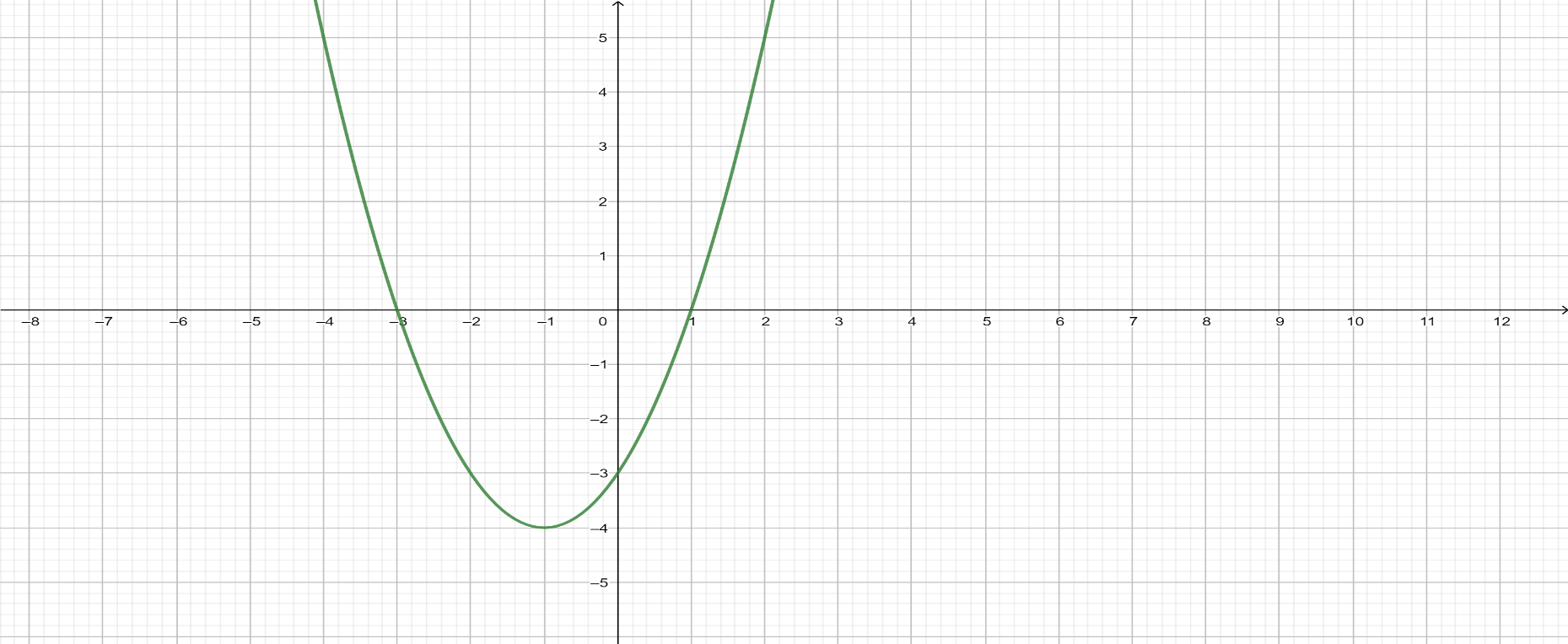
From this figure we can see that the value of x for which this graph is below x axis is (-3, 1)
Hence, from this we can conclude that the value of x for which ${{x}^{2}}-2x+3<0$ is true (-3, 1).
And hence option (a) is correct.
Note: The rules that are given must be kept in mind as there are chances of making mistakes in positive, negative sign or less than, greater than sign. So after solving just try to put some values of x in the range that we get and see if it’s true or not.
Complete step-by-step solution -
Now we will start solving this question by first taking ${{x}^{2}}+1$ on the opposite side.
As we know that ${{x}^{2}}+1$ is always positive hence the sign will not interchange.
So, the expression $\dfrac{{{x}^{2}}+2x-3}{{{x}^{2}}+1}<0$ becomes,
$\begin{align}
& {{x}^{2}}+2x-3<0 \\
& {{x}^{2}}+3x-x-3<0 \\
& x\left( x+3 \right)-1\left( x+3 \right)<0 \\
& \left( x-1 \right)\left( x+3 \right)<0 \\
\end{align}$
Now we are going to look at the graph of this function and then from that we will find in what range it is < 0.
From this figure we can see that the value of x for which this graph is below x axis is (-3, 1)
Hence, from this we can conclude that the value of x for which ${{x}^{2}}-2x+3<0$ is true (-3, 1).
And hence option (a) is correct.
Note: The rules that are given must be kept in mind as there are chances of making mistakes in positive, negative sign or less than, greater than sign. So after solving just try to put some values of x in the range that we get and see if it’s true or not.
Recently Updated Pages
Master Class 10 Computer Science: Engaging Questions & Answers for Success

Master Class 10 General Knowledge: Engaging Questions & Answers for Success
Master Class 10 English: Engaging Questions & Answers for Success
Master Class 10 Social Science: Engaging Questions & Answers for Success
Master Class 10 Maths: Engaging Questions & Answers for Success
Master Class 10 Science: Engaging Questions & Answers for Success
Trending doubts
What is the median of the first 10 natural numbers class 10 maths CBSE
Which women's tennis player has 24 Grand Slam singles titles?
Who is the Brand Ambassador of Incredible India?
Why is there a time difference of about 5 hours between class 10 social science CBSE
Write a letter to the principal requesting him to grant class 10 english CBSE
State and prove converse of BPT Basic Proportionality class 10 maths CBSE