




Find the solution for the bisector AG of triangle ABC in terms of vectors ‘a’ and ‘b’. Given that: G is the centroid of the triangle ABC if \[{\text{AB = a}}\],${\text{AC = b}}$ respectively.
(a) ${\text{AG = }}\dfrac{{\bar a - \bar b}}{3}$
(b) ${\text{AG = }}\dfrac{{\bar a + \bar b}}{3}$
(c) ${\text{AG = }}\dfrac{{\bar a + \bar b}}{2}$
(d) None of the above
Answer
 Verified
515.4k+ views
Hint: We will use the most curious concept of vector geometry which depends on both magnitude and direction of the problem, we are going to use the centroid formula in terms of vector definition and then substituting the values by solving the given conditions, the desired answer can be obtained.
Complete step-by-step solution:
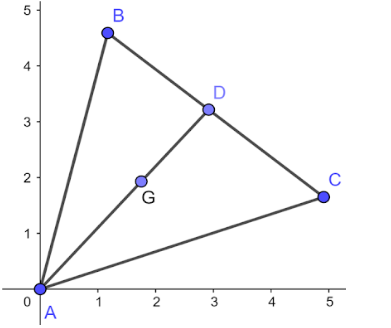
$ \Rightarrow $ Figure implies that position vectors of ‘A’ is $\vec a$, ‘B’ is $\vec b$, ‘C' is $\vec c$.
Since, the problem implies the centroid condition which is the intersection of the median ‘AD’ at point ‘G’,
So, according to vector definition, we know the centroid formula
\[\overrightarrow{G} = \dfrac{{\overrightarrow a + \overrightarrow b + \overrightarrow c }}{3}\]… (i)
But, we have given that ‘AG’ is the bisector of the triangle ABC i.e. $\vartriangle {\text{ABC}}$
Hence, according to the centroid formula [equation (i)],
\[ \Rightarrow \]Bisector\[\overrightarrow {AG} {\text{ = }}\dfrac{{\overrightarrow a + \overrightarrow b + \overrightarrow c }}{3}\]… (ii)
Where, the point ‘A’ is the origin of the vector $\vartriangle {\text{ABC}}$
$\therefore $The vector equation of the point ‘A’ is $A \equiv (0,0,0)$ i.e. $\overrightarrow a {\text{ = }}0$
The equation becomes (ii),
\[ \Rightarrow \overrightarrow {AG} {\text{ = }}\overrightarrow g {\text{ - }}\overrightarrow a {\text{ = }}\overrightarrow g {\text{ }} = {\text{ }}\dfrac{{\overrightarrow a + \overrightarrow b + \overrightarrow c }}{3}\]
\[ \Rightarrow \overrightarrow {AG} {\text{ = }}\dfrac{{0 + \overrightarrow b + \overrightarrow c }}{3}\]
Where, the position vectors of ‘B’ and ‘C’ are ‘$\vec a$’ and ‘$\vec b$’ respectively
(Refer the figure above),
Therefore, the equation becomes,
\[ \Rightarrow \overrightarrow {AG} {\text{ = }}\dfrac{{\overrightarrow a + \overrightarrow b }}{3}\]
$\therefore \Rightarrow $T he option (b) is correct.
Note: Note that the notation used to express the vector condition can be shown either by ‘$\vec a$’ or $\bar a$both are same so no need to be confused in rest of the problems referred to in any other books, etc. Also one must know the definition of vector geometry and its rules to apply such as ‘for cross-product, dot-product, conditions for parallel and perpendicular vectors, triangle law of addition (used in this case) that is, etc. $AB{\text{ }} + {\text{ }}BC{\text{ }} = {\text{ }}AC$’ and also remember the centroid, midpoint formula in terms of vector geometry (since by adding the notation above the respective variable).
Complete step-by-step solution:
$ \Rightarrow $ Figure implies that position vectors of ‘A’ is $\vec a$, ‘B’ is $\vec b$, ‘C' is $\vec c$.
Since, the problem implies the centroid condition which is the intersection of the median ‘AD’ at point ‘G’,
So, according to vector definition, we know the centroid formula
\[\overrightarrow{G} = \dfrac{{\overrightarrow a + \overrightarrow b + \overrightarrow c }}{3}\]… (i)
But, we have given that ‘AG’ is the bisector of the triangle ABC i.e. $\vartriangle {\text{ABC}}$
Hence, according to the centroid formula [equation (i)],
\[ \Rightarrow \]Bisector\[\overrightarrow {AG} {\text{ = }}\dfrac{{\overrightarrow a + \overrightarrow b + \overrightarrow c }}{3}\]… (ii)
Where, the point ‘A’ is the origin of the vector $\vartriangle {\text{ABC}}$
$\therefore $The vector equation of the point ‘A’ is $A \equiv (0,0,0)$ i.e. $\overrightarrow a {\text{ = }}0$
The equation becomes (ii),
\[ \Rightarrow \overrightarrow {AG} {\text{ = }}\overrightarrow g {\text{ - }}\overrightarrow a {\text{ = }}\overrightarrow g {\text{ }} = {\text{ }}\dfrac{{\overrightarrow a + \overrightarrow b + \overrightarrow c }}{3}\]
\[ \Rightarrow \overrightarrow {AG} {\text{ = }}\dfrac{{0 + \overrightarrow b + \overrightarrow c }}{3}\]
Where, the position vectors of ‘B’ and ‘C’ are ‘$\vec a$’ and ‘$\vec b$’ respectively
(Refer the figure above),
Therefore, the equation becomes,
\[ \Rightarrow \overrightarrow {AG} {\text{ = }}\dfrac{{\overrightarrow a + \overrightarrow b }}{3}\]
$\therefore \Rightarrow $T he option (b) is correct.
Note: Note that the notation used to express the vector condition can be shown either by ‘$\vec a$’ or $\bar a$both are same so no need to be confused in rest of the problems referred to in any other books, etc. Also one must know the definition of vector geometry and its rules to apply such as ‘for cross-product, dot-product, conditions for parallel and perpendicular vectors, triangle law of addition (used in this case) that is, etc. $AB{\text{ }} + {\text{ }}BC{\text{ }} = {\text{ }}AC$’ and also remember the centroid, midpoint formula in terms of vector geometry (since by adding the notation above the respective variable).
Recently Updated Pages
Basicity of sulphurous acid and sulphuric acid are

Master Class 12 English: Engaging Questions & Answers for Success
Master Class 12 Social Science: Engaging Questions & Answers for Success
Master Class 12 Maths: Engaging Questions & Answers for Success
Master Class 12 Economics: Engaging Questions & Answers for Success
Master Class 12 Physics: Engaging Questions & Answers for Success
Trending doubts
Which are the Top 10 Largest Countries of the World?
Draw a labelled sketch of the human eye class 12 physics CBSE
Draw ray diagrams each showing i myopic eye and ii class 12 physics CBSE
Give 10 examples of unisexual and bisexual flowers
Give simple chemical tests to distinguish between the class 12 chemistry CBSE
Define Vant Hoff factor How is it related to the degree class 12 chemistry CBSE