



Find the order of rotational symmetry of rhombus. \[\]
A.4 \[\]
B. 3 \[\]
C.2 \[\]
D.1 \[\]
Answer
 Verified
640.5k+ views
Hint: We recall the definition of center of rotation, rotational symmetry of planar objects which are rotated by angles, the order of rotational symmetry as the number of times the object will look exactly like the object in the initial position. We rotate the rhombus by ${{90}^{\circ }}$ until the complete turn of ${{360}^{\circ }}$and check how many times the rhombus looks like the rhombus at the initial position. \[\]
Complete step-by-step solution
We know that rotation is geometric operation mathematics where an object in motion preserves at least one point. If the rotation is only around only one preserved point which happens only for planar objects we call that point center of rotation. \[\]
We know that we call an object rationally symmetrical when the object is invariant of rotation which means if we rotate the object by a partial turn, the object looks the same. \[\]
The planar objects are rotated by an angle, and we know that for regular polygons the center of rotation is the point of intersection of diagonals. The order of rotational symmetry is the number of times the object looks when it is rotated by a full turn which is in-plane by an angle of ${{360}^{\circ }}$.
The rhombus is a regular polygon with four equal sides. Let ABCD be rhombus with O as the point of intersection of diagonals. \[\]
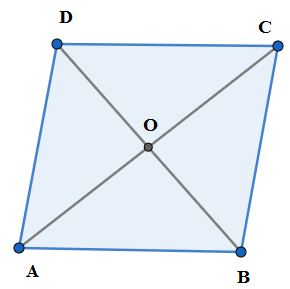
We know that the diagonals of a rhombus are perpendicular to each other whose point of intersection is the center of rotation. So we rotate the rhombus ABCD about O by right angle ${{90}^{\circ }}$. \[\]
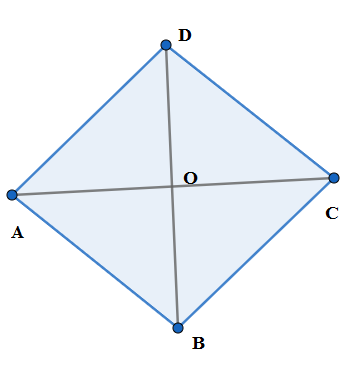
We see that the above figure does not look like the initial figure of the rhombus. So we rotate again by ${{90}^{\circ }}$ and have the figure as. \[\]
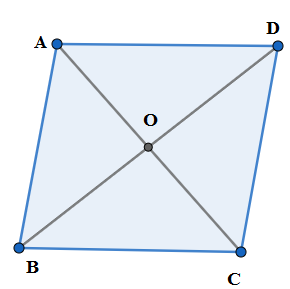
We see that the above figure looks like the initial figure of the rhombus. We rotate again by ${{90}^{\circ }}$ and have the figure as. \[\]
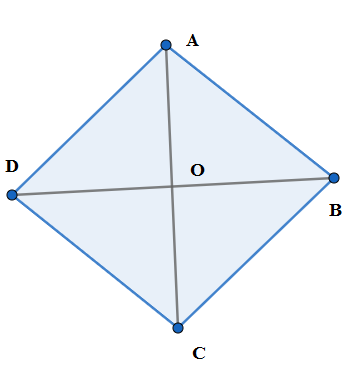
We see that the above figure does not look like the initial figure of the rhombus. So we rotate again by ${{90}^{\circ }}$ and have the figure as. \[\]
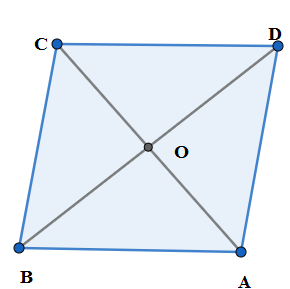
We see that the above figure looks like the initial figure of the rhombus. We have rotated a complete turn of angle ${{90}^{\circ }}+{{90}^{\circ }}+{{90}^{\circ }}+{{90}^{\circ }}={{360}^{\circ }}$. The number of times during the complete turn we rhombus exactly looks like the original rhombus ABCD is twice.
So the order of rotational symmetry for the rhombus is 2 and the correct option is C.
Note: We note that the initial position of the rhombus is at a rotational angle of${{0}^{\circ }}$. A rectangle and a parallelogram have order 2 and a square has order 4 for rotational symmetry. A circle has an infinite order of symmetry. The 3D objects, unlike planar objects, have axes of rotation instead of the center of rotation like cylinder or sphere.
Complete step-by-step solution
We know that rotation is geometric operation mathematics where an object in motion preserves at least one point. If the rotation is only around only one preserved point which happens only for planar objects we call that point center of rotation. \[\]
We know that we call an object rationally symmetrical when the object is invariant of rotation which means if we rotate the object by a partial turn, the object looks the same. \[\]
The planar objects are rotated by an angle, and we know that for regular polygons the center of rotation is the point of intersection of diagonals. The order of rotational symmetry is the number of times the object looks when it is rotated by a full turn which is in-plane by an angle of ${{360}^{\circ }}$.
The rhombus is a regular polygon with four equal sides. Let ABCD be rhombus with O as the point of intersection of diagonals. \[\]
We know that the diagonals of a rhombus are perpendicular to each other whose point of intersection is the center of rotation. So we rotate the rhombus ABCD about O by right angle ${{90}^{\circ }}$. \[\]
We see that the above figure does not look like the initial figure of the rhombus. So we rotate again by ${{90}^{\circ }}$ and have the figure as. \[\]
We see that the above figure looks like the initial figure of the rhombus. We rotate again by ${{90}^{\circ }}$ and have the figure as. \[\]
We see that the above figure does not look like the initial figure of the rhombus. So we rotate again by ${{90}^{\circ }}$ and have the figure as. \[\]
We see that the above figure looks like the initial figure of the rhombus. We have rotated a complete turn of angle ${{90}^{\circ }}+{{90}^{\circ }}+{{90}^{\circ }}+{{90}^{\circ }}={{360}^{\circ }}$. The number of times during the complete turn we rhombus exactly looks like the original rhombus ABCD is twice.
So the order of rotational symmetry for the rhombus is 2 and the correct option is C.
Note: We note that the initial position of the rhombus is at a rotational angle of${{0}^{\circ }}$. A rectangle and a parallelogram have order 2 and a square has order 4 for rotational symmetry. A circle has an infinite order of symmetry. The 3D objects, unlike planar objects, have axes of rotation instead of the center of rotation like cylinder or sphere.

Recently Updated Pages
You are the head boyhead girl Write a notice informing class 7 english CBSE

The image formed by a plane mirror is always laterally class 7 physics CBSE
When phenolphthalein is added toNaOH the colour of class 7 chemistry CBSE
Find the least number which when divided by 15 leaves class 7 maths CBSE
Show that one and only one out of n n + 2n or n + -class-7-maths-CBSE
During heavy exercise we get cramps in the legs due class 7 biology CBSE
Trending doubts
Full Form of IASDMIPSIFSIRSPOLICE class 7 social science CBSE
List of coprime numbers from 1 to 100 class 7 maths CBSE
The plural of Chief is Chieves A True B False class 7 english CBSE
The founder of Jainism was A Rishabhadev B Neminath class 7 social science CBSE
Collective noun a of sailors class 7 english CBSE
Differentiate between weather and climate How do they class 7 social science CBSE