




Find the number of solutions of \[{{\sin }^{2}}x-\sin x-1=0\] in \[\left[ -2\pi ,2\pi \right]\]
Answer
 Verified
574.8k+ views
Hint: We solve this problem by finding the roots of a given equation using the formula of roots. The formula of roots of quadratic equation \[a{{x}^{2}}+bx+c=0\] is given as
\[x=\dfrac{-b\pm \sqrt{{{b}^{2}}-4ac}}{2a}\]
After finding the value of \[\sin x\] using the above formula we can get the number of solutions using graphs that is the number of solutions of \[f\left( x \right)=g\left( x \right)\] is nothing but number of point of intersections of graph \[y=f\left( x \right)\] and \[y=g\left( x \right)\]
Complete step by step answer:
We are given that the quadratic equation as
\[\Rightarrow {{\sin }^{2}}x-\sin x-1=0\]
Let us assume that \[\sin x=t\] then by substituting it in the above equation we get
\[\Rightarrow {{t}^{2}}-t-1=0\]
We know that the formula of roots of quadratic equation \[a{{x}^{2}}+bx+c=0\] is given as
\[x=\dfrac{-b\pm \sqrt{{{b}^{2}}-4ac}}{2a}\]
By using the above formula to given equation we get
\[\begin{align}
& \Rightarrow t=\dfrac{-\left( -1 \right)\pm \sqrt{{{1}^{2}}-4\left( 1 \right)\left( -1 \right)}}{2\left( 1 \right)} \\
& \Rightarrow t=\dfrac{1\pm \sqrt{5}}{2} \\
\end{align}\]
Here, we can see that \['t'\] has two solutions
Let us take one solution as
\[\Rightarrow \sin x=\dfrac{1+\sqrt{5}}{2}\]
Here, we can see that the value that is
\[\Rightarrow \sin x=\dfrac{1+\sqrt{5}}{2}>1\]
Bu we know that the range of \[\sin x\] is \[\left[ -1,1 \right]\]
Therefore, we can say that
\[\Rightarrow \sin x\ne \dfrac{1+\sqrt{5}}{2}\]
Now let us take the second solution
\[\Rightarrow \sin x=\dfrac{1-\sqrt{5}}{2}\]
We know that the number of solutions of \[f\left( x \right)=g\left( x \right)\] is nothing but number of point of intersections of graph \[y=f\left( x \right)\] and \[y=g\left( x \right)\]
Now let us draw the graph of \[y=\sin x\] and \[y=\dfrac{1-\sqrt{5}}{2}\] in the domain \[\left[ -2\pi ,2\pi \right]\] as
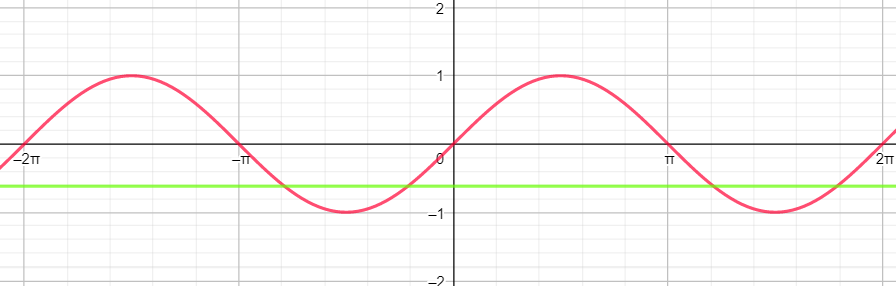
Here, we can see that red line is \[y=\sin x\] and green line is \[y=\dfrac{1-\sqrt{5}}{2}\]
We can see that both graphs intersect at 4 points in the domain \[\left[ -2\pi ,2\pi \right]\]
Therefore, the number of solutions of \[{{\sin }^{2}}x-\sin x-1=0\] is 4.
Note: We can solve this problem in another method.
We are given the equation as
\[\begin{align}
& \Rightarrow {{\sin }^{2}}x-\sin x-1=0 \\
& \Rightarrow \sin x=-\left( 1-{{\sin }^{2}}x \right).........equation(i) \\
\end{align}\]
We know that the standard result that is
\[\begin{align}
& \Rightarrow {{\sin }^{2}}x+{{\cos }^{2}}x=1 \\
& \Rightarrow {{\cos }^{2}}x=1-{{\sin }^{2}}x \\
\end{align}\]
By substituting this value in equation (i) we get
\[\Rightarrow \sin x=-{{\cos }^{2}}x\]
Now let us draw the graph of \[y=\sin x\] and \[y=-{{\cos }^{2}}x\] in the domain \[\left[ -2\pi ,2\pi \right]\] as
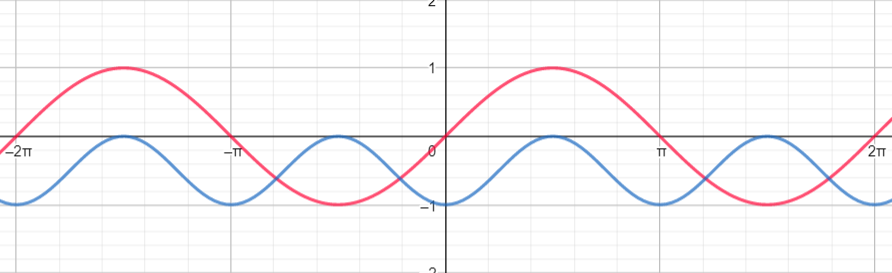
Here, we can see that red line is \[y=\sin x\] and blue line is \[y=-{{\cos }^{2}}x\]
We can see that both graphs intersect at 4 points in the domain \[\left[ -2\pi ,2\pi \right]\]
Therefore, the number of solutions of \[{{\sin }^{2}}x-\sin x-1=0\] is 4.
\[x=\dfrac{-b\pm \sqrt{{{b}^{2}}-4ac}}{2a}\]
After finding the value of \[\sin x\] using the above formula we can get the number of solutions using graphs that is the number of solutions of \[f\left( x \right)=g\left( x \right)\] is nothing but number of point of intersections of graph \[y=f\left( x \right)\] and \[y=g\left( x \right)\]
Complete step by step answer:
We are given that the quadratic equation as
\[\Rightarrow {{\sin }^{2}}x-\sin x-1=0\]
Let us assume that \[\sin x=t\] then by substituting it in the above equation we get
\[\Rightarrow {{t}^{2}}-t-1=0\]
We know that the formula of roots of quadratic equation \[a{{x}^{2}}+bx+c=0\] is given as
\[x=\dfrac{-b\pm \sqrt{{{b}^{2}}-4ac}}{2a}\]
By using the above formula to given equation we get
\[\begin{align}
& \Rightarrow t=\dfrac{-\left( -1 \right)\pm \sqrt{{{1}^{2}}-4\left( 1 \right)\left( -1 \right)}}{2\left( 1 \right)} \\
& \Rightarrow t=\dfrac{1\pm \sqrt{5}}{2} \\
\end{align}\]
Here, we can see that \['t'\] has two solutions
Let us take one solution as
\[\Rightarrow \sin x=\dfrac{1+\sqrt{5}}{2}\]
Here, we can see that the value that is
\[\Rightarrow \sin x=\dfrac{1+\sqrt{5}}{2}>1\]
Bu we know that the range of \[\sin x\] is \[\left[ -1,1 \right]\]
Therefore, we can say that
\[\Rightarrow \sin x\ne \dfrac{1+\sqrt{5}}{2}\]
Now let us take the second solution
\[\Rightarrow \sin x=\dfrac{1-\sqrt{5}}{2}\]
We know that the number of solutions of \[f\left( x \right)=g\left( x \right)\] is nothing but number of point of intersections of graph \[y=f\left( x \right)\] and \[y=g\left( x \right)\]
Now let us draw the graph of \[y=\sin x\] and \[y=\dfrac{1-\sqrt{5}}{2}\] in the domain \[\left[ -2\pi ,2\pi \right]\] as
Here, we can see that red line is \[y=\sin x\] and green line is \[y=\dfrac{1-\sqrt{5}}{2}\]
We can see that both graphs intersect at 4 points in the domain \[\left[ -2\pi ,2\pi \right]\]
Therefore, the number of solutions of \[{{\sin }^{2}}x-\sin x-1=0\] is 4.
Note: We can solve this problem in another method.
We are given the equation as
\[\begin{align}
& \Rightarrow {{\sin }^{2}}x-\sin x-1=0 \\
& \Rightarrow \sin x=-\left( 1-{{\sin }^{2}}x \right).........equation(i) \\
\end{align}\]
We know that the standard result that is
\[\begin{align}
& \Rightarrow {{\sin }^{2}}x+{{\cos }^{2}}x=1 \\
& \Rightarrow {{\cos }^{2}}x=1-{{\sin }^{2}}x \\
\end{align}\]
By substituting this value in equation (i) we get
\[\Rightarrow \sin x=-{{\cos }^{2}}x\]
Now let us draw the graph of \[y=\sin x\] and \[y=-{{\cos }^{2}}x\] in the domain \[\left[ -2\pi ,2\pi \right]\] as
Here, we can see that red line is \[y=\sin x\] and blue line is \[y=-{{\cos }^{2}}x\]
We can see that both graphs intersect at 4 points in the domain \[\left[ -2\pi ,2\pi \right]\]
Therefore, the number of solutions of \[{{\sin }^{2}}x-\sin x-1=0\] is 4.
Recently Updated Pages
Master Class 10 Computer Science: Engaging Questions & Answers for Success

Master Class 10 General Knowledge: Engaging Questions & Answers for Success
Master Class 10 English: Engaging Questions & Answers for Success
Master Class 10 Social Science: Engaging Questions & Answers for Success
Master Class 10 Maths: Engaging Questions & Answers for Success
Master Class 10 Science: Engaging Questions & Answers for Success
Trending doubts
What is the median of the first 10 natural numbers class 10 maths CBSE
Which women's tennis player has 24 Grand Slam singles titles?
Who is the Brand Ambassador of Incredible India?
Why is there a time difference of about 5 hours between class 10 social science CBSE
Write a letter to the principal requesting him to grant class 10 english CBSE
State and prove converse of BPT Basic Proportionality class 10 maths CBSE