




Find the number of elements in set A-B
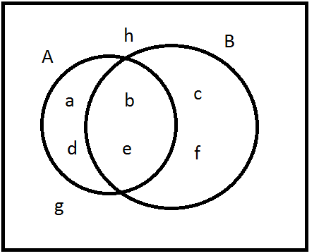
Answer
 Verified
601.8k+ views
Hint: In this question we have to find the number of elements in set A and B. We know that the number of elements in combining both sets is called union of sets and hence we need to find the number of elements in the union of both the sets. To find union we will create a Venn diagram showing all elements of A and B. And analyse where it lies.
We know that,
\[A\bigcup B\Rightarrow \] Contains all elements in either set
\[A\bigcap \bar{B}\Rightarrow \] all the elements of A which are not in B
Complete step-by-step answer:
Given Venn diagram
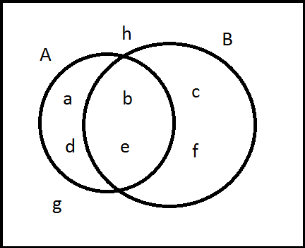
We can see that by this diagram
\[\begin{gathered}
A = \left\{ {a,d,b,e} \right\} \\
B = \left\{ {c,f,b,e} \right\} \\
A \cap b = \left\{ {b,e} \right\} \\
A \cup b = \left\{ {a,b,c,d,e,f} \right\} \\
\end{gathered} \]
Now we have to solve A-B
A-B means all the elements of ‘A’ which are not in B set.
B and c are common in set ‘A’ and set ‘B’ so we cannot write them in A-B
So, we write only a and d
i.e. \[A - B = \left\{ {a,d} \right\}\]
Hence, the number of elements in set A-B is \[\left\{ {a,d} \right\}\]
Note: In mathematics, two sets are said to be disjoint sets if they have no element in common. Equivalently, two disjoint sets are sets, whose intersection is the empty set.
In this question ‘g’ and ‘h’ are those elements who are neither the element of set A nor set B.
We know that,
\[A\bigcup B\Rightarrow \] Contains all elements in either set
\[A\bigcap \bar{B}\Rightarrow \] all the elements of A which are not in B
Complete step-by-step answer:
Given Venn diagram
We can see that by this diagram
\[\begin{gathered}
A = \left\{ {a,d,b,e} \right\} \\
B = \left\{ {c,f,b,e} \right\} \\
A \cap b = \left\{ {b,e} \right\} \\
A \cup b = \left\{ {a,b,c,d,e,f} \right\} \\
\end{gathered} \]
Now we have to solve A-B
A-B means all the elements of ‘A’ which are not in B set.
B and c are common in set ‘A’ and set ‘B’ so we cannot write them in A-B
So, we write only a and d
i.e. \[A - B = \left\{ {a,d} \right\}\]
Hence, the number of elements in set A-B is \[\left\{ {a,d} \right\}\]
Note: In mathematics, two sets are said to be disjoint sets if they have no element in common. Equivalently, two disjoint sets are sets, whose intersection is the empty set.
In this question ‘g’ and ‘h’ are those elements who are neither the element of set A nor set B.
Recently Updated Pages
Master Class 11 Social Science: Engaging Questions & Answers for Success

Master Class 11 Physics: Engaging Questions & Answers for Success
Master Class 11 Maths: Engaging Questions & Answers for Success
Master Class 11 Economics: Engaging Questions & Answers for Success
Master Class 11 Computer Science: Engaging Questions & Answers for Success
Master Class 11 Chemistry: Engaging Questions & Answers for Success
Trending doubts
One Metric ton is equal to kg A 10000 B 1000 C 100 class 11 physics CBSE
There are 720 permutations of the digits 1 2 3 4 5 class 11 maths CBSE
1 Quintal is equal to a 110 kg b 10 kg c 100kg d 1000 class 11 physics CBSE
State and prove Bernoullis theorem class 11 physics CBSE
Difference Between Prokaryotic Cells and Eukaryotic Cells
Which among the following are examples of coming together class 11 social science CBSE