




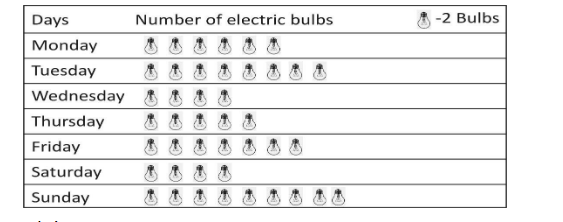
Find the number of electric bulbs by referring to the figure.
Answer
 Verified
600k+ views
Hint: Fundamental principle of addition: Any two numbers can be added using addition sign $ ( + ). $
Example:
$
5 + 3 = 8 \\
1 + 2 = 3 \\
2 + 2 = 4 \\
$
Fundamental principle of multiplication:
Any two numbers can be multiplied using multiplication sign $ ( \times ). $
Example:
$
5 \times 3 = 15 \\
1 \times 2 = 4 \\
2 \times 2 = 4 \\
$
Complete step-by-step answer:
Here, in our question, it is stated that one diagram of represents 2 bulbs

So, we have to find out the number of bulbs on different days of a week starting from. Monday and ending on Sunday. It can be found either by fundamental principle of addition or by fundamental principle of multiplication.
Day:
(i) Monday: There are six such diagrams. Each diagram represents 2 bulbs.

So, total number of bulbs $ = 6 \times 2 = 12 $ bulbs.
(ii) Tuesday: 8 such diagrams.
Each diagram represents 2 bulbs.
So, total bulbs $ = 8 \times 2 = 16 $ bulbs.
(iii) Wednesday: 4 such diagrams.
Each diagram represent 2 bulbs
So, total bulbs $ = 4 \times 2 = 8 $ bulbs.
(iv) Thursday: 5 such diagrams.
Each diagram represent $ = 2 $ bulbs
So, total bulbs $ 5 \times 2 = 10 $ bulbs.
(v) Friday $ = $ such diagrams.
Each diagram represent $ = $ 2 bulbs
So, total bulbs $ 7 \times 2 = 14 $ bulbs
(vi) Saturday
4 such diagrams.
So, total bulbs $ = 4 \times 2 = 8 $ bulbs
(vii) Sunday
9 such diagrams.
Each diagrams $ = $ 2 bulbs
So, total bulbs $ = 9 \times 2 = 18 $ bulbs
Note: Fundamental principle of addition and fundamental principle of multiplication is the most basic and elementary tool in mathematics to solve any basic problem of addition and multiplication.
Example:
$
4 + 6 = 10 \to Addition \\
4 \times 6 \to multiplication \\
$
Example:
$
5 + 3 = 8 \\
1 + 2 = 3 \\
2 + 2 = 4 \\
$
Fundamental principle of multiplication:
Any two numbers can be multiplied using multiplication sign $ ( \times ). $
Example:
$
5 \times 3 = 15 \\
1 \times 2 = 4 \\
2 \times 2 = 4 \\
$
Complete step-by-step answer:
Here, in our question, it is stated that one diagram of represents 2 bulbs
So, we have to find out the number of bulbs on different days of a week starting from. Monday and ending on Sunday. It can be found either by fundamental principle of addition or by fundamental principle of multiplication.
Day:
(i) Monday: There are six such diagrams. Each diagram represents 2 bulbs.
So, total number of bulbs $ = 6 \times 2 = 12 $ bulbs.
(ii) Tuesday: 8 such diagrams.
Each diagram represents 2 bulbs.
So, total bulbs $ = 8 \times 2 = 16 $ bulbs.
(iii) Wednesday: 4 such diagrams.
Each diagram represent 2 bulbs
So, total bulbs $ = 4 \times 2 = 8 $ bulbs.
(iv) Thursday: 5 such diagrams.
Each diagram represent $ = 2 $ bulbs
So, total bulbs $ 5 \times 2 = 10 $ bulbs.
(v) Friday $ = $ such diagrams.
Each diagram represent $ = $ 2 bulbs
So, total bulbs $ 7 \times 2 = 14 $ bulbs
(vi) Saturday
4 such diagrams.
So, total bulbs $ = 4 \times 2 = 8 $ bulbs
(vii) Sunday
9 such diagrams.
Each diagrams $ = $ 2 bulbs
So, total bulbs $ = 9 \times 2 = 18 $ bulbs
Note: Fundamental principle of addition and fundamental principle of multiplication is the most basic and elementary tool in mathematics to solve any basic problem of addition and multiplication.
Example:
$
4 + 6 = 10 \to Addition \\
4 \times 6 \to multiplication \\
$

Recently Updated Pages
Basicity of sulphurous acid and sulphuric acid are

Master Class 11 Business Studies: Engaging Questions & Answers for Success
Master Class 11 Computer Science: Engaging Questions & Answers for Success
Master Class 11 Economics: Engaging Questions & Answers for Success
Master Class 12 English: Engaging Questions & Answers for Success
Master Class 12 Social Science: Engaging Questions & Answers for Success
Trending doubts
What is the capital city of Australia? A) Sydney B) Melbourne C) Brisbane D) Canberra
How many millions make a billion class 6 maths CBSE
Give 10 examples for herbs , shrubs , climbers , creepers
Why is democracy considered as the best form of go class 6 social science CBSE
The planet nearest to earth is A Mercury B Venus C class 6 social science CBSE
Which country first gave women the right to vote?