




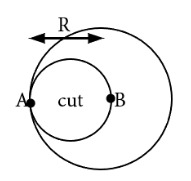
Find the moment of inertia of the circular disc of mass $ M $ and radius $ R $ cut as shown in figure below, about an axis through A and normal to the plane of the disc.
Answer
 Verified
609.6k+ views
Hint : The total moment of inertia is the moment of inertia as though the hole hasn’t been there minus the moment of inertia if the hole had been a solid disk. The moment of inertia at an axis at the surface is equal to the moment of inertial at the centre plus the mass times the square of the radius of the disc.
Formula used: In this solution we will be using the following formula;
$ \Rightarrow {I_d} = \dfrac{{M{R^2}}}{2} $ , where $ {I_d} $ , is the moment of inertia of a disc at an axis through its centre, $ M $ is the mass of the disc.
$ \Rightarrow {I_s} = {I_c} + M{R^2} $ where $ {I_s} $ is the moment of inertia about an axis at the surface , and $ {I_c} $ is the moment of inertia about an axis through its centre.
Complete step by step answer
To calculate the moment of inertia, we first assume that the hole is absent. The moment of inertia through A would be given by
$ \Rightarrow {I_A} = {I_B} + M{R^2} $ , where $ {I_A} $ is the moment of inertia about an axis through A the surface , and $ {I_B} $ is the moment of inertia about an axis through B, its centre, and $ M $ is the mass, $ R $ is the radius.
Hence,
$ \Rightarrow {I_A} = \dfrac{{M{R^2}}}{2} + M{R^2} = \dfrac{3}{2}M{R^2} $ (since $ {I_d} = \dfrac{{M{R^2}}}{2} $ , where $ {I_d} $ , is the moment of inertia of a disc at an axis through its centre)
Now, we shall calculate the moment of inertia of the disk cutaway.
The disk has a radius of $ \dfrac{R}{2} $
Mass can be given as $ M = \sigma A = \sigma 2\pi {R^2} $ where $ \sigma $ is surface density.
Hence, for the cut disk $ {M_c} = \sigma A = \sigma 2\pi {\left( {\dfrac{R}{2}} \right)^2} $ .
$ \Rightarrow {M_c} = \sigma 2\pi \dfrac{{{R^2}}}{4} = \dfrac{M}{4} $
Hence, Moment of inertia is given as
$ \Rightarrow {I_{AC}} = \dfrac{1}{2}\left( {\dfrac{M}{4}{{\left( {\dfrac{R}{2}} \right)}^2}} \right) + \left( {\dfrac{M}{4}{{\left( {\dfrac{R}{2}} \right)}^2}} \right) $ , where $ {I_{AC}} $ is the moment of inertia of the cutaway disk at an axis through A.
Hence,
$ \Rightarrow {I_{AC}} = \dfrac{3}{2}\left[ {\left( {\dfrac{M}{4}\dfrac{{{R^2}}}{4}} \right)} \right] = \dfrac{3}{{32}}M{R^2} $
Now, since the disc with radius $ \dfrac{R}{2} $ is actually removed then, we subtract it from the moment of inertia of the whole disk.
Thus,
$ \Rightarrow {I_{A - AC}} = \dfrac{3}{2}M{R^2} - \dfrac{3}{{32}}M{R^2} $
Hence,
$ \Rightarrow {I_{A - AC}} = \dfrac{3}{2}M{R^2}\left( {1 - \dfrac{1}{{16}}} \right) = \dfrac{3}{2}M{R^2} \times \dfrac{{15}}{{16}} $
$ \Rightarrow {I_{A - AC}} = \dfrac{{45}}{{32}}M{R^2} $.
Note
For clarity, the reason why we can simply subtract the moment of inertia is because the moment of inertia of any body is simply the rotational equivalent of mass. Just like the end mass of the cut disk would have been the mass of the whole disk minus the mass of the cut disk. The end moment of inertia is simply that but with mass replaced with moment of inertia.
Formula used: In this solution we will be using the following formula;
$ \Rightarrow {I_d} = \dfrac{{M{R^2}}}{2} $ , where $ {I_d} $ , is the moment of inertia of a disc at an axis through its centre, $ M $ is the mass of the disc.
$ \Rightarrow {I_s} = {I_c} + M{R^2} $ where $ {I_s} $ is the moment of inertia about an axis at the surface , and $ {I_c} $ is the moment of inertia about an axis through its centre.
Complete step by step answer
To calculate the moment of inertia, we first assume that the hole is absent. The moment of inertia through A would be given by
$ \Rightarrow {I_A} = {I_B} + M{R^2} $ , where $ {I_A} $ is the moment of inertia about an axis through A the surface , and $ {I_B} $ is the moment of inertia about an axis through B, its centre, and $ M $ is the mass, $ R $ is the radius.
Hence,
$ \Rightarrow {I_A} = \dfrac{{M{R^2}}}{2} + M{R^2} = \dfrac{3}{2}M{R^2} $ (since $ {I_d} = \dfrac{{M{R^2}}}{2} $ , where $ {I_d} $ , is the moment of inertia of a disc at an axis through its centre)
Now, we shall calculate the moment of inertia of the disk cutaway.
The disk has a radius of $ \dfrac{R}{2} $
Mass can be given as $ M = \sigma A = \sigma 2\pi {R^2} $ where $ \sigma $ is surface density.
Hence, for the cut disk $ {M_c} = \sigma A = \sigma 2\pi {\left( {\dfrac{R}{2}} \right)^2} $ .
$ \Rightarrow {M_c} = \sigma 2\pi \dfrac{{{R^2}}}{4} = \dfrac{M}{4} $
Hence, Moment of inertia is given as
$ \Rightarrow {I_{AC}} = \dfrac{1}{2}\left( {\dfrac{M}{4}{{\left( {\dfrac{R}{2}} \right)}^2}} \right) + \left( {\dfrac{M}{4}{{\left( {\dfrac{R}{2}} \right)}^2}} \right) $ , where $ {I_{AC}} $ is the moment of inertia of the cutaway disk at an axis through A.
Hence,
$ \Rightarrow {I_{AC}} = \dfrac{3}{2}\left[ {\left( {\dfrac{M}{4}\dfrac{{{R^2}}}{4}} \right)} \right] = \dfrac{3}{{32}}M{R^2} $
Now, since the disc with radius $ \dfrac{R}{2} $ is actually removed then, we subtract it from the moment of inertia of the whole disk.
Thus,
$ \Rightarrow {I_{A - AC}} = \dfrac{3}{2}M{R^2} - \dfrac{3}{{32}}M{R^2} $
Hence,
$ \Rightarrow {I_{A - AC}} = \dfrac{3}{2}M{R^2}\left( {1 - \dfrac{1}{{16}}} \right) = \dfrac{3}{2}M{R^2} \times \dfrac{{15}}{{16}} $
$ \Rightarrow {I_{A - AC}} = \dfrac{{45}}{{32}}M{R^2} $.
Note
For clarity, the reason why we can simply subtract the moment of inertia is because the moment of inertia of any body is simply the rotational equivalent of mass. Just like the end mass of the cut disk would have been the mass of the whole disk minus the mass of the cut disk. The end moment of inertia is simply that but with mass replaced with moment of inertia.
Recently Updated Pages
Master Class 11 English: Engaging Questions & Answers for Success

Master Class 11 Social Science: Engaging Questions & Answers for Success
Master Class 11 Maths: Engaging Questions & Answers for Success
Master Class 11 Biology: Engaging Questions & Answers for Success
Master Class 11 Physics: Engaging Questions & Answers for Success
Master Class 11 Chemistry: Engaging Questions & Answers for Success
Trending doubts
One Metric ton is equal to kg A 10000 B 1000 C 100 class 11 physics CBSE
Difference Between Prokaryotic Cells and Eukaryotic Cells
Two of the body parts which do not appear in MRI are class 11 biology CBSE
Find the value of the expression given below sin 30circ class 11 maths CBSE
Draw a diagram of a plant cell and label at least eight class 11 biology CBSE
10 examples of friction in our daily life