




How do you find the missing side of each right triangle? Side “c” is the hypotenuse and side “a” and “b” are the legs, “a=11m”, “c=15m”?
Answer
 Verified
607.5k+ views
Hint: Here we can solve this question by using the Pythagoras theorem of the triangle, here we have to first draw a right angled triangle then after plotting the values we can use the theorem to find the third side, this theorem can be applied to the right angled triangle only, in this form of triangle one angle of the triangle needs to be ninety.
Complete step by step solution:
To solve the question first we have to draw the triangle, on drawing we get:
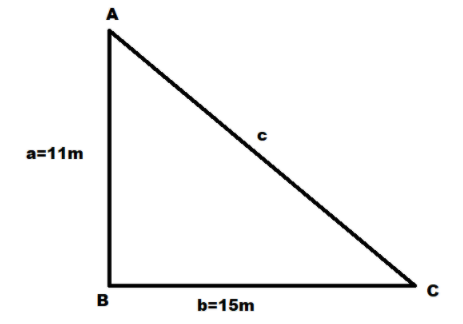
Pythagoras theorem states that:
\[ \Rightarrow {(AC)^2} = {(AB)^2} + {(BC)^2}\]
Now applying this to our triangle we get:
\[
\Rightarrow {(AC)^2} = {(11)^2} + {(15)^2} = 121 + 225 = 346 \\
\Rightarrow AC = \sqrt {346} = 18.6 \\
\]
Formulae Used:
\[ \Rightarrow {(AC)^2} = {(AB)^2} + {(BC)^2}\]for any right angled triangle having vertices as A,B,C and right angles at B and side as AB,BC,CA.
Additional Information: The above question is solved by using Pythagoras theorem and solved accordingly, the theorem states that the square of length of hypotenuse is equal to the sum of squares of the rest two sides of the right angle triangle.
Note:The above question can also be solved by using the trigonometric term that is “sin” in which we can compare the hypotenuse and perpendicular side but for that option first we have to find the rest two angles of the triangle other then ninety which again becomes a separate question, so it is easy and appropriate to go with the Pythagoras theorem then the trigonometric identity.
Complete step by step solution:
To solve the question first we have to draw the triangle, on drawing we get:
Pythagoras theorem states that:
\[ \Rightarrow {(AC)^2} = {(AB)^2} + {(BC)^2}\]
Now applying this to our triangle we get:
\[
\Rightarrow {(AC)^2} = {(11)^2} + {(15)^2} = 121 + 225 = 346 \\
\Rightarrow AC = \sqrt {346} = 18.6 \\
\]
Formulae Used:
\[ \Rightarrow {(AC)^2} = {(AB)^2} + {(BC)^2}\]for any right angled triangle having vertices as A,B,C and right angles at B and side as AB,BC,CA.
Additional Information: The above question is solved by using Pythagoras theorem and solved accordingly, the theorem states that the square of length of hypotenuse is equal to the sum of squares of the rest two sides of the right angle triangle.
Note:The above question can also be solved by using the trigonometric term that is “sin” in which we can compare the hypotenuse and perpendicular side but for that option first we have to find the rest two angles of the triangle other then ninety which again becomes a separate question, so it is easy and appropriate to go with the Pythagoras theorem then the trigonometric identity.
Recently Updated Pages
Master Class 11 Social Science: Engaging Questions & Answers for Success

Master Class 11 English: Engaging Questions & Answers for Success
Master Class 11 Accountancy: Engaging Questions & Answers for Success
Master Class 11 Physics: Engaging Questions & Answers for Success
Master Class 11 Computer Science: Engaging Questions & Answers for Success
Master Class 11 Business Studies: Engaging Questions & Answers for Success
Trending doubts
Find the value of the expression given below sin 30circ class 11 maths CBSE
One Metric ton is equal to kg A 10000 B 1000 C 100 class 11 physics CBSE
10 examples of friction in our daily life
Draw a diagram of nephron and explain its structur class 11 biology CBSE
The teeth used for biting and cutting food are called class 11 biology CBSE
Proton was discovered by A Thomson B Rutherford C Chadwick class 11 chemistry CBSE