




Find the locus of the complex number z = x + iy, satisfying relations $\arg (z-1)=\dfrac{\pi }{4}\text{ and }\left| z-2-3i \right|=2$. Illustrate the locus on the Argand plane.
Answer
 Verified
629.1k+ views
Hint: Mathematics includes the study of topics which are related to quantity, structure, space and change. Mathematics deals with a variety of numbers ranging from natural numbers to irrational numbers. In this problem we are given a complex number and its argument. With this information we can formulate relations between the variables x and y. So, we have two variables and two conditions to evaluate this system.
Complete step-by-step answer:
We are required to find the locus of complex numbers. Let the complex number be z = x + iy.
Now, by using the first information: $\arg (z-1)=\dfrac{\pi }{4}$.
As we know that argument of a complex number is expressed as: $\arg (z)=\theta ={{\tan }^{-1}}\left( \dfrac{y}{x} \right)$, where y belongs to imaginary part and x belongs to real part. Also, addition and subtraction can be done only with corresponding terms such that real can operate with real part and imaginary with imaginary part.
$\begin{align}
& \arg (z-1)=\dfrac{\pi }{4} \\
& \because z-1=x+iy-1 \\
& z-1=x-1+iy \\
\end{align}$
Now, by using argument definition, ${{\tan }^{-1}}\left( \dfrac{y}{x-1} \right)=\dfrac{\pi }{4}$.
Now, applying tan to both sides we get,
$\begin{align}
& \tan \left( {{\tan }^{-1}}\left( \dfrac{y}{x-1} \right) \right)=\tan \dfrac{\pi }{4} \\
& \dfrac{y}{x-1}=1 \\
& \therefore y=x-1 \\
\end{align}$
Hence, the locus for this part will be a straight line.
Now, by using the second information: $\left| z-2-3i \right|=2$.
Also, for the modulus of a complex number z we have, $\left| z \right|=\sqrt{{{x}^{2}}+{{y}^{2}}}$
Therefore first obtaining the proper complex number from information,
$\begin{align}
& z-2-3i=x+iy-2-3i \\
& =(x-2)+i(y-3) \\
\end{align}$
Now, applying the modulus expansion we get,
$\begin{align}
& \left| z-2-3i \right|=\sqrt{{{\left( x-2 \right)}^{2}}+{{\left( y-3 \right)}^{2}}} \\
& \sqrt{{{\left( x-2 \right)}^{2}}+{{\left( y-3 \right)}^{2}}}=2 \\
\end{align}$
Squaring both sides, we get,
\[{{\left( x-2 \right)}^{2}}+{{(y-3)}^{2}}=4\]
Hence, the locus for this part is a circle with center (2,3) and radius 4.
Now, to illustrate both the locus on argand plane:
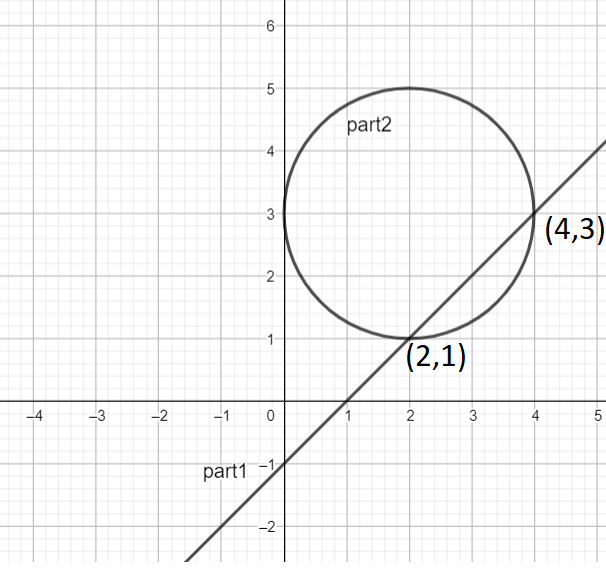
Note: The key step in solving this problem is the knowledge of complex numbers particularly in modulus and argument topics. On correct use of formulas, we can establish a relationship between variables x and y with the given information. After obtaining all the equations, we can easily draw them in an argand plane.
Complete step-by-step answer:
We are required to find the locus of complex numbers. Let the complex number be z = x + iy.
Now, by using the first information: $\arg (z-1)=\dfrac{\pi }{4}$.
As we know that argument of a complex number is expressed as: $\arg (z)=\theta ={{\tan }^{-1}}\left( \dfrac{y}{x} \right)$, where y belongs to imaginary part and x belongs to real part. Also, addition and subtraction can be done only with corresponding terms such that real can operate with real part and imaginary with imaginary part.
$\begin{align}
& \arg (z-1)=\dfrac{\pi }{4} \\
& \because z-1=x+iy-1 \\
& z-1=x-1+iy \\
\end{align}$
Now, by using argument definition, ${{\tan }^{-1}}\left( \dfrac{y}{x-1} \right)=\dfrac{\pi }{4}$.
Now, applying tan to both sides we get,
$\begin{align}
& \tan \left( {{\tan }^{-1}}\left( \dfrac{y}{x-1} \right) \right)=\tan \dfrac{\pi }{4} \\
& \dfrac{y}{x-1}=1 \\
& \therefore y=x-1 \\
\end{align}$
Hence, the locus for this part will be a straight line.
Now, by using the second information: $\left| z-2-3i \right|=2$.
Also, for the modulus of a complex number z we have, $\left| z \right|=\sqrt{{{x}^{2}}+{{y}^{2}}}$
Therefore first obtaining the proper complex number from information,
$\begin{align}
& z-2-3i=x+iy-2-3i \\
& =(x-2)+i(y-3) \\
\end{align}$
Now, applying the modulus expansion we get,
$\begin{align}
& \left| z-2-3i \right|=\sqrt{{{\left( x-2 \right)}^{2}}+{{\left( y-3 \right)}^{2}}} \\
& \sqrt{{{\left( x-2 \right)}^{2}}+{{\left( y-3 \right)}^{2}}}=2 \\
\end{align}$
Squaring both sides, we get,
\[{{\left( x-2 \right)}^{2}}+{{(y-3)}^{2}}=4\]
Hence, the locus for this part is a circle with center (2,3) and radius 4.
Now, to illustrate both the locus on argand plane:
Note: The key step in solving this problem is the knowledge of complex numbers particularly in modulus and argument topics. On correct use of formulas, we can establish a relationship between variables x and y with the given information. After obtaining all the equations, we can easily draw them in an argand plane.
Recently Updated Pages
Basicity of sulphurous acid and sulphuric acid are

Master Class 10 English: Engaging Questions & Answers for Success
Master Class 10 Social Science: Engaging Questions & Answers for Success
Master Class 10 Computer Science: Engaging Questions & Answers for Success
Class 10 Question and Answer - Your Ultimate Solutions Guide
Master Class 10 General Knowledge: Engaging Questions & Answers for Success
Trending doubts
Which country won the ICC Men's ODI World Cup in 2023?
In cricket, how many legal balls are there in a standard over?
Explain the Treaty of Vienna of 1815 class 10 social science CBSE
A boat goes 24 km upstream and 28 km downstream in class 10 maths CBSE
What does "powerplay" mean in limited-overs cricket?
What is the "Powerplay" in T20 cricket?