




Find the least value of sec A + sec B + sec C in acute angle triangle.
Answer
 Verified
622.5k+ views
Hint: For solving this question we will use two theorems that are Carnot's theorem and Euler’s theorem. We will apply the basic trigonometric formulas and the fact that arithmetic sum is greater than or equal to geometric sum and solve accordingly.
Complete step-by-step solution -
The centre of a triangle is known as a circumcentre. It is where the perpendicular bisectors (lines that are at right angles to the midpoint of each side of a triangle) meet. The circumradius(R) of a cyclic polygon is the radius of the circumscribed circle of that polygon. For a triangle, it is the measure of the radius of the circle that circumscribes the triangle. Since every triangle is cyclic, every triangle has a circumscribed circle, or a circumcircle. The inradius(r) of a triangle is the radius of the incircle, which is the largest circle that will fit inside the triangle.
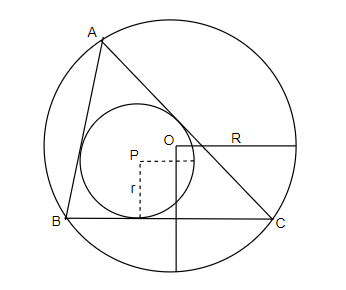
We know that, Carnot's theorem states that the sum of the distances from the circumcentre to the three sides of a triangle equals the sum of the circumradius(R) and the inradius(r),
Hence:
$\Rightarrow R(\cos A+\cos B+\cos C)=R+r$
$\Rightarrow \cos A+\cos B+\cos C=1+\dfrac{r}{R}$ \[\ldots ..\text{ }\left( 1 \right)\]
By Euler’s theorem we have,
$\Rightarrow R\ge 2r$
$\Rightarrow \dfrac{r}{R}\le \dfrac{1}{2}$ \[\ldots ..\text{ }\left( 2 \right)\]
Substituting equation (2) in equation (1), we get,
$\begin{align}
& \Rightarrow \cos A+\cos B+\cos C=1+\dfrac{r}{R} \\
& \Rightarrow \cos A+\cos B+\cos C\le 1+\dfrac{1}{2} \\
\end{align}$
Hence,
$\Rightarrow \cos A+\cos B+\cos C\le \dfrac{3}{2}$ \[\ldots ..\text{ }\left( 3 \right)\]
Now applying the fact that arithmetic mean is greater than equal to the geometric mean we have:
$\Rightarrow \text{A}\text{.M}\ge \text{G}\text{.M}$
$\Rightarrow \dfrac{\cos A+\cos B+\cos C}{3}\ge {{\left( \cos A\cdot \cos B\cdot \cos C \right)}^{\dfrac{1}{3}}}$ \[\ldots ..\text{ }\left( 4 \right)\]
Substituting equation (3) in equation (4) we get,
$\begin{align}
& \Rightarrow \dfrac{3}{2}\times \dfrac{1}{3}\ge {{\left( \cos A\cdot \cos B\cdot \cos C \right)}^{\dfrac{1}{3}}} \\
& \Rightarrow \dfrac{1}{2}\ge {{\left( \cos A\cdot \cos B\cdot \cos C \right)}^{\dfrac{1}{3}}} \\
\end{align}$
It gives,
$\begin{align}
& \Rightarrow \cos A\cdot \cos B\cdot \cos C\le {{\left( \dfrac{1}{2} \right)}^{3}} \\
& \Rightarrow \cos A\cdot \cos B\cdot \cos C\le \left( \dfrac{1}{8} \right) \\
\end{align}$
This means that:
$\begin{align}
& \Rightarrow 8\le \dfrac{1}{\cos A\cdot \cos B\cdot \cos C} \\
& \Rightarrow 8\le \sec A\cdot \sec B\cdot \sec C \\
\end{align}$
Again, applying the fact that arithmetic mean is greater than equal to the geometric mean we have:
$\Rightarrow {{\left( \sec A\cdot \sec B\cdot \sec C \right)}^{\dfrac{1}{3}}}\le \dfrac{\sec A+\sec B+\sec C}{3}$
$\begin{align}
& \Rightarrow \dfrac{\sec A+\sec B+\sec C}{3}\ge {{8}^{\dfrac{1}{3}}} \\
& \Rightarrow \dfrac{\sec A+\sec B+\sec C}{3}\ge 2 \\
\end{align}$
Hence,
$\Rightarrow \sec A+\sec B+\sec C\ge 6$
Hence, the least value of sec A + sec B + sec C in an acute angle triangle is 6.
Note: For solving this type of questions, we should know the concept of trigonometry. We should be aware of the basic facts of arithmetic progression and geometric progression. We should avoid any error related greater than or equal to sign.
Complete step-by-step solution -
The centre of a triangle is known as a circumcentre. It is where the perpendicular bisectors (lines that are at right angles to the midpoint of each side of a triangle) meet. The circumradius(R) of a cyclic polygon is the radius of the circumscribed circle of that polygon. For a triangle, it is the measure of the radius of the circle that circumscribes the triangle. Since every triangle is cyclic, every triangle has a circumscribed circle, or a circumcircle. The inradius(r) of a triangle is the radius of the incircle, which is the largest circle that will fit inside the triangle.
We know that, Carnot's theorem states that the sum of the distances from the circumcentre to the three sides of a triangle equals the sum of the circumradius(R) and the inradius(r),
Hence:
$\Rightarrow R(\cos A+\cos B+\cos C)=R+r$
$\Rightarrow \cos A+\cos B+\cos C=1+\dfrac{r}{R}$ \[\ldots ..\text{ }\left( 1 \right)\]
By Euler’s theorem we have,
$\Rightarrow R\ge 2r$
$\Rightarrow \dfrac{r}{R}\le \dfrac{1}{2}$ \[\ldots ..\text{ }\left( 2 \right)\]
Substituting equation (2) in equation (1), we get,
$\begin{align}
& \Rightarrow \cos A+\cos B+\cos C=1+\dfrac{r}{R} \\
& \Rightarrow \cos A+\cos B+\cos C\le 1+\dfrac{1}{2} \\
\end{align}$
Hence,
$\Rightarrow \cos A+\cos B+\cos C\le \dfrac{3}{2}$ \[\ldots ..\text{ }\left( 3 \right)\]
Now applying the fact that arithmetic mean is greater than equal to the geometric mean we have:
$\Rightarrow \text{A}\text{.M}\ge \text{G}\text{.M}$
$\Rightarrow \dfrac{\cos A+\cos B+\cos C}{3}\ge {{\left( \cos A\cdot \cos B\cdot \cos C \right)}^{\dfrac{1}{3}}}$ \[\ldots ..\text{ }\left( 4 \right)\]
Substituting equation (3) in equation (4) we get,
$\begin{align}
& \Rightarrow \dfrac{3}{2}\times \dfrac{1}{3}\ge {{\left( \cos A\cdot \cos B\cdot \cos C \right)}^{\dfrac{1}{3}}} \\
& \Rightarrow \dfrac{1}{2}\ge {{\left( \cos A\cdot \cos B\cdot \cos C \right)}^{\dfrac{1}{3}}} \\
\end{align}$
It gives,
$\begin{align}
& \Rightarrow \cos A\cdot \cos B\cdot \cos C\le {{\left( \dfrac{1}{2} \right)}^{3}} \\
& \Rightarrow \cos A\cdot \cos B\cdot \cos C\le \left( \dfrac{1}{8} \right) \\
\end{align}$
This means that:
$\begin{align}
& \Rightarrow 8\le \dfrac{1}{\cos A\cdot \cos B\cdot \cos C} \\
& \Rightarrow 8\le \sec A\cdot \sec B\cdot \sec C \\
\end{align}$
Again, applying the fact that arithmetic mean is greater than equal to the geometric mean we have:
$\Rightarrow {{\left( \sec A\cdot \sec B\cdot \sec C \right)}^{\dfrac{1}{3}}}\le \dfrac{\sec A+\sec B+\sec C}{3}$
$\begin{align}
& \Rightarrow \dfrac{\sec A+\sec B+\sec C}{3}\ge {{8}^{\dfrac{1}{3}}} \\
& \Rightarrow \dfrac{\sec A+\sec B+\sec C}{3}\ge 2 \\
\end{align}$
Hence,
$\Rightarrow \sec A+\sec B+\sec C\ge 6$
Hence, the least value of sec A + sec B + sec C in an acute angle triangle is 6.
Note: For solving this type of questions, we should know the concept of trigonometry. We should be aware of the basic facts of arithmetic progression and geometric progression. We should avoid any error related greater than or equal to sign.
Recently Updated Pages
Basicity of sulphurous acid and sulphuric acid are

Master Class 10 English: Engaging Questions & Answers for Success
Master Class 10 Social Science: Engaging Questions & Answers for Success
Master Class 10 Computer Science: Engaging Questions & Answers for Success
Class 10 Question and Answer - Your Ultimate Solutions Guide
Master Class 10 General Knowledge: Engaging Questions & Answers for Success
Trending doubts
Who is known as the "Little Master" in Indian cricket history?
A boat goes 24 km upstream and 28 km downstream in class 10 maths CBSE
Who Won 36 Oscar Awards? Record Holder Revealed
Why is there a time difference of about 5 hours between class 10 social science CBSE
Explain the Treaty of Vienna of 1815 class 10 social science CBSE
What is the median of the first 10 natural numbers class 10 maths CBSE