




How do you find the inverse of $ {{e}^{2x}} $ and is it a function?
Answer
 Verified
574.5k+ views
Hint:
We will look at the definition of the exponential function. We will see the natural exponential function. Then we will see the definition of an inverse function. Using this definition, we will see the inverse of the given exponential function and some of its properties. The inverse of the exponential function is the logarithm function.
Complete step by step answer:
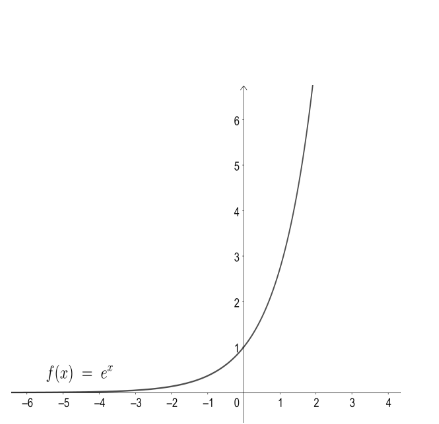
The exponential function is the function of the type $ f\left( x \right)={{a}^{x}} $ where $ a $ is a positive real number. The natural exponential function is $ f\left( x \right)={{e}^{x}} $ where $ e $ is the Euler's number. The graph of the natural exponential function looks like the following,
A function $ f $ takes input as $ x $ and gives output as $ y $ . This means that $ f\left( x \right)=y $ . Now, the inverse of this function takes $ y $ as the input and gives $ x $ as the output. Generally, the inverse of a function $ f $ is denoted by $ {{f}^{-1}} $ . So, we have $ {{f}^{-1}}\left( y \right)=x $ .
The inverse of the exponential function is the logarithm function. That means. if $ y={{e}^{x}} $ , then its inverse is $ {{f}^{-1}}\left( y \right)={{\log }_{e}}\left( y \right) $ . The given function is $ y={{e}^{2x}} $ . So, its inverse is
$ {{\log }_{e}}\left( y \right)={{\log }_{e}}\left( {{e}^{2x}} \right) $
We know the property of the logarithm function that $ \log \left( {{a}^{b}} \right)=b\log \left( a \right) $ .
Therefore, we have
$ {{\log }_{e}}\left( y \right)=2x{{\log }_{e}}\left( e \right) $
We also have the property of the logarithm function that $ {{\log }_{a}}\left( a \right)=1 $ .
Therefore, we get the following,
$ \begin{align}
& {{\log }_{e}}\left( y \right)=2x \\
& \therefore x=\dfrac{{{\log }_{e}}\left( y \right)}{2} \\
\end{align} $
This is the required inverse function.
Note:
The exponential function and the logarithm function are very important functions in mathematics. These functions are used to represent population growth, exponential decay etc, in the form of equations. The relation between these two functions and the properties of these two functions are very useful in calculations.
We will look at the definition of the exponential function. We will see the natural exponential function. Then we will see the definition of an inverse function. Using this definition, we will see the inverse of the given exponential function and some of its properties. The inverse of the exponential function is the logarithm function.
Complete step by step answer:
The exponential function is the function of the type $ f\left( x \right)={{a}^{x}} $ where $ a $ is a positive real number. The natural exponential function is $ f\left( x \right)={{e}^{x}} $ where $ e $ is the Euler's number. The graph of the natural exponential function looks like the following,
A function $ f $ takes input as $ x $ and gives output as $ y $ . This means that $ f\left( x \right)=y $ . Now, the inverse of this function takes $ y $ as the input and gives $ x $ as the output. Generally, the inverse of a function $ f $ is denoted by $ {{f}^{-1}} $ . So, we have $ {{f}^{-1}}\left( y \right)=x $ .
The inverse of the exponential function is the logarithm function. That means. if $ y={{e}^{x}} $ , then its inverse is $ {{f}^{-1}}\left( y \right)={{\log }_{e}}\left( y \right) $ . The given function is $ y={{e}^{2x}} $ . So, its inverse is
$ {{\log }_{e}}\left( y \right)={{\log }_{e}}\left( {{e}^{2x}} \right) $
We know the property of the logarithm function that $ \log \left( {{a}^{b}} \right)=b\log \left( a \right) $ .
Therefore, we have
$ {{\log }_{e}}\left( y \right)=2x{{\log }_{e}}\left( e \right) $
We also have the property of the logarithm function that $ {{\log }_{a}}\left( a \right)=1 $ .
Therefore, we get the following,
$ \begin{align}
& {{\log }_{e}}\left( y \right)=2x \\
& \therefore x=\dfrac{{{\log }_{e}}\left( y \right)}{2} \\
\end{align} $
This is the required inverse function.
Note:
The exponential function and the logarithm function are very important functions in mathematics. These functions are used to represent population growth, exponential decay etc, in the form of equations. The relation between these two functions and the properties of these two functions are very useful in calculations.
Recently Updated Pages
Basicity of sulphurous acid and sulphuric acid are

Master Class 10 English: Engaging Questions & Answers for Success
Master Class 10 Social Science: Engaging Questions & Answers for Success
Master Class 10 Computer Science: Engaging Questions & Answers for Success
Class 10 Question and Answer - Your Ultimate Solutions Guide
Master Class 10 General Knowledge: Engaging Questions & Answers for Success
Trending doubts
Which country won the ICC Men's ODI World Cup in 2023?
In cricket, how many legal balls are there in a standard over?
Explain the Treaty of Vienna of 1815 class 10 social science CBSE
A boat goes 24 km upstream and 28 km downstream in class 10 maths CBSE
What does "powerplay" mean in limited-overs cricket?
What is the "Powerplay" in T20 cricket?