




Find the inverse of a point a with respect to the circle $|z-c|=R$(a and c are complex numbers, centre C and radius R).
Answer
 Verified
622.8k+ views
Hint: Now we know that inverse a center and the point lies on the same line. Hence we get the condition $\arg (a'-c)=\arg (a-c)$ . Now we will use properties of argument \[\arg (\bar{z})=-\arg (z)\] and $\arg ({{z}_{1}}{{z}_{2}})=\arg \left( {{z}_{1}} \right)+\arg \left( {{z}_{2}} \right)$ to prove that \[\left( a'-c \right)(\bar{a}-\bar{c})\] then we will use the facts that if a is real then $|a|=a$. Now since a and a’ lies on circle we know that $|a'-c|=|a-c|=R$. Using this we will find the equation in a, a’, c and R.
Complete step by step answer:
Now we need to find inverse of a point a with respect to the circle $|z-c|=R$ to do so let us consider the inverse point as a’.
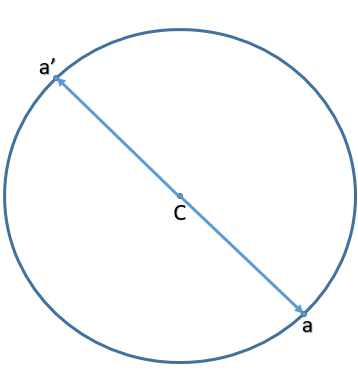
Now we have a’ be inverse of a with respect to the circle $|z-c|=R$
Now we know that a, c, a’ are all collinear points
Hence we get
$\arg (a'-c)=\arg (a-c)$
Now we know that \[\arg (\bar{z})=-\arg (z)\], using this result we get
$\arg (a'-c)=-\arg (\bar{a}-\bar{c})$
Taking $\arg (\bar{a}-\bar{c})$ to LHS we get
$\arg (a'-c)+\arg (\bar{a}-\bar{c})=0$
Now we also know that $\arg ({{z}_{1}}{{z}_{2}})=\arg \left( {{z}_{1}} \right)+\arg \left( {{z}_{2}} \right)$ , using this result we get
\[\arg [\left( a'-c \right)(\bar{a}-\bar{c})]=0\]
Now if we have $\arg \left( z \right)=0$ this means that z lies on real axis and hence z is real
Hence we can say that \[\arg [\left( a'-c \right)(\bar{a}-\bar{c})]=0\] which means that \[\left( a'-c \right)(\bar{a}-\bar{c})\] is real…………… (1)
Now we know that the point a and a’ lies on circle with radius R, hence we can say
$|a-c|=R$ and $|a'-c|=R$
Hence we have $|a-c||a'-c|={{R}^{2}}$
Now we have $|\bar{z}|=|z|$ , using this we can write \[|a-c|=|\bar{a}-\bar{c}|\]
Hence we get,
$|\bar{a}-\bar{c}||a'-c|={{R}^{2}}$
$\Rightarrow |\left( \bar{a}-\bar{c} \right)\left( a'-c \right)|={{R}^{2}}$
But from (1) we know that \[\left( a'-c \right)(\bar{a}-\bar{c})\] is real
Now if a is real then $|a|=a$
Hence we get
\[\begin{align}
& \left( \bar{a}-\bar{c} \right)\left( a'-c \right)={{R}^{2}} \\
& \Rightarrow (a'-c)=\dfrac{{{R}^{2}}}{\left( \bar{a}-\bar{c} \right)} \\
& \Rightarrow a'=c+\dfrac{{{R}^{2}}}{\left( \bar{a}-\bar{c} \right)} \\
\end{align}\]
Hence now we have inverse of a that is a’ is such that \[a'=c+\dfrac{{{R}^{2}}}{\left( \bar{a}-\bar{c} \right)}\]
Note: Note that $|x+iy|=\sqrt{{{x}^{2}}+{{y}^{2}}}$ hence if y = 0 we get |x|=x. hence this is only true if the complex number is purely real. Hence if we use |a| = a, we first need to prove that a is real.
Complete step by step answer:
Now we need to find inverse of a point a with respect to the circle $|z-c|=R$ to do so let us consider the inverse point as a’.
Now we have a’ be inverse of a with respect to the circle $|z-c|=R$
Now we know that a, c, a’ are all collinear points
Hence we get
$\arg (a'-c)=\arg (a-c)$
Now we know that \[\arg (\bar{z})=-\arg (z)\], using this result we get
$\arg (a'-c)=-\arg (\bar{a}-\bar{c})$
Taking $\arg (\bar{a}-\bar{c})$ to LHS we get
$\arg (a'-c)+\arg (\bar{a}-\bar{c})=0$
Now we also know that $\arg ({{z}_{1}}{{z}_{2}})=\arg \left( {{z}_{1}} \right)+\arg \left( {{z}_{2}} \right)$ , using this result we get
\[\arg [\left( a'-c \right)(\bar{a}-\bar{c})]=0\]
Now if we have $\arg \left( z \right)=0$ this means that z lies on real axis and hence z is real
Hence we can say that \[\arg [\left( a'-c \right)(\bar{a}-\bar{c})]=0\] which means that \[\left( a'-c \right)(\bar{a}-\bar{c})\] is real…………… (1)
Now we know that the point a and a’ lies on circle with radius R, hence we can say
$|a-c|=R$ and $|a'-c|=R$
Hence we have $|a-c||a'-c|={{R}^{2}}$
Now we have $|\bar{z}|=|z|$ , using this we can write \[|a-c|=|\bar{a}-\bar{c}|\]
Hence we get,
$|\bar{a}-\bar{c}||a'-c|={{R}^{2}}$
$\Rightarrow |\left( \bar{a}-\bar{c} \right)\left( a'-c \right)|={{R}^{2}}$
But from (1) we know that \[\left( a'-c \right)(\bar{a}-\bar{c})\] is real
Now if a is real then $|a|=a$
Hence we get
\[\begin{align}
& \left( \bar{a}-\bar{c} \right)\left( a'-c \right)={{R}^{2}} \\
& \Rightarrow (a'-c)=\dfrac{{{R}^{2}}}{\left( \bar{a}-\bar{c} \right)} \\
& \Rightarrow a'=c+\dfrac{{{R}^{2}}}{\left( \bar{a}-\bar{c} \right)} \\
\end{align}\]
Hence now we have inverse of a that is a’ is such that \[a'=c+\dfrac{{{R}^{2}}}{\left( \bar{a}-\bar{c} \right)}\]
Note: Note that $|x+iy|=\sqrt{{{x}^{2}}+{{y}^{2}}}$ hence if y = 0 we get |x|=x. hence this is only true if the complex number is purely real. Hence if we use |a| = a, we first need to prove that a is real.
Recently Updated Pages
The given figure shows two endocrine glands marked class 11 biology NEET_UG

Match columnI with columnII and select the correct class 11 biology NEET
Match column I with column II and select the correct class 11 biology NEET_UG
Which floral family has left 9 right + 1 arrangement class 11 biology NEET_UG
Which is not a variety of sheep A Lohi B Beetal C Nellore class 11 biology NEET_UG
Match column I with column II and select the correct class 11 biology NEET_UG
Trending doubts
One Metric ton is equal to kg A 10000 B 1000 C 100 class 11 physics CBSE
Draw a diagram of a plant cell and label at least eight class 11 biology CBSE
Difference Between Prokaryotic Cells and Eukaryotic Cells
Draw a well labelled diagram of reflex arc and explain class 11 biology CBSE
Two of the body parts which do not appear in MRI are class 11 biology CBSE
1 ton equals to A 100 kg B 1000 kg C 10 kg D 10000 class 11 physics CBSE