




How do you find the intercepts of $4y=2x+6$?
Answer
 Verified
573.6k+ views
Hint: Change of form of the given equation will give the y intercept and x-intercept of the line $4y=2x+6$. We change it to the form of $\dfrac{x}{p}+\dfrac{y}{q}=1$ to find the x intercept, and y intercept of the line as p and q respectively. Then we place the line on the graph based on that.
Complete step by step answer:
We are taking the general equation of line to understand the intercept form of the line $4y=2x+6$.
The given equation $4y=2x+6$ is of the form $ax+by=c$. Here a, b, c are the constants.
Now we have to find the y intercept, and x-intercept of the same line $4y=2x+6$.
For this we convert the given equation into the form of $\dfrac{x}{p}+\dfrac{y}{q}=1$. From the form we get that the x intercept, and y intercept of the line will be p and q respectively.
The intersecting points for the line with the axes will be $\left( p,0 \right)$ and $\left( 0,q \right)$.
The given equation is $4y=2x+6$.
$\begin{align}
& 4y=2x+6 \\
& \Rightarrow 2x-4y=-6 \\
\end{align}$
Dividing both sides with -6 we get
$\begin{align}
& 2x-4y=-6 \\
& \Rightarrow \dfrac{2x}{-6}+\dfrac{-4y}{-6}=1 \\
& \Rightarrow \dfrac{x}{-3}+\dfrac{y}{{}^{3}/{}_{2}}=1 \\
\end{align}$
The intersecting points for the line $4y=2x+6$ with the axes will be $\left( -3,0 \right)$ and $\left( 0,\dfrac{3}{2} \right)$.
Therefore, the x intercept, and y intercept of the line $2x+y=5$ is 4 and 8 respectively.
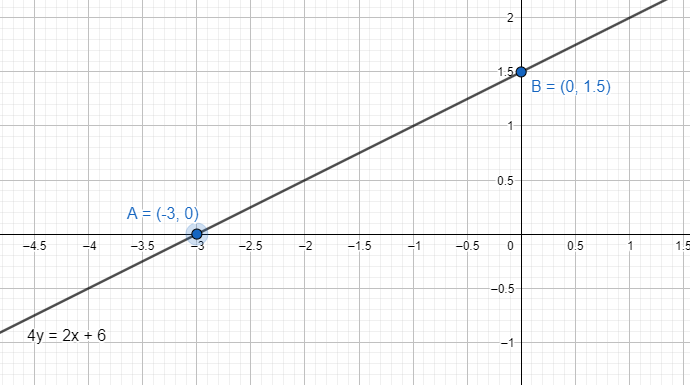
Note: A line parallel to the X-axis does not intersect the X-axis at any finite distance and hence we cannot get any finite x-intercept of such a line. Same goes for lines parallel to the Y-axis. In case of slope of a line the range of the slope is 0 to $\infty $.
Complete step by step answer:
We are taking the general equation of line to understand the intercept form of the line $4y=2x+6$.
The given equation $4y=2x+6$ is of the form $ax+by=c$. Here a, b, c are the constants.
Now we have to find the y intercept, and x-intercept of the same line $4y=2x+6$.
For this we convert the given equation into the form of $\dfrac{x}{p}+\dfrac{y}{q}=1$. From the form we get that the x intercept, and y intercept of the line will be p and q respectively.
The intersecting points for the line with the axes will be $\left( p,0 \right)$ and $\left( 0,q \right)$.
The given equation is $4y=2x+6$.
$\begin{align}
& 4y=2x+6 \\
& \Rightarrow 2x-4y=-6 \\
\end{align}$
Dividing both sides with -6 we get
$\begin{align}
& 2x-4y=-6 \\
& \Rightarrow \dfrac{2x}{-6}+\dfrac{-4y}{-6}=1 \\
& \Rightarrow \dfrac{x}{-3}+\dfrac{y}{{}^{3}/{}_{2}}=1 \\
\end{align}$
The intersecting points for the line $4y=2x+6$ with the axes will be $\left( -3,0 \right)$ and $\left( 0,\dfrac{3}{2} \right)$.
Therefore, the x intercept, and y intercept of the line $2x+y=5$ is 4 and 8 respectively.
Note: A line parallel to the X-axis does not intersect the X-axis at any finite distance and hence we cannot get any finite x-intercept of such a line. Same goes for lines parallel to the Y-axis. In case of slope of a line the range of the slope is 0 to $\infty $.
Recently Updated Pages
Basicity of sulphurous acid and sulphuric acid are

Master Class 11 Business Studies: Engaging Questions & Answers for Success
Master Class 11 Computer Science: Engaging Questions & Answers for Success
Master Class 11 Economics: Engaging Questions & Answers for Success
Master Class 11 Social Science: Engaging Questions & Answers for Success
Master Class 11 English: Engaging Questions & Answers for Success
Trending doubts
One Metric ton is equal to kg A 10000 B 1000 C 100 class 11 physics CBSE
The largest wind power cluster is located in the state class 11 social science CBSE
Explain zero factorial class 11 maths CBSE
State and prove Bernoullis theorem class 11 physics CBSE
What steps did the French revolutionaries take to create class 11 social science CBSE
Which among the following are examples of coming together class 11 social science CBSE