




Find the following ratio.
$\tan x$, \[\cos \left( {{90}^{\circ }}-y \right)\] , $\sin y$, \[\cos \left( {{90}^{\circ }}-x \right)\], \[\tan \left( {{90}^{\circ }}-x \right)\] , $\sin x$
Answer
 Verified
585.3k+ views
Hint: To solve this question, we will use the trigonometric formulas given as \[\tan \theta =\dfrac{\text{perpendicular}}{\text{base}},\cos \theta =\dfrac{\text{base}}{\text{hypotenuse}},\sin \theta =\dfrac{\text{perpendicular}}{\text{hypotenuse}}.\] To solve this, we will consider triangle BAD and triangle ADC separately and then apply these above stated formulas to get the result.
Complete step-by-step solution:
Consider the triangle given below.
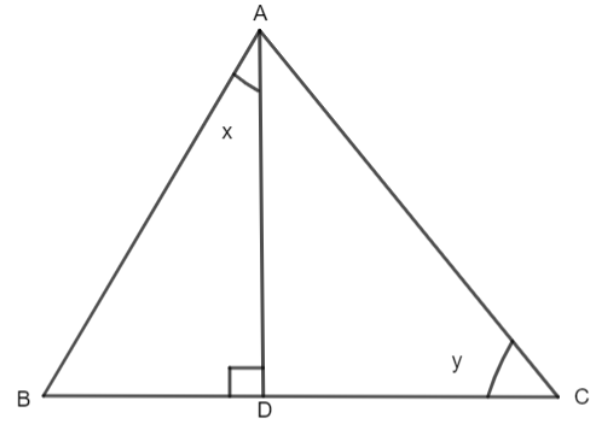
We have to calculate tan x first by using the formula of \[\tan \theta =\dfrac{\text{perpendicular}}{\text{base}}\] in a triangle. In triangle BAD, we have,
\[\tan x=\dfrac{\text{perpendicular}}{\text{base}}\]
In triangle BAD, here perpendicular is BD and the base is AD. Therefore, we get,
\[\Rightarrow \tan x=\dfrac{BD}{AD}......\left( i \right)\]
Now to compute \[\cos \left( {{90}^{\circ }}-y \right)\], consider triangle ADC given,
\[\angle ACD=y\]
\[\angle ACD={{90}^{\circ }}\]
Then by angle sum property of the triangle, we have the sum of all three angles of the triangle as \[{{180}^{\circ }}.\]
\[\Rightarrow \angle ADC+\angle ACD+\angle DAC={{180}^{\circ }}\]
\[\Rightarrow {{90}^{\circ }}+y+\angle DAC={{180}^{\circ }}\]
\[\Rightarrow \angle DAC={{180}^{\circ }}-{{90}^{\circ }}-y\]
\[\Rightarrow \angle DAC={{90}^{\circ }}-y\]
So, we have in triangle ADC, \[\angle DAC={{90}^{\circ }}-y.\]
Now, \[\cos \theta =\dfrac{\text{base}}{\text{hypotenuse}}\] where \[\theta \] is an angle in the given triangle.
In triangle ADC, AC is the hypotenuse and AD is the base with respect to angle DAC.
\[\cos \left( \angle DAC \right)=\dfrac{\text{base}}{\text{hypotenuse}}\]
\[\Rightarrow \cos \left( \angle DAC \right)=\dfrac{AD}{AC}\]
\[\angle DAC={{90}^{\circ }}-y\]
\[\Rightarrow \cos \left( {{90}^{\circ }}-y \right)=\dfrac{AD}{AC}.....\left( ii \right)\]
Now to compute sin y, use the formula of \[\sin \theta \] given as \[\sin \theta =\dfrac{\text{perpendicular}}{\text{hypotenuse}}.\]
In triangle ADC,
\[\sin y=\dfrac{\text{perpendicular}}{\text{hypotenuse}}\]
Here, perpendicular is AD and hypotenuse is AC.
\[\Rightarrow \sin y=\dfrac{AD}{AC}.....\left( iii \right)\]
Now, consider triangle ABD,
\[\angle BAD=x\]
\[\angle ADB ={{90}^{\circ }}\]
As by linearity, ADC is a straight line and \[\angle ADC={{90}^{\circ }},\] then by angle sum property of the triangle stated above, we have,
\[\angle ADB+\angle ABD+\angle DAB={{180}^{\circ }}\]
\[\Rightarrow {{90}^{\circ }}+x+\angle ABD={{180}^{\circ }}\]
\[\Rightarrow \angle ABD={{180}^{\circ }}-{{90}^{\circ }}-x\]
\[\Rightarrow \angle ABD={{90}^{\circ }}-x\]
Now, in triangle ABD,
\[\cos \left( \angle ABD \right)=\dfrac{\text{base}}{\text{hypotenuse}}\]
\[\Rightarrow \cos \left( \angle ABD \right)=\dfrac{BD}{AB}\]
Now, as \[\angle ABD={{90}^{\circ }}-x\]
\[\Rightarrow \cos \left( {{90}^{\circ }}-x \right)=\dfrac{BD}{AB}......\left( iv \right)\]
Again the same triangle ABD,
\[\tan \left( {{90}^{\circ }}-x \right)=\dfrac{\text{perpendicular}}{\text{base}}\]
\[\Rightarrow \tan \left( {{90}^{\circ }}-x \right)=\dfrac{AD}{BD}.....\left( v \right)\]
Finally, we have to compute sin x. Consider triangle ABD,
\[\sin x=\dfrac{\text{perpendiuclar}}{\text{hypotenuse}}\]
\[\Rightarrow \sin x=\dfrac{BD}{AB}.....\left( vi \right)\]
From equations (i), (ii), (iii), (iv), (v) and (vi), we have our answers as
\[\tan x=\dfrac{BD}{AD}\]
\[\cos \left( {{90}^{\circ }}-y \right)=\dfrac{AD}{AC}\]
\[\sin y=\dfrac{AD}{AC}\]
\[\cos \left( {{90}^{\circ }}-x \right)=\dfrac{BD}{AB}\]
\[\tan \left( {{90}^{\circ }}-x \right)=\dfrac{AD}{BD}\]
\[\sin x=\dfrac{BD}{AB}\]
Note: Another method to compute \[\cos \left( {{90}^{\circ }}-y \right)\] is by using the formula \[\cos \left( {{90}^{\circ }}-\theta \right)=\sin \theta .\] Replace \[\theta \] by y we have, so we get, \[\sin y=\dfrac{AD}{AC}.\]
\[\Rightarrow \cos \left( {{90}^{\circ }}-y \right)=\sin y=\dfrac{AD}{AC}\]
\[\Rightarrow \cos \left( {{90}^{\circ }}-y \right)=\dfrac{AD}{AC}\]
Similarly, we can compute \[\cos \left( {{90}^{\circ }}-x \right)\] from sin x by using \[\cos \left( {{90}^{\circ }}-x \right)=\sin x.\]
Complete step-by-step solution:
Consider the triangle given below.
We have to calculate tan x first by using the formula of \[\tan \theta =\dfrac{\text{perpendicular}}{\text{base}}\] in a triangle. In triangle BAD, we have,
\[\tan x=\dfrac{\text{perpendicular}}{\text{base}}\]
In triangle BAD, here perpendicular is BD and the base is AD. Therefore, we get,
\[\Rightarrow \tan x=\dfrac{BD}{AD}......\left( i \right)\]
Now to compute \[\cos \left( {{90}^{\circ }}-y \right)\], consider triangle ADC given,
\[\angle ACD=y\]
\[\angle ACD={{90}^{\circ }}\]
Then by angle sum property of the triangle, we have the sum of all three angles of the triangle as \[{{180}^{\circ }}.\]
\[\Rightarrow \angle ADC+\angle ACD+\angle DAC={{180}^{\circ }}\]
\[\Rightarrow {{90}^{\circ }}+y+\angle DAC={{180}^{\circ }}\]
\[\Rightarrow \angle DAC={{180}^{\circ }}-{{90}^{\circ }}-y\]
\[\Rightarrow \angle DAC={{90}^{\circ }}-y\]
So, we have in triangle ADC, \[\angle DAC={{90}^{\circ }}-y.\]
Now, \[\cos \theta =\dfrac{\text{base}}{\text{hypotenuse}}\] where \[\theta \] is an angle in the given triangle.
In triangle ADC, AC is the hypotenuse and AD is the base with respect to angle DAC.
\[\cos \left( \angle DAC \right)=\dfrac{\text{base}}{\text{hypotenuse}}\]
\[\Rightarrow \cos \left( \angle DAC \right)=\dfrac{AD}{AC}\]
\[\angle DAC={{90}^{\circ }}-y\]
\[\Rightarrow \cos \left( {{90}^{\circ }}-y \right)=\dfrac{AD}{AC}.....\left( ii \right)\]
Now to compute sin y, use the formula of \[\sin \theta \] given as \[\sin \theta =\dfrac{\text{perpendicular}}{\text{hypotenuse}}.\]
In triangle ADC,
\[\sin y=\dfrac{\text{perpendicular}}{\text{hypotenuse}}\]
Here, perpendicular is AD and hypotenuse is AC.
\[\Rightarrow \sin y=\dfrac{AD}{AC}.....\left( iii \right)\]
Now, consider triangle ABD,
\[\angle BAD=x\]
\[\angle ADB ={{90}^{\circ }}\]
As by linearity, ADC is a straight line and \[\angle ADC={{90}^{\circ }},\] then by angle sum property of the triangle stated above, we have,
\[\angle ADB+\angle ABD+\angle DAB={{180}^{\circ }}\]
\[\Rightarrow {{90}^{\circ }}+x+\angle ABD={{180}^{\circ }}\]
\[\Rightarrow \angle ABD={{180}^{\circ }}-{{90}^{\circ }}-x\]
\[\Rightarrow \angle ABD={{90}^{\circ }}-x\]
Now, in triangle ABD,
\[\cos \left( \angle ABD \right)=\dfrac{\text{base}}{\text{hypotenuse}}\]
\[\Rightarrow \cos \left( \angle ABD \right)=\dfrac{BD}{AB}\]
Now, as \[\angle ABD={{90}^{\circ }}-x\]
\[\Rightarrow \cos \left( {{90}^{\circ }}-x \right)=\dfrac{BD}{AB}......\left( iv \right)\]
Again the same triangle ABD,
\[\tan \left( {{90}^{\circ }}-x \right)=\dfrac{\text{perpendicular}}{\text{base}}\]
\[\Rightarrow \tan \left( {{90}^{\circ }}-x \right)=\dfrac{AD}{BD}.....\left( v \right)\]
Finally, we have to compute sin x. Consider triangle ABD,
\[\sin x=\dfrac{\text{perpendiuclar}}{\text{hypotenuse}}\]
\[\Rightarrow \sin x=\dfrac{BD}{AB}.....\left( vi \right)\]
From equations (i), (ii), (iii), (iv), (v) and (vi), we have our answers as
\[\tan x=\dfrac{BD}{AD}\]
\[\cos \left( {{90}^{\circ }}-y \right)=\dfrac{AD}{AC}\]
\[\sin y=\dfrac{AD}{AC}\]
\[\cos \left( {{90}^{\circ }}-x \right)=\dfrac{BD}{AB}\]
\[\tan \left( {{90}^{\circ }}-x \right)=\dfrac{AD}{BD}\]
\[\sin x=\dfrac{BD}{AB}\]
Note: Another method to compute \[\cos \left( {{90}^{\circ }}-y \right)\] is by using the formula \[\cos \left( {{90}^{\circ }}-\theta \right)=\sin \theta .\] Replace \[\theta \] by y we have, so we get, \[\sin y=\dfrac{AD}{AC}.\]
\[\Rightarrow \cos \left( {{90}^{\circ }}-y \right)=\sin y=\dfrac{AD}{AC}\]
\[\Rightarrow \cos \left( {{90}^{\circ }}-y \right)=\dfrac{AD}{AC}\]
Similarly, we can compute \[\cos \left( {{90}^{\circ }}-x \right)\] from sin x by using \[\cos \left( {{90}^{\circ }}-x \right)=\sin x.\]
Recently Updated Pages
Master Class 10 Computer Science: Engaging Questions & Answers for Success

Master Class 10 General Knowledge: Engaging Questions & Answers for Success
Master Class 10 English: Engaging Questions & Answers for Success
Master Class 10 Social Science: Engaging Questions & Answers for Success
Master Class 10 Maths: Engaging Questions & Answers for Success
Master Class 10 Science: Engaging Questions & Answers for Success
Trending doubts
What is the median of the first 10 natural numbers class 10 maths CBSE
Which women's tennis player has 24 Grand Slam singles titles?
Who is the Brand Ambassador of Incredible India?
Why is there a time difference of about 5 hours between class 10 social science CBSE
Write a letter to the principal requesting him to grant class 10 english CBSE
State and prove converse of BPT Basic Proportionality class 10 maths CBSE