




How do you find the focus, vertex and directrix of \[{y^2} + 4x - 4y - 8 = 0\]?
Answer
 Verified
546.3k+ views
Hint: The equation is second degree in one variable $y$ and first degree in another variable $x$. Such an equation is of a parabola. We can find the focus, vertex and directrix using the standard form of the equation of parabola ${(y - k)^2} = 4a(x - h)$. In this equation, the vertex is $(h,{\kern 1pt} {\kern 1pt} {\kern 1pt} k)$, focus is at a distance $a$ units from $(h,{\kern 1pt} {\kern 1pt} {\kern 1pt} k)$ along the axis of the parabola, i.e. the focus is $(h + a,{\kern 1pt} {\kern 1pt} {\kern 1pt} k)$, and the directrix is a straight line perpendicular to the axis of the parabola situated at $a$ units from $(h,{\kern 1pt} {\kern 1pt} {\kern 1pt} k)$ on the opposite side of the focus, i.e. equation of the directrix is given by, $x = h - a$.
Complete step by step solution:
The given equation is \[{y^2} + 4x - 4y - 8 = 0\]. Since we have the equation in the second degree of exactly one variable, the given equation is of a parabola. To find the focus, vertex and the directrix we transform it into the standard form of the equation of the parabola ${(y - k)^2} = 4a(x - h)$.
We can write,
\[
\Rightarrow {y^2} + 4x - 4y - 8 = 0 \\
\Rightarrow {y^2} - 4y - 8 = - 4x \\
\Rightarrow {y^2} - 4y + 4 - 8 - 4 = - 4x \\
\Rightarrow {(y - 2)^2} - 12 = - 4x \\
\Rightarrow {(y - 2)^2} = - 4x + 12 \\
\Rightarrow {(y - 2)^2} = - 4(x - 3) \\
\]
Therefore, $h = 3$, $k = 2$ and $a = - 1$.
The vertex of the given parabola is $(h,{\kern 1pt} {\kern 1pt} {\kern 1pt} k)$, i.e. the vertex is $(3,{\kern 1pt} {\kern 1pt} {\kern 1pt} 2)$
The focus is $(h + a,{\kern 1pt} {\kern 1pt} {\kern 1pt} k)$, i.e. the focus is $(3 - 1,{\kern 1pt} {\kern 1pt} {\kern 1pt} 2){\kern 1pt} {\kern 1pt} {\kern 1pt} or{\kern 1pt} {\kern 1pt} {\kern 1pt} (2,{\kern 1pt} {\kern 1pt} {\kern 1pt} 2)$
The equation of the directrix is given by $x = h - a$, i.e. the directrix is $x = 3 + 1$ or $x = 4$.
Hence, for the given equation we get the vertex is $(3,{\kern 1pt} {\kern 1pt} {\kern 1pt} 2)$, the focus is $(2,{\kern 1pt} {\kern 1pt} {\kern 1pt} 2)$ and the directrix is $x = 4$.
This is also shown in the graph,
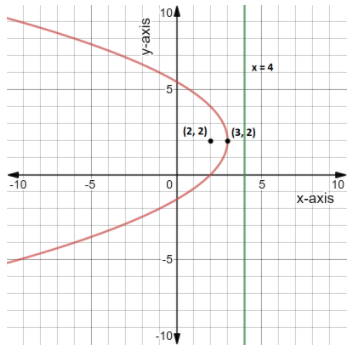
Note: The vertex and focus of the parabola both lies on the axis of the parabola. The line of the directrix is perpendicular to the axis of the parabola. The distance of the vertex from the directrix is equal to the distance of the vertex from the focus, i.e. $a$ units. For an equation in second degree in $x$ we use the standard form of the equation as ${(x - h)^2} = 4a(y - k)$ where the vertex is $(h,{\kern 1pt} {\kern 1pt} {\kern 1pt} k)$, the focus is $(h,{\kern 1pt} {\kern 1pt} {\kern 1pt} k + a)$ and the directrix is $y = k - a$.
Complete step by step solution:
The given equation is \[{y^2} + 4x - 4y - 8 = 0\]. Since we have the equation in the second degree of exactly one variable, the given equation is of a parabola. To find the focus, vertex and the directrix we transform it into the standard form of the equation of the parabola ${(y - k)^2} = 4a(x - h)$.
We can write,
\[
\Rightarrow {y^2} + 4x - 4y - 8 = 0 \\
\Rightarrow {y^2} - 4y - 8 = - 4x \\
\Rightarrow {y^2} - 4y + 4 - 8 - 4 = - 4x \\
\Rightarrow {(y - 2)^2} - 12 = - 4x \\
\Rightarrow {(y - 2)^2} = - 4x + 12 \\
\Rightarrow {(y - 2)^2} = - 4(x - 3) \\
\]
Therefore, $h = 3$, $k = 2$ and $a = - 1$.
The vertex of the given parabola is $(h,{\kern 1pt} {\kern 1pt} {\kern 1pt} k)$, i.e. the vertex is $(3,{\kern 1pt} {\kern 1pt} {\kern 1pt} 2)$
The focus is $(h + a,{\kern 1pt} {\kern 1pt} {\kern 1pt} k)$, i.e. the focus is $(3 - 1,{\kern 1pt} {\kern 1pt} {\kern 1pt} 2){\kern 1pt} {\kern 1pt} {\kern 1pt} or{\kern 1pt} {\kern 1pt} {\kern 1pt} (2,{\kern 1pt} {\kern 1pt} {\kern 1pt} 2)$
The equation of the directrix is given by $x = h - a$, i.e. the directrix is $x = 3 + 1$ or $x = 4$.
Hence, for the given equation we get the vertex is $(3,{\kern 1pt} {\kern 1pt} {\kern 1pt} 2)$, the focus is $(2,{\kern 1pt} {\kern 1pt} {\kern 1pt} 2)$ and the directrix is $x = 4$.
This is also shown in the graph,
Note: The vertex and focus of the parabola both lies on the axis of the parabola. The line of the directrix is perpendicular to the axis of the parabola. The distance of the vertex from the directrix is equal to the distance of the vertex from the focus, i.e. $a$ units. For an equation in second degree in $x$ we use the standard form of the equation as ${(x - h)^2} = 4a(y - k)$ where the vertex is $(h,{\kern 1pt} {\kern 1pt} {\kern 1pt} k)$, the focus is $(h,{\kern 1pt} {\kern 1pt} {\kern 1pt} k + a)$ and the directrix is $y = k - a$.
Recently Updated Pages
Master Class 11 Computer Science: Engaging Questions & Answers for Success

Master Class 11 Business Studies: Engaging Questions & Answers for Success
Master Class 11 Economics: Engaging Questions & Answers for Success
Master Class 11 English: Engaging Questions & Answers for Success
Master Class 11 Maths: Engaging Questions & Answers for Success
Master Class 11 Biology: Engaging Questions & Answers for Success
Trending doubts
One Metric ton is equal to kg A 10000 B 1000 C 100 class 11 physics CBSE
There are 720 permutations of the digits 1 2 3 4 5 class 11 maths CBSE
Discuss the various forms of bacteria class 11 biology CBSE
Draw a diagram of a plant cell and label at least eight class 11 biology CBSE
State the laws of reflection of light
Explain zero factorial class 11 maths CBSE