




Find the exact value of \[\operatorname{cosec} \theta \] trigonometric functions for the angle formed when the terminal side passes through \[\left( {3,4} \right)\].
A. \[\dfrac{4}{5}\]
B. \[\dfrac{3}{5}\]
C. \[\dfrac{5}{3}\]
D. \[\dfrac{5}{4}\]
Answer
 Verified
622.8k+ views
Hint: The terminal side is the one that can be anywhere and defines the angle. As the terminal side passes through \[\left( {3,4} \right)\] we have indirectly given the lengths of opposite side and adjacent side. By using Pythagoras theorem, find the hypotenuse and then the value of \[\operatorname{cosec} \theta \].
Complete step-by-step answer:
The angle formed by the terminal side passes through \[\left( {3,4} \right)\] is shown in the below figure:
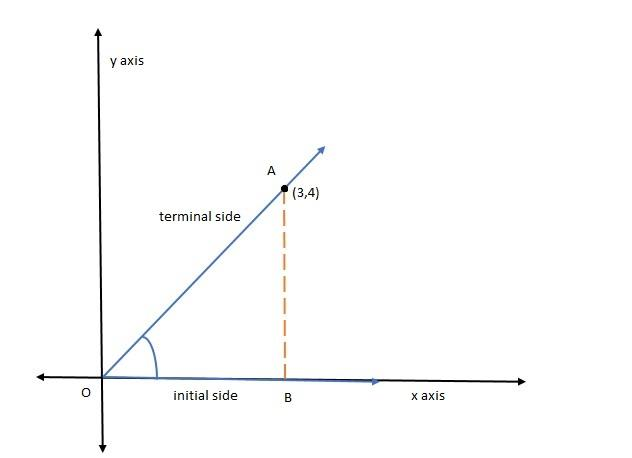
Where \[\angle AOB = \theta \]
Clearly from the figure,
\[
AB = 4{\text{ units }}\left( {{\text{Opposite side}}} \right) \\
OB = 3{\text{ units }}\left( {{\text{Adjacent side}}} \right) \\
\]
Using Pythagoras theorem i.e., \[{\left( {{\text{Hypotenuse}}} \right)^2} = {\left(
{{\text{Opposite}}} \right)^2} + {\left( {{\text{Adjacent}}} \right)^2}\], we have
\[
{\left( {OA} \right)^2} = {\left( {AB} \right)^2} + {\left( {OB} \right)^2} \\
{\left( {OA} \right)^2} = {\left( 4 \right)^2} + {\left( 3 \right)^2} \\
{\left( {OA} \right)^2} = 16 + 9 = 25 \\
\therefore OA = 5 \\
\]
We know that \[\operatorname{cosec} \theta =
\dfrac{{{\text{Hypotenuse}}}}{{{\text{Opposite side}}}}\].
Thus, we have \[\operatorname{cosec} \theta = \dfrac{5}{3}\]
Therefore, the correct option is C. \[\dfrac{5}{3}\]
Note: Pythagoras theorem states that \[{\left( {{\text{Hypotenuse}}} \right)^2} = {\left( {{\text{Opposite}}} \right)^2} + {\left( {{\text{Adjacent}}} \right)^2}\]. Also remember that the initial side is a stationary straight line that contains a point about which another straight line is rotated to form an angle.
Complete step-by-step answer:
The angle formed by the terminal side passes through \[\left( {3,4} \right)\] is shown in the below figure:
Where \[\angle AOB = \theta \]
Clearly from the figure,
\[
AB = 4{\text{ units }}\left( {{\text{Opposite side}}} \right) \\
OB = 3{\text{ units }}\left( {{\text{Adjacent side}}} \right) \\
\]
Using Pythagoras theorem i.e., \[{\left( {{\text{Hypotenuse}}} \right)^2} = {\left(
{{\text{Opposite}}} \right)^2} + {\left( {{\text{Adjacent}}} \right)^2}\], we have
\[
{\left( {OA} \right)^2} = {\left( {AB} \right)^2} + {\left( {OB} \right)^2} \\
{\left( {OA} \right)^2} = {\left( 4 \right)^2} + {\left( 3 \right)^2} \\
{\left( {OA} \right)^2} = 16 + 9 = 25 \\
\therefore OA = 5 \\
\]
We know that \[\operatorname{cosec} \theta =
\dfrac{{{\text{Hypotenuse}}}}{{{\text{Opposite side}}}}\].
Thus, we have \[\operatorname{cosec} \theta = \dfrac{5}{3}\]
Therefore, the correct option is C. \[\dfrac{5}{3}\]
Note: Pythagoras theorem states that \[{\left( {{\text{Hypotenuse}}} \right)^2} = {\left( {{\text{Opposite}}} \right)^2} + {\left( {{\text{Adjacent}}} \right)^2}\]. Also remember that the initial side is a stationary straight line that contains a point about which another straight line is rotated to form an angle.
Recently Updated Pages
Basicity of sulphurous acid and sulphuric acid are

Master Class 10 English: Engaging Questions & Answers for Success
Master Class 10 Social Science: Engaging Questions & Answers for Success
Master Class 10 Computer Science: Engaging Questions & Answers for Success
Class 10 Question and Answer - Your Ultimate Solutions Guide
Master Class 10 General Knowledge: Engaging Questions & Answers for Success
Trending doubts
Who is known as the "Little Master" in Indian cricket history?
A boat goes 24 km upstream and 28 km downstream in class 10 maths CBSE
State and explain Ohms law class 10 physics CBSE
Distinguish between soap and detergent class 10 chemistry CBSE
a Why did Mendel choose pea plants for his experiments class 10 biology CBSE
Draw the diagram of the sectional view of the human class 10 biology CBSE