




Find the equations of tangent and normal to the curve $x=a{{\sin }^{3}}\theta $ and $y=a{{\cos }^{3}}\theta $ at \[\theta =\dfrac{\pi }{4}\].
Answer
 Verified
615.3k+ views
Hint: To solve this problem, we should know the concept related to the tangent and normal to a curve at a point. We should know that the slope of tangent at a point $\left( {{x}_{1}},{{y}_{1}} \right)$ to the curve $y=f\left( x \right)$ is given by $m={{\left. \dfrac{dy}{dx} \right|}_{\left( {{x}_{1}},{{y}_{1}} \right)}}$. We know that the normal is perpendicular to the tangent, the slope of normal can be given by the formula ${{m}_{normal}}={{\left. -\dfrac{dx}{dy} \right|}_{\left( {{x}_{1}},{{y}_{1}} \right)}}$. In the question, we are not given a direct function in x and y. Instead we are given x and y in terms of a parameter $\theta $. Then we can rearrange the slope of tangent as $m={{\left. \dfrac{\dfrac{dy}{d\theta }}{\dfrac{dx}{d\theta }} \right|}_{\left( {{\theta }_{1}} \right)}}$. Using this relation and the parametric equations, we can find the slope of the tangent and normal. We also have the x and y coordinates of the point and using the slope and the point, we can get the equation of the tangent and the normal. The equation of a line with slope m and coordinates of the point $\left( {{x}_{1}},{{y}_{1}} \right)$ is given by $y-{{y}_{1}}=m\left( x-{{x}_{1}} \right)$.
Complete step by step answer:
We are given the parametric equations of the curve as $x=a{{\sin }^{3}}\theta $ and $y=a{{\cos }^{3}}\theta $.
We are asked to find the equations of tangent and normal to the curve at \[\theta =\dfrac{\pi }{4}\].
We know the relation between the slopes of tangent and normal and the equation of the curve.
The slope of tangent at a point $\left( {{x}_{1}},{{y}_{1}} \right)$ to the curve $y=f\left( x \right)$ is given by $m={{\left. \dfrac{dy}{dx} \right|}_{\left( {{x}_{1}},{{y}_{1}} \right)}}$. We know that the normal is perpendicular to the tangent, the slope of normal can be given by the formula ${{m}_{normal}}={{\left. -\dfrac{dx}{dy} \right|}_{\left( {{x}_{1}},{{y}_{1}} \right)}}$
In the question, we are not given a direct function in x and y. Instead we are given x and y in terms of a parameter $\theta $. Then we can rearrange the slope of tangent as $m={{\left. \dfrac{\dfrac{dy}{d\theta }}{\dfrac{dx}{d\theta }} \right|}_{\left( {{\theta }_{1}} \right)}}$.
Calculating the values of $\dfrac{dx}{d\theta }$ and $\dfrac{dy}{d\theta }$ at \[\theta =\dfrac{\pi }{4}\]
\[\begin{align}
& x=a{{\sin }^{3}}\theta \\
& \dfrac{dx}{d\theta }=3a{{\sin }^{2}}\theta \cos \theta \\
& {{\left. \dfrac{dx}{d\theta } \right|}_{\theta =\dfrac{\pi }{4}}}=3a{{\sin }^{2}}\left( \dfrac{\pi }{4} \right)\cos \left( \dfrac{\pi }{4} \right)=3a{{\left( \dfrac{1}{\sqrt{2}} \right)}^{2}}\left( \dfrac{1}{\sqrt{2}} \right)=\dfrac{3a}{2\sqrt{2}} \\
\end{align}\]
\[\begin{align}
& y=a{{\cos }^{3}}\theta \\
& \dfrac{dy}{d\theta }=3a{{\cos }^{2}}\theta \left( -\sin \theta \right) \\
& {{\left. \dfrac{dy}{d\theta } \right|}_{\theta =\dfrac{\pi }{4}}}=-3a{{\cos }^{2}}\left( \dfrac{\pi }{4} \right)\sin \left( \dfrac{\pi }{4} \right)=-3a{{\left( \dfrac{1}{\sqrt{2}} \right)}^{2}}\left( \dfrac{1}{\sqrt{2}} \right)=-\dfrac{3a}{2\sqrt{2}} \\
\end{align}\]
From the relation $m={{\left. \dfrac{\dfrac{dy}{d\theta }}{\dfrac{dx}{d\theta }} \right|}_{\left( {{\theta }_{1}} \right)}}$
We get the slope of the tangent as $m={{\left. \dfrac{\dfrac{dy}{d\theta }}{\dfrac{dx}{d\theta }} \right|}_{\left( \dfrac{\pi }{4} \right)}}=\dfrac{\dfrac{-3a}{2\sqrt{2}}}{\dfrac{3a}{2\sqrt{2}}}=-1$
We know that the tangent and normal are perpendicular to each other. We know that the product of slopes of perpendicular lines is -1. Using this, we get the slope of normal as
$\begin{align}
& {{m}_{normal}}\times -1=-1 \\
& {{m}_{normal}}=1 \\
\end{align}$
At \[\theta =\dfrac{\pi }{4}\] the x and y coordinates are
$\begin{align}
& x=a{{\sin }^{3}}\dfrac{\pi }{4}=\dfrac{a}{2\sqrt{2}} \\
& y=a{{\cos }^{3}}\dfrac{\pi }{4}=\dfrac{a}{2\sqrt{2}} \\
\end{align}$
The equation of a line with slope m and coordinates of the point $\left( {{x}_{1}},{{y}_{1}} \right)$ is given by $y-{{y}_{1}}=m\left( x-{{x}_{1}} \right)$.
Equation of tangent with slope = -1 is
$\begin{align}
& y-\dfrac{a}{2\sqrt{2}}=-1\left( x-\dfrac{a}{2\sqrt{2}} \right) \\
& y-\dfrac{a}{2\sqrt{2}}=-x+\dfrac{a}{2\sqrt{2}} \\
& x+y=\dfrac{a}{2\sqrt{2}}+\dfrac{a}{2\sqrt{2}}=\dfrac{a}{\sqrt{2}} \\
& x+y=\dfrac{a}{\sqrt{2}} \\
\end{align}$
Equation of normal with slope = 1 is
\[\begin{align}
& y-\dfrac{a}{2\sqrt{2}}=\left( x-\dfrac{a}{2\sqrt{2}} \right) \\
& y-\dfrac{a}{2\sqrt{2}}=x-\dfrac{a}{2\sqrt{2}} \\
& y=x \\
& x-y=0 \\
\end{align}\]
$\therefore $ The equations of tangent and normal are $x+y=\dfrac{a}{\sqrt{2}}$ and \[x-y=0\] respectively.
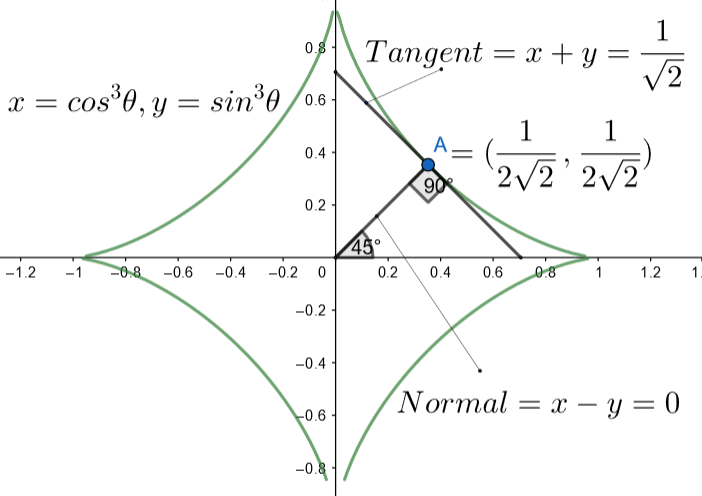
The above graph is a curve in the family of the curves in the question when a = 1.
Note: Students who don’t know how to arrange the term $\dfrac{dy}{dx}$ in terms of the parameter can remove the parameter from the process. That is
$\begin{align}
& \dfrac{x}{a}={{\sin }^{3}}\theta ,\dfrac{y}{a}={{\cos }^{3}}\theta \\
& {{\left( \dfrac{x}{a} \right)}^{\dfrac{1}{3}}}=\sin \theta ,{{\left( \dfrac{y}{a} \right)}^{\dfrac{1}{3}}}=\cos \theta \\
& {{\left( {{\left( \dfrac{x}{a} \right)}^{\dfrac{1}{3}}} \right)}^{2}}+{{\left( {{\left( \dfrac{y}{a} \right)}^{\dfrac{1}{3}}} \right)}^{2}}={{\sin }^{2}}\theta +{{\cos }^{2}}\theta =1 \\
& {{\left( \dfrac{x}{a} \right)}^{\dfrac{2}{3}}}+{{\left( \dfrac{y}{a} \right)}^{\dfrac{2}{3}}}=1 \\
& {{x}^{\dfrac{2}{3}}}+{{y}^{\dfrac{2}{3}}}={{a}^{\dfrac{2}{3}}} \\
\end{align}$
Now, we can apply the usual process to find the equations of tangent and normal.
Complete step by step answer:
We are given the parametric equations of the curve as $x=a{{\sin }^{3}}\theta $ and $y=a{{\cos }^{3}}\theta $.
We are asked to find the equations of tangent and normal to the curve at \[\theta =\dfrac{\pi }{4}\].
We know the relation between the slopes of tangent and normal and the equation of the curve.
The slope of tangent at a point $\left( {{x}_{1}},{{y}_{1}} \right)$ to the curve $y=f\left( x \right)$ is given by $m={{\left. \dfrac{dy}{dx} \right|}_{\left( {{x}_{1}},{{y}_{1}} \right)}}$. We know that the normal is perpendicular to the tangent, the slope of normal can be given by the formula ${{m}_{normal}}={{\left. -\dfrac{dx}{dy} \right|}_{\left( {{x}_{1}},{{y}_{1}} \right)}}$
In the question, we are not given a direct function in x and y. Instead we are given x and y in terms of a parameter $\theta $. Then we can rearrange the slope of tangent as $m={{\left. \dfrac{\dfrac{dy}{d\theta }}{\dfrac{dx}{d\theta }} \right|}_{\left( {{\theta }_{1}} \right)}}$.
Calculating the values of $\dfrac{dx}{d\theta }$ and $\dfrac{dy}{d\theta }$ at \[\theta =\dfrac{\pi }{4}\]
\[\begin{align}
& x=a{{\sin }^{3}}\theta \\
& \dfrac{dx}{d\theta }=3a{{\sin }^{2}}\theta \cos \theta \\
& {{\left. \dfrac{dx}{d\theta } \right|}_{\theta =\dfrac{\pi }{4}}}=3a{{\sin }^{2}}\left( \dfrac{\pi }{4} \right)\cos \left( \dfrac{\pi }{4} \right)=3a{{\left( \dfrac{1}{\sqrt{2}} \right)}^{2}}\left( \dfrac{1}{\sqrt{2}} \right)=\dfrac{3a}{2\sqrt{2}} \\
\end{align}\]
\[\begin{align}
& y=a{{\cos }^{3}}\theta \\
& \dfrac{dy}{d\theta }=3a{{\cos }^{2}}\theta \left( -\sin \theta \right) \\
& {{\left. \dfrac{dy}{d\theta } \right|}_{\theta =\dfrac{\pi }{4}}}=-3a{{\cos }^{2}}\left( \dfrac{\pi }{4} \right)\sin \left( \dfrac{\pi }{4} \right)=-3a{{\left( \dfrac{1}{\sqrt{2}} \right)}^{2}}\left( \dfrac{1}{\sqrt{2}} \right)=-\dfrac{3a}{2\sqrt{2}} \\
\end{align}\]
From the relation $m={{\left. \dfrac{\dfrac{dy}{d\theta }}{\dfrac{dx}{d\theta }} \right|}_{\left( {{\theta }_{1}} \right)}}$
We get the slope of the tangent as $m={{\left. \dfrac{\dfrac{dy}{d\theta }}{\dfrac{dx}{d\theta }} \right|}_{\left( \dfrac{\pi }{4} \right)}}=\dfrac{\dfrac{-3a}{2\sqrt{2}}}{\dfrac{3a}{2\sqrt{2}}}=-1$
We know that the tangent and normal are perpendicular to each other. We know that the product of slopes of perpendicular lines is -1. Using this, we get the slope of normal as
$\begin{align}
& {{m}_{normal}}\times -1=-1 \\
& {{m}_{normal}}=1 \\
\end{align}$
At \[\theta =\dfrac{\pi }{4}\] the x and y coordinates are
$\begin{align}
& x=a{{\sin }^{3}}\dfrac{\pi }{4}=\dfrac{a}{2\sqrt{2}} \\
& y=a{{\cos }^{3}}\dfrac{\pi }{4}=\dfrac{a}{2\sqrt{2}} \\
\end{align}$
The equation of a line with slope m and coordinates of the point $\left( {{x}_{1}},{{y}_{1}} \right)$ is given by $y-{{y}_{1}}=m\left( x-{{x}_{1}} \right)$.
Equation of tangent with slope = -1 is
$\begin{align}
& y-\dfrac{a}{2\sqrt{2}}=-1\left( x-\dfrac{a}{2\sqrt{2}} \right) \\
& y-\dfrac{a}{2\sqrt{2}}=-x+\dfrac{a}{2\sqrt{2}} \\
& x+y=\dfrac{a}{2\sqrt{2}}+\dfrac{a}{2\sqrt{2}}=\dfrac{a}{\sqrt{2}} \\
& x+y=\dfrac{a}{\sqrt{2}} \\
\end{align}$
Equation of normal with slope = 1 is
\[\begin{align}
& y-\dfrac{a}{2\sqrt{2}}=\left( x-\dfrac{a}{2\sqrt{2}} \right) \\
& y-\dfrac{a}{2\sqrt{2}}=x-\dfrac{a}{2\sqrt{2}} \\
& y=x \\
& x-y=0 \\
\end{align}\]
$\therefore $ The equations of tangent and normal are $x+y=\dfrac{a}{\sqrt{2}}$ and \[x-y=0\] respectively.
The above graph is a curve in the family of the curves in the question when a = 1.
Note: Students who don’t know how to arrange the term $\dfrac{dy}{dx}$ in terms of the parameter can remove the parameter from the process. That is
$\begin{align}
& \dfrac{x}{a}={{\sin }^{3}}\theta ,\dfrac{y}{a}={{\cos }^{3}}\theta \\
& {{\left( \dfrac{x}{a} \right)}^{\dfrac{1}{3}}}=\sin \theta ,{{\left( \dfrac{y}{a} \right)}^{\dfrac{1}{3}}}=\cos \theta \\
& {{\left( {{\left( \dfrac{x}{a} \right)}^{\dfrac{1}{3}}} \right)}^{2}}+{{\left( {{\left( \dfrac{y}{a} \right)}^{\dfrac{1}{3}}} \right)}^{2}}={{\sin }^{2}}\theta +{{\cos }^{2}}\theta =1 \\
& {{\left( \dfrac{x}{a} \right)}^{\dfrac{2}{3}}}+{{\left( \dfrac{y}{a} \right)}^{\dfrac{2}{3}}}=1 \\
& {{x}^{\dfrac{2}{3}}}+{{y}^{\dfrac{2}{3}}}={{a}^{\dfrac{2}{3}}} \\
\end{align}$
Now, we can apply the usual process to find the equations of tangent and normal.
Recently Updated Pages
Master Class 12 Business Studies: Engaging Questions & Answers for Success

Master Class 12 Chemistry: Engaging Questions & Answers for Success
Master Class 12 Biology: Engaging Questions & Answers for Success
Class 12 Question and Answer - Your Ultimate Solutions Guide
Master Class 11 English: Engaging Questions & Answers for Success
Master Class 11 Maths: Engaging Questions & Answers for Success
Trending doubts
Which is more stable and why class 12 chemistry CBSE
Which are the Top 10 Largest Countries of the World?
Draw a labelled sketch of the human eye class 12 physics CBSE
Differentiate between homogeneous and heterogeneous class 12 chemistry CBSE
What are the major means of transport Explain each class 12 social science CBSE
Sulphuric acid is known as the king of acids State class 12 chemistry CBSE