




Find the distance between the points$\left( a\cos {{35}^{\circ }},0 \right),\left( 0,a\cos {{55}^{\circ }} \right)$. \[\]
Answer
 Verified
585k+ views
Hint: We use the distance formula between two points $A\left( {{x}_{1}},{{y}_{1}} \right)$ and $B\left( {{x}_{2}},{{y}_{2}} \right)$$AB=\sqrt{{{\left( {{x}_{2}}-{{x}_{1}} \right)}^{2}}+{{\left( {{y}_{2}}-{{y}_{1}} \right)}^{2}}}$ to find the distance and then use reduction formula of sine and cosine $\cos \left( {{90}^{\circ }}-\theta \right)=\sin \theta $and Pythagorean trigonometric identity involving sine and cosine ${{\sin }^{2}}\theta +{{\cos }^{2}}\theta =1$ to find simplify.\[\]
Complete step by step answer:
We know that distance between two points is the measure of shortest path we need to move from one point to another and it is given by length of line segment joining those two points. The distance between two points $A$ and $B$ on a plane with their coordinates $A\left( {{x}_{1}},{{y}_{1}} \right)$ and $B\left( {{x}_{2}},{{y}_{2}} \right)$ is given by the formula
\[AB=\sqrt{{{\left( {{x}_{2}}-{{x}_{1}} \right)}^{2}}+{{\left( {{y}_{2}}-{{y}_{1}} \right)}^{2}}}\]
The distance is always a positive quantity and hence we take only positive square root. We know from Pythagorean trigonometric identity for sine and cosine with any acute angle $\theta $ we have;
\[{{\sin }^{2}}\theta +{{\cos }^{2}}\theta =1\]
We know the reduction formula about angle ${{90}^{\circ }}$ for two complimentary angles $\theta $ and ${{90}^{\circ }}-\theta $ as
\[\begin{align}
& \sin \left( {{90}^{\circ }}-\theta \right)=\cos \theta \\
& \cos \left( {{90}^{\circ }}-\theta \right)=\sin \theta \\
\end{align}\]
We are asked in the question to find the distance between$\left( a\cos {{35}^{\circ }},0 \right),\left( 0,a\cos {{55}^{\circ }} \right)$. Let us denote the points as $A\left( a\cos {{35}^{\circ }},0 \right),B\left( 0,a\cos {{55}^{\circ }} \right)$ and find the distance between them as $AB$ using the distance formula for${{x}_{1}}=a\cos {{35}^{\circ }},{{y}_{1}}=0,{{x}_{2}}=a\cos {{55}^{\circ }},{{y}_{2}}=0$. We have;
\[\begin{align}
& AB=\sqrt{{{\left( a\cos {{55}^{\circ }}-0 \right)}^{2}}+{{\left( 0-a\cos {{35}^{\circ }} \right)}^{2}}} \\
& \Rightarrow AB=\sqrt{{{\left( a\cos {{55}^{\circ }} \right)}^{2}}+{{\left( -a\cos {{35}^{\circ }} \right)}^{2}}} \\
\end{align}\]
We use the reduction formula for complimentary angles ${{35}^{\circ }}$ and ${{90}^{\circ }}-{{35}^{\circ }}={{55}^{\circ }}$and convert $\cos {{55}^{\circ }}$ to $\sin {{35}^{\circ }}$as
\[\begin{align}
& \Rightarrow AB=\sqrt{{{\left( a\cos \left( {{90}^{\circ }}-{{35}^{\circ }} \right) \right)}^{2}}+{{\left( a\cos {{35}^{\circ }} \right)}^{2}}} \\
& \Rightarrow AB=\sqrt{{{\left( a\sin {{35}^{\circ }} \right)}^{2}}+{{\left( a\cos {{35}^{\circ }} \right)}^{2}}} \\
& \Rightarrow AB=\sqrt{{{a}^{2}}{{\sin }^{2}}{{35}^{\circ }}+{{a}^{2}}{{\cos }^{2}}{{35}^{\circ }}} \\
& \Rightarrow AB=\sqrt{{{a}^{2}}\left( {{\sin }^{2}}{{35}^{\circ }}+{{\cos }^{2}}{{35}^{\circ }} \right)} \\
\end{align}\]
We use the Pythagorean trigonometric identity for sine and cosine with any angle $\theta ={{35}^{\circ }}$ to have;
\[\begin{align}
& \Rightarrow AB=\sqrt{{{a}^{2}}\cdot 1} \\
& \Rightarrow AB=a \\
\end{align}\]
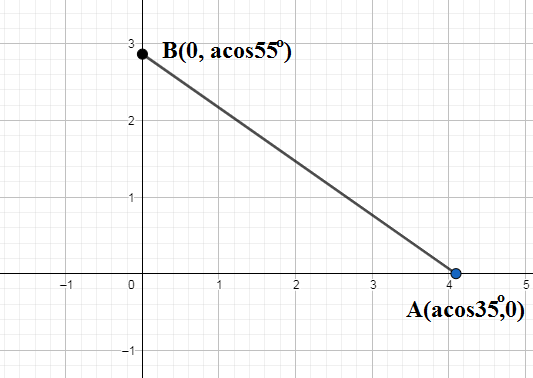
So the distance between the points $A\left( a\cos {{35}^{\circ }},0 \right),B\left( 0,a\cos {{55}^{\circ }} \right)$ is $a$ unit. \[\]
Note: We note that the given points $A\left( a\cos {{35}^{\circ }},0 \right),B\left( 0,a\cos {{55}^{\circ }} \right)$ lie on coordinate axes which we have shown in the figure for $a=5$ and the line joining them wills always in the first quadrant. We must be careful of confusion between the complementary angle for formula and shift by right angle formula which is given as $\cos \left( \theta \pm {{90}^{\circ }} \right)=\mp \sin \theta $
Complete step by step answer:
We know that distance between two points is the measure of shortest path we need to move from one point to another and it is given by length of line segment joining those two points. The distance between two points $A$ and $B$ on a plane with their coordinates $A\left( {{x}_{1}},{{y}_{1}} \right)$ and $B\left( {{x}_{2}},{{y}_{2}} \right)$ is given by the formula
\[AB=\sqrt{{{\left( {{x}_{2}}-{{x}_{1}} \right)}^{2}}+{{\left( {{y}_{2}}-{{y}_{1}} \right)}^{2}}}\]
The distance is always a positive quantity and hence we take only positive square root. We know from Pythagorean trigonometric identity for sine and cosine with any acute angle $\theta $ we have;
\[{{\sin }^{2}}\theta +{{\cos }^{2}}\theta =1\]
We know the reduction formula about angle ${{90}^{\circ }}$ for two complimentary angles $\theta $ and ${{90}^{\circ }}-\theta $ as
\[\begin{align}
& \sin \left( {{90}^{\circ }}-\theta \right)=\cos \theta \\
& \cos \left( {{90}^{\circ }}-\theta \right)=\sin \theta \\
\end{align}\]
We are asked in the question to find the distance between$\left( a\cos {{35}^{\circ }},0 \right),\left( 0,a\cos {{55}^{\circ }} \right)$. Let us denote the points as $A\left( a\cos {{35}^{\circ }},0 \right),B\left( 0,a\cos {{55}^{\circ }} \right)$ and find the distance between them as $AB$ using the distance formula for${{x}_{1}}=a\cos {{35}^{\circ }},{{y}_{1}}=0,{{x}_{2}}=a\cos {{55}^{\circ }},{{y}_{2}}=0$. We have;
\[\begin{align}
& AB=\sqrt{{{\left( a\cos {{55}^{\circ }}-0 \right)}^{2}}+{{\left( 0-a\cos {{35}^{\circ }} \right)}^{2}}} \\
& \Rightarrow AB=\sqrt{{{\left( a\cos {{55}^{\circ }} \right)}^{2}}+{{\left( -a\cos {{35}^{\circ }} \right)}^{2}}} \\
\end{align}\]
We use the reduction formula for complimentary angles ${{35}^{\circ }}$ and ${{90}^{\circ }}-{{35}^{\circ }}={{55}^{\circ }}$and convert $\cos {{55}^{\circ }}$ to $\sin {{35}^{\circ }}$as
\[\begin{align}
& \Rightarrow AB=\sqrt{{{\left( a\cos \left( {{90}^{\circ }}-{{35}^{\circ }} \right) \right)}^{2}}+{{\left( a\cos {{35}^{\circ }} \right)}^{2}}} \\
& \Rightarrow AB=\sqrt{{{\left( a\sin {{35}^{\circ }} \right)}^{2}}+{{\left( a\cos {{35}^{\circ }} \right)}^{2}}} \\
& \Rightarrow AB=\sqrt{{{a}^{2}}{{\sin }^{2}}{{35}^{\circ }}+{{a}^{2}}{{\cos }^{2}}{{35}^{\circ }}} \\
& \Rightarrow AB=\sqrt{{{a}^{2}}\left( {{\sin }^{2}}{{35}^{\circ }}+{{\cos }^{2}}{{35}^{\circ }} \right)} \\
\end{align}\]
We use the Pythagorean trigonometric identity for sine and cosine with any angle $\theta ={{35}^{\circ }}$ to have;
\[\begin{align}
& \Rightarrow AB=\sqrt{{{a}^{2}}\cdot 1} \\
& \Rightarrow AB=a \\
\end{align}\]
So the distance between the points $A\left( a\cos {{35}^{\circ }},0 \right),B\left( 0,a\cos {{55}^{\circ }} \right)$ is $a$ unit. \[\]
Note: We note that the given points $A\left( a\cos {{35}^{\circ }},0 \right),B\left( 0,a\cos {{55}^{\circ }} \right)$ lie on coordinate axes which we have shown in the figure for $a=5$ and the line joining them wills always in the first quadrant. We must be careful of confusion between the complementary angle for formula and shift by right angle formula which is given as $\cos \left( \theta \pm {{90}^{\circ }} \right)=\mp \sin \theta $
Recently Updated Pages
The magnetic field in a plane electromagnetic wave class 11 physics CBSE

In a plane electromagnetic wave the electric field class 12 physics CBSE
A plane electromagnetic wave travels in vacuum along class 12 physics CBSE
Basicity of sulphurous acid and sulphuric acid are
Master Class 11 Business Studies: Engaging Questions & Answers for Success
Master Class 11 Computer Science: Engaging Questions & Answers for Success
Trending doubts
One Metric ton is equal to kg A 10000 B 1000 C 100 class 11 physics CBSE
What are the examples of C3 and C4 plants class 11 biology CBSE
State and prove Bernoullis theorem class 11 physics CBSE
10 examples of friction in our daily life
A body is said to be in dynamic equilibrium if A When class 11 physics CBSE
Difference Between Prokaryotic Cells and Eukaryotic Cells