



How do I find the directrix of a hyperbola?
Answer
 Verified
597.9k+ views
Hint: Here we need to draw the figure of general hyperbola which is $\dfrac{{{x^2}}}{{{a^2}}} - \dfrac{{{y^2}}}{{{b^2}}} = 1$ and then we must know how to calculate the focus which is given by $\left( {c,0} \right)$ and here ${c^2} = {a^2} + {b^2}$ now we can simply apply the formula to calculate the straight line that represent the directrix and this will be equal to $x = \dfrac{a}{e}{\text{ or }}\dfrac{{{a^2}}}{c}$ where $e$ is eccentricity and given by $e = \sqrt {\dfrac{{{a^2} + {b^2}}}{{{a^2}}}} $.
Complete step by step solution:
Here we need to find the equation of the directrix of the hyperbola. For this, we must know what the equation and the representation of hyperbola are. So let us consider hyperbola as represented below:
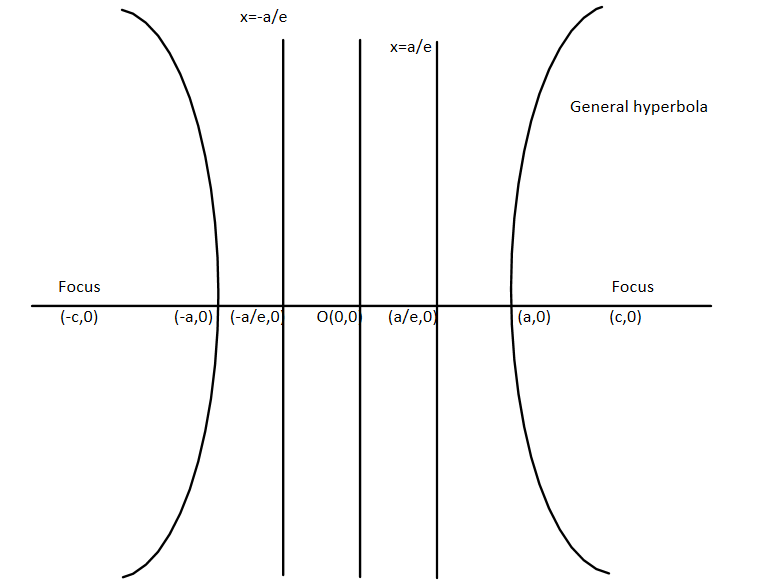
Here we can see that this is the general hyperbola and its general equation is given by:
$\dfrac{{{x^2}}}{{{a^2}}} - \dfrac{{{y^2}}}{{{b^2}}} = 1$
Here the axis on which the vertex is there is called the transverse axis and another is called the conjugate axis.
Now we can see that focus is given by $\left( {c,0} \right)$ and ${c^2} = {a^2} + {b^2}$ where $\left( {a,0} \right){\text{ and }}\left( { - a,0} \right)$ are the two vertices.
The directrix is the line which is parallel to y axis and is given by $x = \dfrac{a}{e}{\text{ or }}\dfrac{{{a^2}}}{c}$ and here $e = \sqrt {\dfrac{{{a^2} + {b^2}}}{{{a^2}}}} $ and represents the eccentricity of the hyperbola.
This can be made clear with an example:
Let us have the hyperbola where we have \[\]
$\dfrac{{{x^2}}}{{16}} - \dfrac{{{y^2}}}{9} = 1$
So we can compare this above equation with $\dfrac{{{x^2}}}{{{a^2}}} - \dfrac{{{y^2}}}{{{b^2}}} = 1$ and we will get:
$
a = 4 \\
b = 3 \\
$
Hence we can now calculate the value of $c$ by using the formula which is given by:
${c^2} = {a^2} + {b^2}$
$
{c^2} = {4^2} + {3^2} \\
{c^2} = 16 + 9 = 25 \\
c = \pm 5 \\
$
Now we know that directrix of hyperbola is given by $x = \dfrac{{{a^2}}}{c}$
Substituting the values we get:
$x = \dfrac{{{a^2}}}{c} = \dfrac{{{4^2}}}{5} = \dfrac{{16}}{5} = 3.2$
So $x = 3.2$ is the directrix of this hyperbola.
Note:
Here the student must know every formula of the general hyperbola because this will be helpful to calculate the results faster and also when we shift the hyperbola centre from origin to any other point.
Complete step by step solution:
Here we need to find the equation of the directrix of the hyperbola. For this, we must know what the equation and the representation of hyperbola are. So let us consider hyperbola as represented below:
Here we can see that this is the general hyperbola and its general equation is given by:
$\dfrac{{{x^2}}}{{{a^2}}} - \dfrac{{{y^2}}}{{{b^2}}} = 1$
Here the axis on which the vertex is there is called the transverse axis and another is called the conjugate axis.
Now we can see that focus is given by $\left( {c,0} \right)$ and ${c^2} = {a^2} + {b^2}$ where $\left( {a,0} \right){\text{ and }}\left( { - a,0} \right)$ are the two vertices.
The directrix is the line which is parallel to y axis and is given by $x = \dfrac{a}{e}{\text{ or }}\dfrac{{{a^2}}}{c}$ and here $e = \sqrt {\dfrac{{{a^2} + {b^2}}}{{{a^2}}}} $ and represents the eccentricity of the hyperbola.
This can be made clear with an example:
Let us have the hyperbola where we have \[\]
$\dfrac{{{x^2}}}{{16}} - \dfrac{{{y^2}}}{9} = 1$
So we can compare this above equation with $\dfrac{{{x^2}}}{{{a^2}}} - \dfrac{{{y^2}}}{{{b^2}}} = 1$ and we will get:
$
a = 4 \\
b = 3 \\
$
Hence we can now calculate the value of $c$ by using the formula which is given by:
${c^2} = {a^2} + {b^2}$
$
{c^2} = {4^2} + {3^2} \\
{c^2} = 16 + 9 = 25 \\
c = \pm 5 \\
$
Now we know that directrix of hyperbola is given by $x = \dfrac{{{a^2}}}{c}$
Substituting the values we get:
$x = \dfrac{{{a^2}}}{c} = \dfrac{{{4^2}}}{5} = \dfrac{{16}}{5} = 3.2$
So $x = 3.2$ is the directrix of this hyperbola.
Note:
Here the student must know every formula of the general hyperbola because this will be helpful to calculate the results faster and also when we shift the hyperbola centre from origin to any other point.
Recently Updated Pages
Master Class 12 Business Studies: Engaging Questions & Answers for Success

Master Class 12 Chemistry: Engaging Questions & Answers for Success
Master Class 12 Biology: Engaging Questions & Answers for Success
Class 12 Question and Answer - Your Ultimate Solutions Guide
Master Class 11 English: Engaging Questions & Answers for Success
Master Class 11 Social Science: Engaging Questions & Answers for Success
Trending doubts
Which are the Top 10 Largest Countries of the World?
The total number of vertebrae in man is a30 b31 c32 class 12 biology CBSE
Draw a labelled sketch of the human eye class 12 physics CBSE
The number of cranial nerves in a frog is A 10 pairs class 12 biology CBSE
Differentiate between homogeneous and heterogeneous class 12 chemistry CBSE
Differentiate between Pyramid of energy and pyramid class 12 biology CBSE