




Find the country with highest population density if the population density is defined as $\dfrac{{population}}{{area}}$.
A. Ecuador
B. Uruguay
C. Venezuela
D. Chile
Answer
 Verified
626.1k+ views
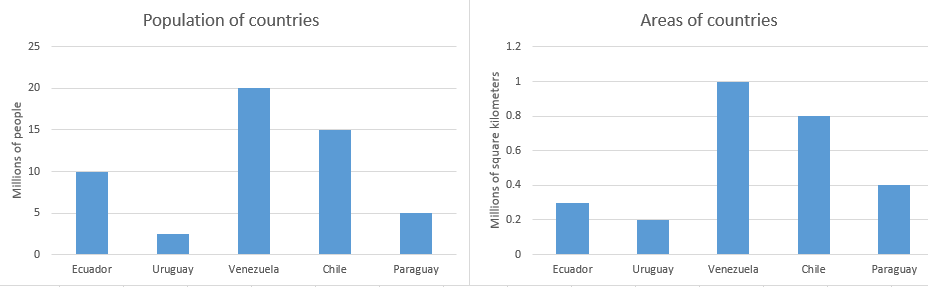
Hint: Given the graphs of total population of the countries (in millions) and areas of the countries in (millions of square km). So to find which country has the highest population density, as already given in the question that the population density of a particular country is defined as the ratio of the population of that particular country to the area of that particular country. All we have to do is find the population density of each country and find out which country has the highest population density.
Complete step-by-step solution:
The population density of a country is given by:
$ \Rightarrow \dfrac{{population}}{{area}}$
Now in the given graph of the population of 5 countries, we can find out the population in each country.
The population in Ecuador = 10 million.
The population in Uruguay = 2.5 million.
The population in Venezuela = 20 million.
The population in Chile = 15 million.
The population in Paraguay = 5 million.
From the graph of areas of countries, we can find out the area of each country.
The area of Ecuador = 0.3 million sq km.
The area of Uruguay = 0.2 million sq km.
The area of Venezuela = 1 million sq km.
The area of Chile = 0.8 million sq km.
The area of Paraguay = 0.4 million sq km.
Now calculating the population density of each country is given by:
$ \dfrac{{population}}{{area}}$
The population density of Ecuador :
$ \Rightarrow \dfrac{{10}}{{0.3}} = 33.33$
$\therefore $The population density of Ecuador is 33.33 million per million sq km.
The population density of Uruguay :
$ \Rightarrow \dfrac{{2.5}}{{0.2}} = 12.5$
$\therefore $The population density of Uruguay is 12.5 million per million sq km.
The population density of Venezuela :
$ \Rightarrow \dfrac{{20}}{1} = 20$
$\therefore $The population density of Venezuela is 20 million per million sq km.
The population density of Chile :
$ \Rightarrow \dfrac{{15}}{{0.8}} = 18.75$
$\therefore $The population density of Chile is 18.75 million per million sq km.
The population density of Paraguay :
$ \Rightarrow \dfrac{5}{{0.4}} = 12.5$
$\therefore $The population density of Paraguay is 12.5 million per million sq km.
The population density of Ecuador in (million per million sq km) = 33.33
The population density of Uruguay in (million per million sq km) = 12.5
The population density of Venezuela in (million per million sq km) = 20
The population density of Chile in (million per million sq km) = 18.75
The population density of Paraguay in (million per million sq km) = 12.5
$\therefore $Ecuador has the highest population density of 33.33 million per million sq km.
Ecuador has the highest population density.
Note: While calculating the population density of the countries it is very important to check whether the population and area of the country are in the same unit of conversion, if not we have to convert the unit such that both have the same unit of conversion.
Complete step-by-step solution:
The population density of a country is given by:
$ \Rightarrow \dfrac{{population}}{{area}}$
Now in the given graph of the population of 5 countries, we can find out the population in each country.
The population in Ecuador = 10 million.
The population in Uruguay = 2.5 million.
The population in Venezuela = 20 million.
The population in Chile = 15 million.
The population in Paraguay = 5 million.
From the graph of areas of countries, we can find out the area of each country.
The area of Ecuador = 0.3 million sq km.
The area of Uruguay = 0.2 million sq km.
The area of Venezuela = 1 million sq km.
The area of Chile = 0.8 million sq km.
The area of Paraguay = 0.4 million sq km.
Now calculating the population density of each country is given by:
$ \dfrac{{population}}{{area}}$
The population density of Ecuador :
$ \Rightarrow \dfrac{{10}}{{0.3}} = 33.33$
$\therefore $The population density of Ecuador is 33.33 million per million sq km.
The population density of Uruguay :
$ \Rightarrow \dfrac{{2.5}}{{0.2}} = 12.5$
$\therefore $The population density of Uruguay is 12.5 million per million sq km.
The population density of Venezuela :
$ \Rightarrow \dfrac{{20}}{1} = 20$
$\therefore $The population density of Venezuela is 20 million per million sq km.
The population density of Chile :
$ \Rightarrow \dfrac{{15}}{{0.8}} = 18.75$
$\therefore $The population density of Chile is 18.75 million per million sq km.
The population density of Paraguay :
$ \Rightarrow \dfrac{5}{{0.4}} = 12.5$
$\therefore $The population density of Paraguay is 12.5 million per million sq km.
The population density of Ecuador in (million per million sq km) = 33.33
The population density of Uruguay in (million per million sq km) = 12.5
The population density of Venezuela in (million per million sq km) = 20
The population density of Chile in (million per million sq km) = 18.75
The population density of Paraguay in (million per million sq km) = 12.5
$\therefore $Ecuador has the highest population density of 33.33 million per million sq km.
Ecuador has the highest population density.
Note: While calculating the population density of the countries it is very important to check whether the population and area of the country are in the same unit of conversion, if not we have to convert the unit such that both have the same unit of conversion.
Recently Updated Pages
Master Class 11 Social Science: Engaging Questions & Answers for Success

Master Class 11 English: Engaging Questions & Answers for Success
Master Class 11 Accountancy: Engaging Questions & Answers for Success
Master Class 11 Physics: Engaging Questions & Answers for Success
Master Class 11 Computer Science: Engaging Questions & Answers for Success
Master Class 11 Business Studies: Engaging Questions & Answers for Success
Trending doubts
Find the value of the expression given below sin 30circ class 11 maths CBSE
One Metric ton is equal to kg A 10000 B 1000 C 100 class 11 physics CBSE
Draw a diagram of nephron and explain its structur class 11 biology CBSE
10 examples of friction in our daily life
Proton was discovered by A Thomson B Rutherford C Chadwick class 11 chemistry CBSE
The teeth used for biting and cutting food are called class 11 biology CBSE