




How do you find the continuity of a function on a closed interval?
Answer
 Verified
624k+ views
Hint: Continuity of function in a closed interval $\left[ {a,b} \right]$: A function $f$ is said to be continuous on a closed interval $\left[ {a,b} \right]$ if
$f$ is continuous on $\left( {a,b} \right)$.
$f$ is continuous from the right at $a$, i.e., $\mathop {\lim }\limits_{x \to {a^ + }} f\left( x \right) = f\left( a \right)$, and
$f$ is continuous from the left at $b$, i.e., $\mathop {\lim }\limits_{x \to {b^ - }} f\left( x \right) = f\left( b \right)$.
Complete step by step solution:
First, we will discuss the continuity on a closed interval.
Continuity on a closed interval: A function $f\left( x \right)$ is said to be continuous on a closed interval $\left[ {a,b} \right]$ if and only if
$f$ is continuous on the open interval $\left( {a,b} \right)$
$\mathop {\lim }\limits_{x \to {a^ + }} f\left( x \right) = f\left( a \right)$, and
$\mathop {\lim }\limits_{x \to {b^ - }} f\left( x \right) = f\left( b \right)$
In other words, $f\left( x \right)$ is continuous on $\left[ {a,b} \right]$ if and only if it is continuous on $\left( {a,b} \right)$ and it continuous at $a$ from the right and at $b$ from the left.
Final solution: Hence, to determine if a function is continuous or not on a closed interval we check if the function is continuous or not in a closed interval, and it is continuous at endpoints from the right and left.
Note: Consider the function
$f\left( x \right) = 1$ if $x \leqslant 0$ and $f\left( x \right) = 0$ if $x > 0$
This function is of course defined at every point of the real line. Graph of this function is
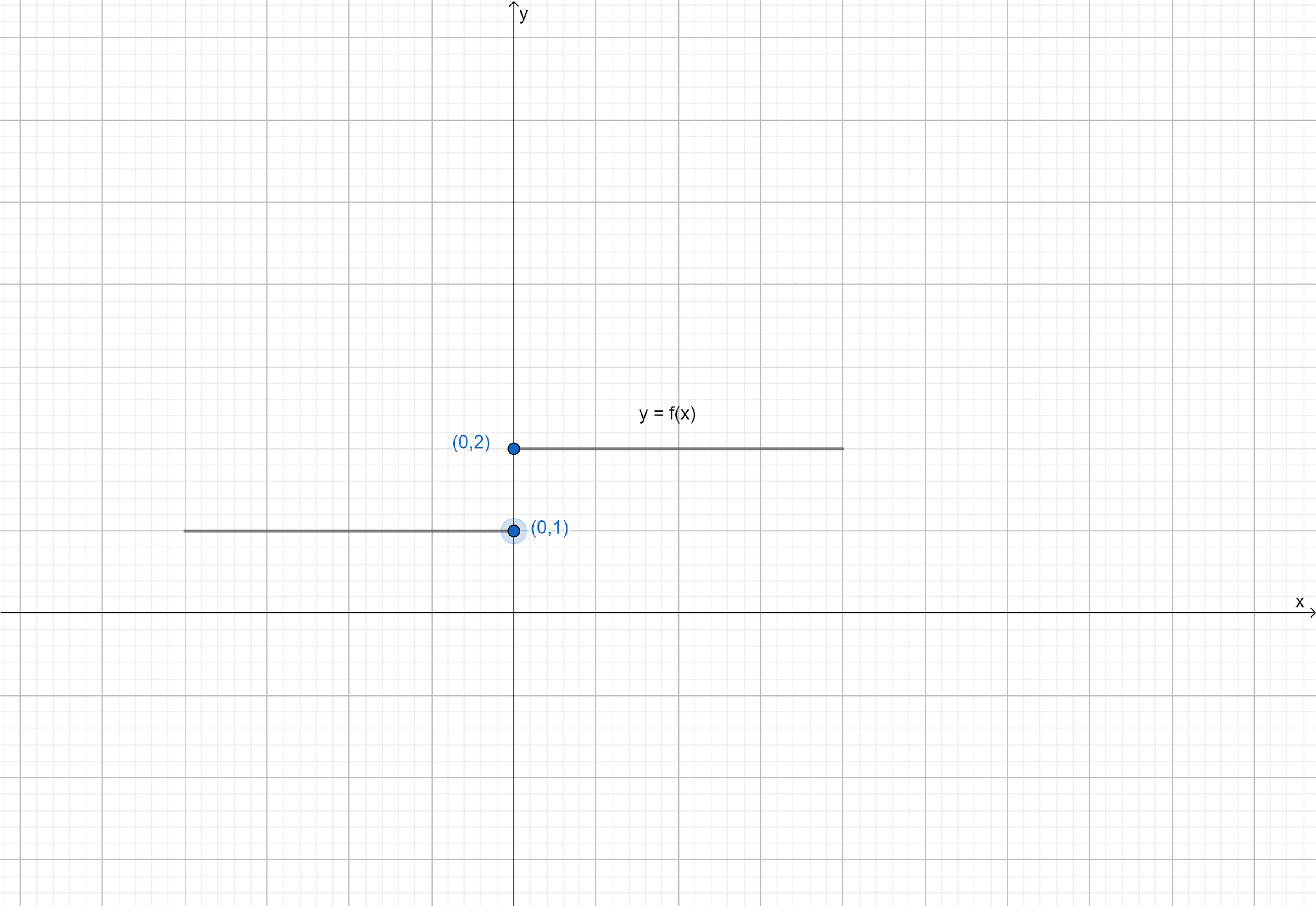
One can deduce from the graph that the value of the function at nearly points on $x$-axis remains close to each other except at $x = 0$. At the points near and to the left of $0$, i.e., at points like $ - 0.1, - 0.01, - 0.001$, the value of the functions is $1$. At the points near and to the right of $0$, i.e., at points like $0.1,0.01,0.001$, the value of the function is $2$. Using the language of left and right hand limits, we may say that the left (respectively right) hand limit of $f$ at $0$ is $1$ (respectively $2$). In particular the left and right hand limits do not coincide. We also observe that the value of the function at $x = 0$ coincides with the left hand limit. Note that when we try to draw the graph, we cannot draw it one stroke, i.e., without lifting a pen from the plane of the paper, we cannot draw the graph of this function. In fact, we need to lift the pen when we come to $0$ from left. This is one instance of function being not continuous.
$f$ is continuous on $\left( {a,b} \right)$.
$f$ is continuous from the right at $a$, i.e., $\mathop {\lim }\limits_{x \to {a^ + }} f\left( x \right) = f\left( a \right)$, and
$f$ is continuous from the left at $b$, i.e., $\mathop {\lim }\limits_{x \to {b^ - }} f\left( x \right) = f\left( b \right)$.
Complete step by step solution:
First, we will discuss the continuity on a closed interval.
Continuity on a closed interval: A function $f\left( x \right)$ is said to be continuous on a closed interval $\left[ {a,b} \right]$ if and only if
$f$ is continuous on the open interval $\left( {a,b} \right)$
$\mathop {\lim }\limits_{x \to {a^ + }} f\left( x \right) = f\left( a \right)$, and
$\mathop {\lim }\limits_{x \to {b^ - }} f\left( x \right) = f\left( b \right)$
In other words, $f\left( x \right)$ is continuous on $\left[ {a,b} \right]$ if and only if it is continuous on $\left( {a,b} \right)$ and it continuous at $a$ from the right and at $b$ from the left.
Final solution: Hence, to determine if a function is continuous or not on a closed interval we check if the function is continuous or not in a closed interval, and it is continuous at endpoints from the right and left.
Note: Consider the function
$f\left( x \right) = 1$ if $x \leqslant 0$ and $f\left( x \right) = 0$ if $x > 0$
This function is of course defined at every point of the real line. Graph of this function is
One can deduce from the graph that the value of the function at nearly points on $x$-axis remains close to each other except at $x = 0$. At the points near and to the left of $0$, i.e., at points like $ - 0.1, - 0.01, - 0.001$, the value of the functions is $1$. At the points near and to the right of $0$, i.e., at points like $0.1,0.01,0.001$, the value of the function is $2$. Using the language of left and right hand limits, we may say that the left (respectively right) hand limit of $f$ at $0$ is $1$ (respectively $2$). In particular the left and right hand limits do not coincide. We also observe that the value of the function at $x = 0$ coincides with the left hand limit. Note that when we try to draw the graph, we cannot draw it one stroke, i.e., without lifting a pen from the plane of the paper, we cannot draw the graph of this function. In fact, we need to lift the pen when we come to $0$ from left. This is one instance of function being not continuous.
Recently Updated Pages
Which will be the least stable resonating structure class 11 chemistry CBSE

How many 5 digit telephone numbers can be construc-class-11-maths-CBSE
How do you find the angle of the resultant vector class 11 physics CBSE
Draw labelled diagram of the following i Gram seed class 11 biology CBSE
1 Quintal is equal to a 110 kg b 10 kg c 100kg d 1000 class 11 physics CBSE
What is the need and importance of classification class 11 biology CBSE
Trending doubts
Find the value of the expression given below sin 30circ class 11 maths CBSE
One Metric ton is equal to kg A 10000 B 1000 C 100 class 11 physics CBSE
10 examples of friction in our daily life
Draw a diagram of a plant cell and label at least eight class 11 biology CBSE
Difference between physical and chemical change class 11 chemistry CBSE
Proton was discovered by A Thomson B Rutherford C Chadwick class 11 chemistry CBSE