




How do you find the conjugate of the complex number $7-3i$ ?
Answer
 Verified
584.4k+ views
Hint: We are given a complex number as $7-3i$ , we are asked to find the conjugate of it, to find the conjugate of our given number we will learn what are complex number, how they are defined, we learn about ‘I’, then we will understand about conjugate, work on some example. Once we get the concept we work on $7-3i$ .
Complete step-by-step answer:
We are given a number as $7-3i$ , we are asked to find the conjugate of it, to do so we will first learn about complex numbers.
Complex numbers are defined by $z=a+ib$ , where a, b are real numbers, and ‘I’ is called iota.
‘I’ is used to denote the square root of -1 i.e. $i=\sqrt{-1}$ .
Now, we will learn about the conjugate,
The conjugate of any complex number ‘z’ is denoted by $\overline{z}$ and the conjugate of any complex number is the reflection of it along the real axis (x-axis).
And to find the conjugate of a number, we just need to find a number whose real part is the same as the given complex number and the imaginary part is opposite is sign but same in magnitude as the given complex number.
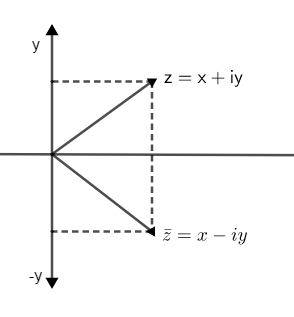
So, for any complex number $2=x+iy$ , its conjugate have real part is same as real part of ‘z’ which is ‘x’ while imaginary part is opposite in sign than that of ‘z’, so its imaginary part is ‘-y’,
So, the conjugate of $z=x+iy$ is $\overline{z}=x-iy$ .
For example we have $z=2+3i$ then the conjugate of it is $\overline{z}=2-3i$.
Now we work on our problem.
We have $z=7-3i$ , here $x=7$ and $y=-3$ .
So, its conjugate is $\overline{z}=x-iy$ .
So putting value, we get –
$\begin{align}
& \overline{z}=7-\left( -3 \right)i \\
& =7+3i \\
\end{align}$
So, the conjugate of $7-3i$ is $7+3i$ .
Note: Remember that it is not that we just need to change the positive to negative always in the imaginary part in actual, the sign gets reversed positive becomes negative but also negative becomes positive.
Also we do not have to change sign of whole the term that is for $z=2+3i$ , its conjugate is not $\overline{z}=-2-3i$ ,
Remember magnitude of any real quantity means the absolute value of it, for -2 and 2, their magnitude is same as $\left| -2 \right|=2$ and $\left| 2 \right|=2$ .
Complete step-by-step answer:
We are given a number as $7-3i$ , we are asked to find the conjugate of it, to do so we will first learn about complex numbers.
Complex numbers are defined by $z=a+ib$ , where a, b are real numbers, and ‘I’ is called iota.
‘I’ is used to denote the square root of -1 i.e. $i=\sqrt{-1}$ .
Now, we will learn about the conjugate,
The conjugate of any complex number ‘z’ is denoted by $\overline{z}$ and the conjugate of any complex number is the reflection of it along the real axis (x-axis).
And to find the conjugate of a number, we just need to find a number whose real part is the same as the given complex number and the imaginary part is opposite is sign but same in magnitude as the given complex number.
So, for any complex number $2=x+iy$ , its conjugate have real part is same as real part of ‘z’ which is ‘x’ while imaginary part is opposite in sign than that of ‘z’, so its imaginary part is ‘-y’,
So, the conjugate of $z=x+iy$ is $\overline{z}=x-iy$ .
For example we have $z=2+3i$ then the conjugate of it is $\overline{z}=2-3i$.
Now we work on our problem.
We have $z=7-3i$ , here $x=7$ and $y=-3$ .
So, its conjugate is $\overline{z}=x-iy$ .
So putting value, we get –
$\begin{align}
& \overline{z}=7-\left( -3 \right)i \\
& =7+3i \\
\end{align}$
So, the conjugate of $7-3i$ is $7+3i$ .
Note: Remember that it is not that we just need to change the positive to negative always in the imaginary part in actual, the sign gets reversed positive becomes negative but also negative becomes positive.
Also we do not have to change sign of whole the term that is for $z=2+3i$ , its conjugate is not $\overline{z}=-2-3i$ ,
Remember magnitude of any real quantity means the absolute value of it, for -2 and 2, their magnitude is same as $\left| -2 \right|=2$ and $\left| 2 \right|=2$ .
Recently Updated Pages
Master Class 12 Business Studies: Engaging Questions & Answers for Success

Master Class 12 Chemistry: Engaging Questions & Answers for Success
Master Class 12 Biology: Engaging Questions & Answers for Success
Class 12 Question and Answer - Your Ultimate Solutions Guide
Master Class 11 English: Engaging Questions & Answers for Success
Master Class 11 Social Science: Engaging Questions & Answers for Success
Trending doubts
Which are the Top 10 Largest Countries of the World?
Draw a labelled sketch of the human eye class 12 physics CBSE
Differentiate between homogeneous and heterogeneous class 12 chemistry CBSE
Why is the cell called the structural and functional class 12 biology CBSE
Draw ray diagrams each showing i myopic eye and ii class 12 physics CBSE
Which is the correct genotypic ratio of mendel dihybrid class 12 biology CBSE