




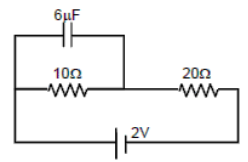
Find the charge on the capacitor shown in figure.
Answer
 Verified
545.7k+ views
Hint: A capacitor is an electrical energy storage system that operates in an electric field. It's a two-terminal passive electronic component. Capacitance is the term used to describe the effect of a capacitor. Although there is some capacitance between any two electrical conductors in close proximity in a circuit, a capacitor is a device that is specifically engineered to add capacitance to a circuit.
Complete step by step answer:
The ability of a part or circuit to collect and retain energy in the form of an electrical charge is known as capacitance. Capacitors are energy-storage devices that come in a variety of shapes and sizes. They are made up of two conductor plates (usually thin metal) sandwiched between an insulator made of ceramic, film, glass, or other materials, like air. The insulator, also known as a dielectric, increases the charging potential of a capacitor. In the aerospace, maritime, and aircraft industries, capacitors are referred to as condensers.
The capacitor has a voltage through it in steady state, but no current passes across the circuit: it behaves like an open circuit. The capacitor is totally charged in steady state and then has limitless resistance to direct current flow. As a result, in a steady state, no current will pass through the capacitor. The circuit's effective resistance.
${{\text{R}}_{eff}} = 10 + 20 = 30\Omega $
The circuit's current flowing
$i = \dfrac{2}{{30}} = \dfrac{1}{{15}}\;{\text{A}}$
The voltage drop over the 10 $\Omega $ resistor
$V = IR$
$\Rightarrow V = \dfrac{1}{{15}} \times 10$
$\Rightarrow V = \dfrac{{10}}{{15}} = \dfrac{2}{3}\;{\text{V}}$
The charge deposited on the capacitor is the same since the potential decreases around the capacitor and the 10$\Omega $ resistor are the same.
$Q = C V$
$\Rightarrow Q = 6 \times {10^{ - 6}} \times \dfrac{2}{3}$
$\therefore Q = 4 \times {10^{ - 6}}{\text{ C}} = 4{\text{ mC}}$
Hence, the charge on the capacitor is $4{\text{ mC}}$.
Note: When matter is put under an electromagnetic field, it acquires an electric charge, which allows it to undergo a force. Positive and negative charges are the two forms of electric charge. Charges that are similar repel each other, while charges that are dissimilar attract each other. Furthermore, the higher the capacitance of the capacitor, the more charge would be driven into it by a given voltage. The formula $q=CV$ describes this relationship, where q is the charge collected, C is the capacitance, and V is the applied voltage.
Complete step by step answer:
The ability of a part or circuit to collect and retain energy in the form of an electrical charge is known as capacitance. Capacitors are energy-storage devices that come in a variety of shapes and sizes. They are made up of two conductor plates (usually thin metal) sandwiched between an insulator made of ceramic, film, glass, or other materials, like air. The insulator, also known as a dielectric, increases the charging potential of a capacitor. In the aerospace, maritime, and aircraft industries, capacitors are referred to as condensers.
The capacitor has a voltage through it in steady state, but no current passes across the circuit: it behaves like an open circuit. The capacitor is totally charged in steady state and then has limitless resistance to direct current flow. As a result, in a steady state, no current will pass through the capacitor. The circuit's effective resistance.
${{\text{R}}_{eff}} = 10 + 20 = 30\Omega $
The circuit's current flowing
$i = \dfrac{2}{{30}} = \dfrac{1}{{15}}\;{\text{A}}$
The voltage drop over the 10 $\Omega $ resistor
$V = IR$
$\Rightarrow V = \dfrac{1}{{15}} \times 10$
$\Rightarrow V = \dfrac{{10}}{{15}} = \dfrac{2}{3}\;{\text{V}}$
The charge deposited on the capacitor is the same since the potential decreases around the capacitor and the 10$\Omega $ resistor are the same.
$Q = C V$
$\Rightarrow Q = 6 \times {10^{ - 6}} \times \dfrac{2}{3}$
$\therefore Q = 4 \times {10^{ - 6}}{\text{ C}} = 4{\text{ mC}}$
Hence, the charge on the capacitor is $4{\text{ mC}}$.
Note: When matter is put under an electromagnetic field, it acquires an electric charge, which allows it to undergo a force. Positive and negative charges are the two forms of electric charge. Charges that are similar repel each other, while charges that are dissimilar attract each other. Furthermore, the higher the capacitance of the capacitor, the more charge would be driven into it by a given voltage. The formula $q=CV$ describes this relationship, where q is the charge collected, C is the capacitance, and V is the applied voltage.
Recently Updated Pages
Master Class 12 Business Studies: Engaging Questions & Answers for Success

Master Class 12 Chemistry: Engaging Questions & Answers for Success
Master Class 12 Biology: Engaging Questions & Answers for Success
Class 12 Question and Answer - Your Ultimate Solutions Guide
Master Class 11 Social Science: Engaging Questions & Answers for Success
Master Class 11 Chemistry: Engaging Questions & Answers for Success
Trending doubts
Which are the Top 10 Largest Countries of the World?
Draw a labelled sketch of the human eye class 12 physics CBSE
Name the crygenes that control cotton bollworm and class 12 biology CBSE
Differentiate between homogeneous and heterogeneous class 12 chemistry CBSE
Ribosomal RNA is actively synthesised in A Nucleoplasm class 12 biology CBSE
How many molecules of ATP and NADPH are required information class 12 biology CBSE