




Find the center of the circle passing through the points $\left( {6, - 6} \right),\left( {3, - 7} \right)$and $\left( {3,3} \right)$.
Answer
 Verified
624.3k+ views
Hint: Name all the coordinates A,B and C. Draw a circle and name its center O. assume the coordinates of the center of the circle O to be $\left( {x,y} \right)$. After doing so, apply the formula by naming the coordinates of the points A,B and C as $\left( {{x_1},{y_1}} \right);\left( {{x_2},{y_2}} \right);\left( {{x_3},{y_3}} \right)$respectively, $\sqrt {{{\left( {x - {x_1}} \right)}^2} + {{\left( {y - {y_1}} \right)}^2}} $.
Complete step-by-step answer:
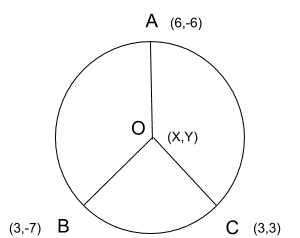
The coordinates given to us by the question are-
$\left( {6, - 6} \right),\left( {3, - 7} \right)$and $\left( {3,3} \right)$
Name the coordinates A, B and C respectively, we get-
$
A = \left( {6, - 6} \right) \\
B = \left( {3, - 7} \right) \\
$
And
$C = \left( {3,3} \right)$
Now, let the center of the circle be O and its coordinates be $\left( {x,y} \right)$
Since O is the center of the circle and the points A, B and C are on its circumference, then by property:
$OA = OB = OC = R$, where R is the radius of the circle.
now,
$
A = \left( {6, - 6} \right) \Rightarrow {x_1} = 6,{y_1} = - 6 \\
B = \left( {3, - 7} \right) \Rightarrow {x_2} = 3,{y_2} = - 7 \\
C = \left( {3,3} \right) \Rightarrow {x_3} = 3,{y_3} = 3 \\
$
Since,
$OA = OB = OC$, then
$
OA = OB \\
OA = OC \\
$
Putting the formula $\sqrt {{{\left( {x - {x_1}} \right)}^2} + {{\left( {y - {y_1}} \right)}^2}} $ into OA, OB, and OC we get:
$
OA = \sqrt {\left( {x - {x_1}} \right) + {{\left( {y - {y_1}} \right)}^2}} = \sqrt {{{\left( {x - 6} \right)}^2} + {{\left( {y + 6} \right)}^2}} \\
\\
OB = \sqrt {{{\left( {x - {x_2}} \right)}^2} + {{\left( {y - {y_2}} \right)}^2}} = \sqrt {{{\left( {x - 3} \right)}^2} + {{\left( {y - 3} \right)}^2}} \\
\\
OC = \sqrt {{{\left( {x - {x_3}} \right)}^2} + {{\left( {y - {y_3}} \right)}^2}} = \sqrt {{{\left( {x - 3} \right)}^2} + {{\left( {y + 7} \right)}^2}} \\
$
Name each equation mentioned above as equation 1, equation 2, and equation 3 respectively,
$OA = \sqrt {\left( {x - {x_1}} \right) + {{\left( {y - {y_1}} \right)}^2}} = \sqrt {{{\left( {x - 6} \right)}^2} + {{\left( {y + 6} \right)}^2}} $ $ \to $ equation 1
$OB = \sqrt {{{\left( {x - {x_2}} \right)}^2} + {{\left( {y - {y_2}} \right)}^2}} = \sqrt {{{\left( {x - 3} \right)}^2} + {{\left( {y - 3} \right)}^2}} $ $ \to $ equation 2
$OC = \sqrt {{{\left( {x - {x_3}} \right)}^2} + {{\left( {y - {y_3}} \right)}^2}} = \sqrt {{{\left( {x - 3} \right)}^2} + {{\left( {y + 7} \right)}^2}} $ $ \to $ equation 3
Now, since we already discussed that $OA = OB = OC = R$ , we will put each equations equal to one another.
By putting $OA = OB$, which means by putting equation 1 and equation 2 equal to each other we get,
$\sqrt {{{\left( {x - 6} \right)}^2} + {{\left( {y + 6} \right)}^2}} = \sqrt {{{\left( {x - 3} \right)}^2} + {{\left( {y - 3} \right)}^2}} $
Squaring both sides, we get-
${x^2} + 36 - 12x + {y^2} + 36 + 12y = {x^2} + 9 - 6x + {y^2} - 6y + 9$
Cancelling ${x^2}$ and ${y^2}$ from both the sides,
$
- 6x + 18y = - 54 \\
\Rightarrow x - 3y = 9 \\
$
Thus, mark the above equation as equation 4
$x - 3y = 9$ $ \to $ equation 4
Similarly, putting $OA = OC$and squaring both sides we get,
${x^2} + 36 - 12x + {y^2} + 12y + 36 = {x^2} + 9 - 6x + {y^2} + 49 + 14y$
$
\Rightarrow - 6x - 2y = - 14 \\
\Rightarrow 3x + y = 7 \\
$
Naming the above equation as equation 5
$3x + y = 7$ $ \to $ equation 5
Now, solve equation 4 and equation 5
Multiply both the sides of equation four by 3 then subtract equation five from equation four and we will get the value of x and y as:
$x = 3,y = - 2$
Hence, the coordinates of the center of the circle are $x = 3,y = - 2$.
Note: While subtracting, multiplying either one of the equations (sometimes both) by a number is necessary in order to make the equation balanced and to get the answer easily. These type of questions are always solved by using the formula $\sqrt {{{\left( {x - {x_1}} \right)}^2} + {{\left( {y - {y_1}} \right)}^2}} $ directly or indirectly.
Complete step-by-step answer:
The coordinates given to us by the question are-
$\left( {6, - 6} \right),\left( {3, - 7} \right)$and $\left( {3,3} \right)$
Name the coordinates A, B and C respectively, we get-
$
A = \left( {6, - 6} \right) \\
B = \left( {3, - 7} \right) \\
$
And
$C = \left( {3,3} \right)$
Now, let the center of the circle be O and its coordinates be $\left( {x,y} \right)$
Since O is the center of the circle and the points A, B and C are on its circumference, then by property:
$OA = OB = OC = R$, where R is the radius of the circle.
now,
$
A = \left( {6, - 6} \right) \Rightarrow {x_1} = 6,{y_1} = - 6 \\
B = \left( {3, - 7} \right) \Rightarrow {x_2} = 3,{y_2} = - 7 \\
C = \left( {3,3} \right) \Rightarrow {x_3} = 3,{y_3} = 3 \\
$
Since,
$OA = OB = OC$, then
$
OA = OB \\
OA = OC \\
$
Putting the formula $\sqrt {{{\left( {x - {x_1}} \right)}^2} + {{\left( {y - {y_1}} \right)}^2}} $ into OA, OB, and OC we get:
$
OA = \sqrt {\left( {x - {x_1}} \right) + {{\left( {y - {y_1}} \right)}^2}} = \sqrt {{{\left( {x - 6} \right)}^2} + {{\left( {y + 6} \right)}^2}} \\
\\
OB = \sqrt {{{\left( {x - {x_2}} \right)}^2} + {{\left( {y - {y_2}} \right)}^2}} = \sqrt {{{\left( {x - 3} \right)}^2} + {{\left( {y - 3} \right)}^2}} \\
\\
OC = \sqrt {{{\left( {x - {x_3}} \right)}^2} + {{\left( {y - {y_3}} \right)}^2}} = \sqrt {{{\left( {x - 3} \right)}^2} + {{\left( {y + 7} \right)}^2}} \\
$
Name each equation mentioned above as equation 1, equation 2, and equation 3 respectively,
$OA = \sqrt {\left( {x - {x_1}} \right) + {{\left( {y - {y_1}} \right)}^2}} = \sqrt {{{\left( {x - 6} \right)}^2} + {{\left( {y + 6} \right)}^2}} $ $ \to $ equation 1
$OB = \sqrt {{{\left( {x - {x_2}} \right)}^2} + {{\left( {y - {y_2}} \right)}^2}} = \sqrt {{{\left( {x - 3} \right)}^2} + {{\left( {y - 3} \right)}^2}} $ $ \to $ equation 2
$OC = \sqrt {{{\left( {x - {x_3}} \right)}^2} + {{\left( {y - {y_3}} \right)}^2}} = \sqrt {{{\left( {x - 3} \right)}^2} + {{\left( {y + 7} \right)}^2}} $ $ \to $ equation 3
Now, since we already discussed that $OA = OB = OC = R$ , we will put each equations equal to one another.
By putting $OA = OB$, which means by putting equation 1 and equation 2 equal to each other we get,
$\sqrt {{{\left( {x - 6} \right)}^2} + {{\left( {y + 6} \right)}^2}} = \sqrt {{{\left( {x - 3} \right)}^2} + {{\left( {y - 3} \right)}^2}} $
Squaring both sides, we get-
${x^2} + 36 - 12x + {y^2} + 36 + 12y = {x^2} + 9 - 6x + {y^2} - 6y + 9$
Cancelling ${x^2}$ and ${y^2}$ from both the sides,
$
- 6x + 18y = - 54 \\
\Rightarrow x - 3y = 9 \\
$
Thus, mark the above equation as equation 4
$x - 3y = 9$ $ \to $ equation 4
Similarly, putting $OA = OC$and squaring both sides we get,
${x^2} + 36 - 12x + {y^2} + 12y + 36 = {x^2} + 9 - 6x + {y^2} + 49 + 14y$
$
\Rightarrow - 6x - 2y = - 14 \\
\Rightarrow 3x + y = 7 \\
$
Naming the above equation as equation 5
$3x + y = 7$ $ \to $ equation 5
Now, solve equation 4 and equation 5
Multiply both the sides of equation four by 3 then subtract equation five from equation four and we will get the value of x and y as:
$x = 3,y = - 2$
Hence, the coordinates of the center of the circle are $x = 3,y = - 2$.
Note: While subtracting, multiplying either one of the equations (sometimes both) by a number is necessary in order to make the equation balanced and to get the answer easily. These type of questions are always solved by using the formula $\sqrt {{{\left( {x - {x_1}} \right)}^2} + {{\left( {y - {y_1}} \right)}^2}} $ directly or indirectly.
Recently Updated Pages
Basicity of sulphurous acid and sulphuric acid are

Master Class 11 Business Studies: Engaging Questions & Answers for Success
Master Class 11 Computer Science: Engaging Questions & Answers for Success
Master Class 11 Economics: Engaging Questions & Answers for Success
Master Class 11 Social Science: Engaging Questions & Answers for Success
Master Class 11 English: Engaging Questions & Answers for Success
Trending doubts
One Metric ton is equal to kg A 10000 B 1000 C 100 class 11 physics CBSE
The largest wind power cluster is located in the state class 11 social science CBSE
Explain zero factorial class 11 maths CBSE
State and prove Bernoullis theorem class 11 physics CBSE
What steps did the French revolutionaries take to create class 11 social science CBSE
Which among the following are examples of coming together class 11 social science CBSE