




Find the center of mass of a uniform solid cone.
Answer
 Verified
628.8k+ views
Hint: The center of a solid body can be calculated by taking a suitable cross section in the body, applying it in the center of mass formula for continuous bodies and integrating it throughout to get the center of mass.
Complete answer:
In this question we are given a solid uniform cone of radius R and height h, we need to find the center of mass from the vertex. We need to use the below diagram to understand the problem.
Let us consider the radius of the base of the cone to be R and height is h.
We will consider a small circular cross section of radius ‘z’ and thickness ‘dr’ from a distance ‘r’ from the vertex of the solid cone.
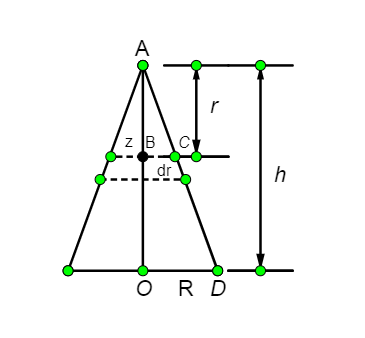
Consider two triangles ABC and AOD. These triangles are similar triangles, so we can write,
$\dfrac{AB}{AO}=\dfrac{BC}{OD}$
This can be expressed as,
$\dfrac{r}{h}=\dfrac{z}{R}$ ……………… (1)
The volume of the small volume element considered is, $dV=\pi {{z}^{2}}dr$, which can be written in terms of r from equation (1). So we get,
$dV=\dfrac{\pi {{R}^{2}}{{r}^{2}}}{{{h}^{2}}}dr$ ……… (2)
Center of mass for continuous mass distribution is given by the formula,
$\begin{align}
& C.M=\dfrac{1}{M}\int{r\rho \dfrac{\pi {{R}^{2}}{{r}^{2}}}{{{h}^{2}}}dr} \\
& \implies C.M=\dfrac{\pi {{R}^{2}}\rho }{M{{h}^{2}}}\int{{{r}^{3}}}dr \\
\end{align}$
The limits of integration are from 0 to h, so
$C.M=\dfrac{\pi {{R}^{2}}\rho }{M{{h}^{2}}}\int\limits_{0}^{h}{{{r}^{3}}}dr$
.
On integrating and applying the limits we get,
$C.M=\dfrac{\pi {{R}^{2}}\rho {{h}^{2}}}{4M}$
Substituting M as$M=\rho V=\dfrac{\rho }{3\pi {{R}^{2}}h}$, we can write
C.M=$\dfrac{3h}{4}$
Note:
The distance of the center of mass from point O is $\dfrac{h}{4}$.
The center of mass of the cone will always lie on its axis due to symmetry.
The center of mass of a distribution of mass in space (sometimes referred to as the balance point) is the unique point where the weighted relative position of the distributed mass sums to zero. This is the point at which a force may be applied to cause a linear acceleration without an angular acceleration.
Complete answer:
In this question we are given a solid uniform cone of radius R and height h, we need to find the center of mass from the vertex. We need to use the below diagram to understand the problem.
Let us consider the radius of the base of the cone to be R and height is h.
We will consider a small circular cross section of radius ‘z’ and thickness ‘dr’ from a distance ‘r’ from the vertex of the solid cone.
Consider two triangles ABC and AOD. These triangles are similar triangles, so we can write,
$\dfrac{AB}{AO}=\dfrac{BC}{OD}$
This can be expressed as,
$\dfrac{r}{h}=\dfrac{z}{R}$ ……………… (1)
The volume of the small volume element considered is, $dV=\pi {{z}^{2}}dr$, which can be written in terms of r from equation (1). So we get,
$dV=\dfrac{\pi {{R}^{2}}{{r}^{2}}}{{{h}^{2}}}dr$ ……… (2)
Center of mass for continuous mass distribution is given by the formula,
$\begin{align}
& C.M=\dfrac{1}{M}\int{r\rho \dfrac{\pi {{R}^{2}}{{r}^{2}}}{{{h}^{2}}}dr} \\
& \implies C.M=\dfrac{\pi {{R}^{2}}\rho }{M{{h}^{2}}}\int{{{r}^{3}}}dr \\
\end{align}$
The limits of integration are from 0 to h, so
$C.M=\dfrac{\pi {{R}^{2}}\rho }{M{{h}^{2}}}\int\limits_{0}^{h}{{{r}^{3}}}dr$
.
On integrating and applying the limits we get,
$C.M=\dfrac{\pi {{R}^{2}}\rho {{h}^{2}}}{4M}$
Substituting M as$M=\rho V=\dfrac{\rho }{3\pi {{R}^{2}}h}$, we can write
C.M=$\dfrac{3h}{4}$
Note:
The distance of the center of mass from point O is $\dfrac{h}{4}$.
The center of mass of the cone will always lie on its axis due to symmetry.
The center of mass of a distribution of mass in space (sometimes referred to as the balance point) is the unique point where the weighted relative position of the distributed mass sums to zero. This is the point at which a force may be applied to cause a linear acceleration without an angular acceleration.
Recently Updated Pages
Master Class 11 English: Engaging Questions & Answers for Success

Master Class 11 Social Science: Engaging Questions & Answers for Success
Master Class 11 Maths: Engaging Questions & Answers for Success
Master Class 11 Biology: Engaging Questions & Answers for Success
Master Class 11 Physics: Engaging Questions & Answers for Success
Master Class 11 Chemistry: Engaging Questions & Answers for Success
Trending doubts
One Metric ton is equal to kg A 10000 B 1000 C 100 class 11 physics CBSE
Difference Between Prokaryotic Cells and Eukaryotic Cells
Two of the body parts which do not appear in MRI are class 11 biology CBSE
Find the value of the expression given below sin 30circ class 11 maths CBSE
Draw a diagram of a plant cell and label at least eight class 11 biology CBSE
10 examples of friction in our daily life