




Find the area of the region bounded by the parabola ${{y}^{2}}=4x$, the x-axis and the lines x=1 and x=4.
Answer
 Verified
615.9k+ views
Hint: Plot the curve on the graph. Observe that the required area is the area in the first quadrant. For finding the area of the curve in the first quadrant express y in terms of x. Note that y>0 and hence take only the positive sign. Then use the fact that the area under the curve is given by $\int_{a}^{b}{ydx}$. Substitute suitable values of a and b and integrate and hence find the area.
Complete step-by-step answer:
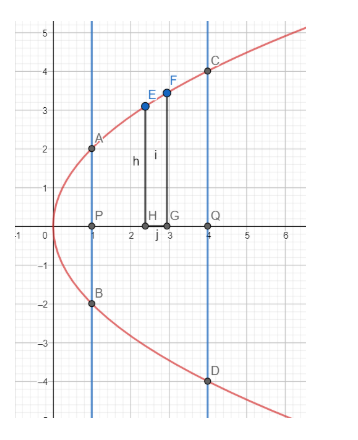
As is evident from the graph, the required area is the area in the first quadrant.
Now, we have ${{y}^{2}}=4x\Rightarrow y=\pm 2\sqrt{x}$
Since in the first quadrant, y is positive, we have $y=2\sqrt{x}$
Now consider the strip EFGH
We have EH = y and GH = dx
Hence the area of the strip is ydx.
The area in the first quadrant is the sum of the areas of the strips from P to Q.
Hence, we have
The area in the first quadrant $=\int_{1}^{4}{ydx}$
Substituting the value of y, we get
The area in the first quadrant $=\int_{1}^{4}{2\sqrt{x}dx}$
Let $I=\int_{1}^{4}{2\sqrt{x}dx}$
Now, we know that $\int_{a}^{b}{kf\left( x \right)dx}=k\int_{a}^{b}{f\left( x \right)dx}$
Hence, we have
$I=2\int_{1}^{4}{\sqrt{x}dx}$
Now, we know that $\int{{{x}^{n}}dx=\dfrac{{{x}^{n+1}}}{n+1},n\ne -1}$
Hence, we have
$I=2\left( \left. \dfrac{{{x}^{\dfrac{1}{2}+1}}}{\dfrac{1}{2}+1} \right|_{1}^{4} \right)=\left. \dfrac{4\times {{x}^{\dfrac{3}{2}}}}{3} \right|_{1}^{4}=4\times \left( \dfrac{{{4}^{\dfrac{3}{2}}}}{3}-\dfrac{{{1}^{\dfrac{3}{2}}}}{3} \right)=\dfrac{28}{3}$
Hence the area in the first quadrant is $\dfrac{28}{3}$ square units
Hence the area bounded by the curve ${{y}^{2}}=4x$, the x-axis and the ordinates x=1 and x= 4 is $\dfrac{28}{3}$ square units.
Note: Alternative solution:
Instead of taking vertical strips, we can take horizontal strips as shown
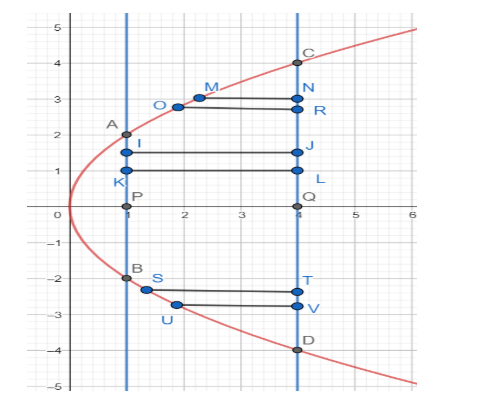
There are two types of horizontal strips
[1] MNRO (Lower bounded by $x=\dfrac{{{y}^{2}}}{4}$ and upper bounded by x=4)
[2] IJLK (Lower bounded by x=1 and upper bounded by x=4).
Area of the strip from C to A is $\left( 4-\dfrac{{{y}^{2}}}{4} \right)dy$
Area of the strip from A to P is $\left( 4-1 \right)dy$
Now, we have $A\equiv \left( 1,2 \right),B\equiv \left( 1,-2 \right),C\equiv \left( 4,4 \right)$ and $D\equiv \left( 4,-4 \right)$
Hence, we have
\[\begin{align}
& A=\int_{0}^{2}{\left( 4-1 \right)dy}+\int_{2}^{4}{\left( 4-\dfrac{{{y}^{2}}}{4} \right)dy} \\
& =6+8-\dfrac{56}{12}=14-\dfrac{14}{3}=\dfrac{28}{3} \\
\end{align}\]
Hence the total area $=\dfrac{28}{3}$ square units, which is the same as obtained above.
Complete step-by-step answer:
As is evident from the graph, the required area is the area in the first quadrant.
Now, we have ${{y}^{2}}=4x\Rightarrow y=\pm 2\sqrt{x}$
Since in the first quadrant, y is positive, we have $y=2\sqrt{x}$
Now consider the strip EFGH
We have EH = y and GH = dx
Hence the area of the strip is ydx.
The area in the first quadrant is the sum of the areas of the strips from P to Q.
Hence, we have
The area in the first quadrant $=\int_{1}^{4}{ydx}$
Substituting the value of y, we get
The area in the first quadrant $=\int_{1}^{4}{2\sqrt{x}dx}$
Let $I=\int_{1}^{4}{2\sqrt{x}dx}$
Now, we know that $\int_{a}^{b}{kf\left( x \right)dx}=k\int_{a}^{b}{f\left( x \right)dx}$
Hence, we have
$I=2\int_{1}^{4}{\sqrt{x}dx}$
Now, we know that $\int{{{x}^{n}}dx=\dfrac{{{x}^{n+1}}}{n+1},n\ne -1}$
Hence, we have
$I=2\left( \left. \dfrac{{{x}^{\dfrac{1}{2}+1}}}{\dfrac{1}{2}+1} \right|_{1}^{4} \right)=\left. \dfrac{4\times {{x}^{\dfrac{3}{2}}}}{3} \right|_{1}^{4}=4\times \left( \dfrac{{{4}^{\dfrac{3}{2}}}}{3}-\dfrac{{{1}^{\dfrac{3}{2}}}}{3} \right)=\dfrac{28}{3}$
Hence the area in the first quadrant is $\dfrac{28}{3}$ square units
Hence the area bounded by the curve ${{y}^{2}}=4x$, the x-axis and the ordinates x=1 and x= 4 is $\dfrac{28}{3}$ square units.
Note: Alternative solution:
Instead of taking vertical strips, we can take horizontal strips as shown
There are two types of horizontal strips
[1] MNRO (Lower bounded by $x=\dfrac{{{y}^{2}}}{4}$ and upper bounded by x=4)
[2] IJLK (Lower bounded by x=1 and upper bounded by x=4).
Area of the strip from C to A is $\left( 4-\dfrac{{{y}^{2}}}{4} \right)dy$
Area of the strip from A to P is $\left( 4-1 \right)dy$
Now, we have $A\equiv \left( 1,2 \right),B\equiv \left( 1,-2 \right),C\equiv \left( 4,4 \right)$ and $D\equiv \left( 4,-4 \right)$
Hence, we have
\[\begin{align}
& A=\int_{0}^{2}{\left( 4-1 \right)dy}+\int_{2}^{4}{\left( 4-\dfrac{{{y}^{2}}}{4} \right)dy} \\
& =6+8-\dfrac{56}{12}=14-\dfrac{14}{3}=\dfrac{28}{3} \\
\end{align}\]
Hence the total area $=\dfrac{28}{3}$ square units, which is the same as obtained above.
Recently Updated Pages
Basicity of sulphurous acid and sulphuric acid are

Master Class 12 English: Engaging Questions & Answers for Success
Master Class 12 Social Science: Engaging Questions & Answers for Success
Master Class 12 Maths: Engaging Questions & Answers for Success
Master Class 12 Economics: Engaging Questions & Answers for Success
Master Class 12 Physics: Engaging Questions & Answers for Success
Trending doubts
Which are the Top 10 Largest Countries of the World?
Draw a labelled sketch of the human eye class 12 physics CBSE
Draw ray diagrams each showing i myopic eye and ii class 12 physics CBSE
Organisms of a higher trophic level which feed on several class 12 biology CBSE
Give 10 examples of unisexual and bisexual flowers
Give simple chemical tests to distinguish between the class 12 chemistry CBSE