




Find the area of the greatest of isosceles triangles that can be inscribed in a given ellipse having its vertex coincide with one end of the major axis?
Answer
 Verified
627k+ views
Hint: Consider the general equation of the ellipse. Draw the triangle inscribed in an ellipse, as the ellipse is symmetrical the 2 opposite vertices will have similar coordinates. Thus find the area of the triangle, differentiate the obtained equation, take \[z={{A}^{2}}\].
Complete step-by-step answer:
Let us consider the general equation of ellipse is,
\[\dfrac{{{x}^{2}}}{{{a}^{2}}}+\dfrac{{{y}^{2}}}{{{b}^{2}}}=1\]
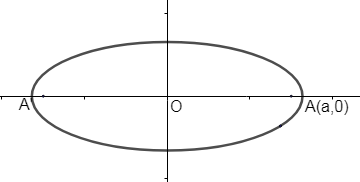
The major axis of the ellipse is AA’, which is along the x-axis. We know that the length of the major axis = 2a.
\[\therefore AA'=2a\].
Thus from the figure, we can say that OA’ = OA = a.
Hence we can form the coordinates of A as (a, 0).
An isosceles triangle inscribed in the ellipse it in the ellipse its vertex at one end of the major axis. Let \[\Delta PAP'\] be an isosceles triangle.
Thus the coordinates of P can be taken as (h, k) and coordinates of P’ (h, -k) as the ellipse is symmetric.
We need to find the greatest area of the triangle.
Let A be the area of the isosceles triangle \[\Delta PAP'\].
We know the area of the isosceles triangle \[\Delta PAP'\].
We know the area of the triangle = \[\dfrac{1}{2}\times \] base \[\times \] height.
\[A=\dfrac{1}{2}\times PP'\times AM\], (From the figure)
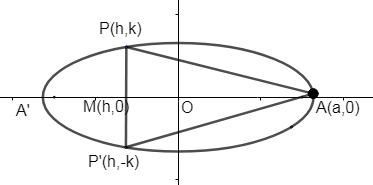
Let us consider a point M which lies on the x-axis. Thus the coordinates of M are (h, 0) as it lies on the x-axis.
Since point (h, k) lie on the ellipse.
\[\therefore \] (h, k) will satisfy the equation of ellipse.
Let us put x = h and y = k in the equation of ellipse.
\[\dfrac{{{x}^{2}}}{{{a}^{2}}}+\dfrac{{{y}^{2}}}{{{b}^{2}}}=1\]
\[\therefore \dfrac{{{\left( h \right)}^{2}}}{{{a}^{2}}}+\dfrac{{{\left( k \right)}^{2}}}{{{b}^{2}}}=1\]
By simplifying the expression,
\[\Rightarrow \dfrac{{{h}^{2}}{{b}^{2}}+{{k}^{2}}{{a}^{2}}}{{{a}^{2}}{{b}^{2}}}=1\]
Cross multiply the above,
\[\begin{align}
& {{h}^{2}}{{b}^{2}}+{{k}^{2}}{{a}^{2}}={{a}^{2}}{{b}^{2}} \\
& \therefore {{a}^{2}}{{k}^{2}}={{a}^{2}}{{b}^{2}}-{{b}^{2}}{{h}^{2}} \\
\end{align}\]
\[{{k}^{2}}=\dfrac{{{a}^{2}}{{b}^{2}}-{{b}^{2}}{{h}^{2}}}{{{a}^{2}}}\]
\[\therefore k=\sqrt{\dfrac{{{a}^{2}}{{b}^{2}}-{{b}^{2}}{{h}^{2}}}{{{a}^{2}}}}=\dfrac{1}{a}\sqrt{{{\left( ab \right)}^{2}}-{{\left( bh \right)}^{2}}}-(1)\]
We know the values, P (h, k), P’ (h, -k), A (a, 0) and M (h, 0).
Now let us find PP’.
We can use the distance formula to find the distance which is given by
\[\begin{align}
& \sqrt{{{\left( {{x}_{2}}-{{x}_{1}} \right)}^{2}}+{{\left( {{y}_{2}}-{{y}_{1}} \right)}^{2}}} \\
& \therefore PP'=\sqrt{{{\left( h-h \right)}^{2}}+{{\left( -k-k \right)}^{2}}}=\sqrt{0+{{\left( -2k \right)}^{2}}}=\sqrt{4{{k}^{2}}} \\
& \therefore PP'=2k \\
\end{align}\]
Similarly let us find AM using distance formula.
\[\begin{align}
& AM=\sqrt{{{\left( a-h \right)}^{2}}+{{\left( 0-0 \right)}^{2}}} \\
& AM=\sqrt{{{\left( a-h \right)}^{2}}} \\
& AM=a-h \\
\end{align}\]
Thus we found the area of the triangle as, \[A=\dfrac{1}{2}\times PP'\times AM\].
\[\therefore A=\dfrac{1}{2}\times \left( a-h \right)\times 2k=\left( a-h \right)k\]
From equation (1), substitute the value of k to the above expression,
\[A=\dfrac{\left( a-h \right)}{a}\sqrt{{{\left( ab \right)}^{2}}-{{\left( bh \right)}^{2}}}\]
Let us consider, \[z={{A}^{2}}\].
\[\begin{align}
& \therefore z={{\left[ \left( \dfrac{a-h}{a} \right)\sqrt{{{\left( ab \right)}^{2}}-{{\left( bh \right)}^{2}}} \right]}^{2}} \\
& z=\dfrac{{{\left( a-h \right)}^{2}}}{{{a}^{2}}}\left[ {{\left( ab \right)}^{2}}-{{\left( bh \right)}^{2}} \right] \\
\end{align}\]
\[z=\dfrac{{{\left( a-h \right)}^{2}}}{{{a}^{2}}}\times {{b}^{2}}\left[ {{a}^{2}}-{{h}^{2}} \right]\]
\[z={{\left( \dfrac{b}{a} \right)}^{2}}{{\left( a-h \right)}^{2}}\left( {{a}^{2}}-{{h}^{2}} \right)\]
Now let us differentiate the above expression with respect to h.
\[\begin{align}
& \dfrac{dz}{dh}=\dfrac{d}{dh}\left[ {{\left( \dfrac{b}{a} \right)}^{2}}{{\left( a-h \right)}^{2}}\left( {{a}^{2}}-{{h}^{2}} \right) \right] \\
& \dfrac{dz}{dh}={{\left( \dfrac{b}{a} \right)}^{2}}\dfrac{d}{dh}\left[ {{\left( a-h \right)}^{2}}\left( {{a}^{2}}-{{h}^{2}} \right) \right] \\
\end{align}\]
Now let us use the product rule, as
\[uv=u'v+v'u\]
\[\begin{align}
& \dfrac{dz}{dh}={{\left( \dfrac{b}{a} \right)}^{2}}\left[ \dfrac{d}{dh}{{\left( a-h \right)}^{2}}.\left( {{a}^{2}}-{{h}^{2}} \right)+\dfrac{d}{dh}\left( {{a}^{2}}-{{h}^{2}} \right).{{\left( a-h \right)}^{2}} \right] \\
& \dfrac{dz}{dh}={{\left( \dfrac{b}{a} \right)}^{2}}\left[ 2\left( a-h \right)\left( -1 \right)\left( {{a}^{2}}-{{h}^{2}} \right)+\left( 0-2h \right){{\left( a-h \right)}^{2}} \right] \\
& \dfrac{dz}{dh}={{\left( \dfrac{b}{a} \right)}^{2}}\left[ -2\left( a-h \right)\left( {{a}^{2}}-{{h}^{2}} \right)-2h{{\left( a-h \right)}^{2}} \right] \\
& \dfrac{dz}{dh}={{\left( \dfrac{b}{a} \right)}^{2}}\left( -2 \right)\left( a-h \right)\left[ {{a}^{2}}-{{h}^{2}}+ha-{{h}^{2}} \right] \\
& \dfrac{dz}{dh}=-2{{\left( \dfrac{b}{a} \right)}^{2}}\left( a-h \right)\left[ {{a}^{2}}+ha-2{{h}^{2}} \right] \\
\end{align}\]
Let us put, \[\dfrac{dz}{dh}=0\].
\[\begin{align}
& -2{{\left( \dfrac{b}{a} \right)}^{2}}\left( a-h \right)\left[ {{a}^{2}}+ha-2{{h}^{2}} \right]=0 \\
& \therefore \left( a-h \right)\left( {{a}^{2}}+ah-2{{h}^{2}} \right)=0 \\
\end{align}\]
From the above expression, we know that
\[a-h=0\] and \[{{a}^{2}}+ah-2{{h}^{2}}=0\]
Thus by solving, \[a-h=0\], we get, a = h.
\[{{a}^{2}}+ah-2{{h}^{2}}=0\], add and subtract ah in this expression.
\[\begin{align}
& {{a}^{2}}+ah-2{{h}^{2}}+ah-ah=0 \\
& {{a}^{2}}+2ah-2{{h}^{2}}-ah=0 \\
& {{a}^{2}}+2ah-ah-2{{h}^{2}}=0 \\
& a\left( a+2h \right)-h\left( a+2h \right)=0 \\
& \left( a-h \right)\left( a+2h \right)=0 \\
\end{align}\]
\[\therefore a-h=0\] and \[a+2h=0\].
\[\therefore h=a\] and \[h=\dfrac{-a}{2}\].
Thus we get h = a and \[h=\dfrac{-a}{2}\].
If h = a,
\[\therefore k=\dfrac{1}{a}\sqrt{{{\left( ab \right)}^{2}}-{{\left( bh \right)}^{2}}}\]
\[k=\dfrac{1}{a}\sqrt{{{\left( ab \right)}^{2}}-{{\left( bh \right)}^{2}}}=0\], but this is not possible.
So, let us find \[\dfrac{{{d}^{2}}z}{d{{h}^{2}}}\], w.r.t ‘h’.
\[\begin{align}
& \dfrac{dz}{dh}=-2{{\left( \dfrac{b}{a} \right)}^{2}}\left[ \left( a-h \right)\left( {{a}^{2}}+ah-2{{h}^{2}} \right) \right] \\
& \dfrac{{{d}^{2}}z}{d{{h}^{2}}}=-2{{\left( \dfrac{b}{a} \right)}^{2}}\dfrac{d}{dh}\left[ \left( a-h \right)\left( {{a}^{2}}+ah-2{{h}^{2}} \right) \right] \\
\end{align}\]
Use the product rule to solve, \[uv=u'v+v'u\].
\[\begin{align}
& \dfrac{{{d}^{2}}z}{d{{h}^{2}}}=-2{{\left( \dfrac{b}{a} \right)}^{2}}\left[ \dfrac{d}{dh}\left( a-h \right)\left( {{a}^{2}}+ah-2{{h}^{2}} \right)+\dfrac{d}{dh}\left( {{a}^{2}}+ah-2{{h}^{2}} \right)\left( a-h \right) \right] \\
& \dfrac{{{d}^{2}}z}{d{{h}^{2}}}=-2{{\left( \dfrac{b}{a} \right)}^{2}}\left[ \left( -1 \right)\left( {{a}^{2}}+ah-2{{h}^{2}} \right)+\left( a-4h \right)\left( a-h \right) \right] \\
& \dfrac{{{d}^{2}}z}{d{{h}^{2}}}=-2{{\left( \dfrac{b}{a} \right)}^{2}}\left[ -{{a}^{2}}-ah+2{{h}^{2}}+{{a}^{2}}-ah-4ah+4{{h}^{2}} \right] \\
\end{align}\]
Open the brackets and simplify the expression,
\[\dfrac{{{d}^{2}}z}{d{{h}^{2}}}=-2{{\left( \dfrac{b}{a} \right)}^{2}}\left[ -2ah-4ah+6{{h}^{2}} \right]\]
Now let us put, \[h=\dfrac{-a}{2}\].
\[\begin{align}
& \dfrac{{{d}^{2}}z}{d{{h}^{2}}}=-2{{\left( \dfrac{b}{a} \right)}^{2}}\left[ -2a\left( \dfrac{-a}{2} \right)-4a\left( \dfrac{-a}{2} \right)+6{{\left( \dfrac{-a}{2} \right)}^{2}} \right] \\
& \dfrac{{{d}^{2}}z}{d{{h}^{2}}}=-2{{\left( \dfrac{b}{a} \right)}^{2}}\left[ {{a}^{2}}+2{{a}^{2}}+\dfrac{3}{2}{{a}^{2}} \right] \\
& \dfrac{{{d}^{2}}z}{d{{h}^{2}}}=-2{{\left( \dfrac{b}{a} \right)}^{2}}\left[ \dfrac{9{{a}^{2}}}{2} \right]=-2{{\left( \dfrac{b}{a} \right)}^{2}}\left( \dfrac{9{{a}^{2}}}{2} \right) \\
& \dfrac{{{d}^{2}}z}{d{{h}^{2}}}=-9{{b}^{2}}<0 \\
\end{align}\]
\[\dfrac{{{d}^{2}}z}{d{{h}^{2}}}<0\] at \[h=\dfrac{-a}{2}\].
Therefore z is maximum when, \[h=\dfrac{-a}{2}\].
Thus the area will be maximum when, \[h=\dfrac{-a}{2}\].
Let us put \[h=\dfrac{-a}{2}\], in equation (1).
\[\begin{align}
& k=\dfrac{1}{a}\sqrt{{{\left( ab \right)}^{2}}-{{\left( bh \right)}^{2}}} \\
& k=\dfrac{1}{a}\sqrt{{{\left( ab \right)}^{2}}-{{b}^{2}}{{\left( \dfrac{-a}{2} \right)}^{2}}} \\
& k=\dfrac{1}{a}\sqrt{{{\left( ab \right)}^{2}}-\dfrac{{{a}^{2}}{{b}^{2}}}{4}}=\dfrac{ab}{a}\sqrt{1-\dfrac{1}{4}} \\
& k=b\sqrt{\dfrac{4-1}{4}}=\dfrac{b\sqrt{3}}{2} \\
\end{align}\]
Hence, we have \[h=\dfrac{-a}{2}\] and \[k=\dfrac{b\sqrt{3}}{2}\].
We need to find the maximum value of Area.
\[\begin{align}
& A=\dfrac{1}{2}\times \left( a-h \right)\left( 2k \right) \\
& A=\dfrac{1}{2}\left( a-\left( \dfrac{-a}{2} \right) \right)\times 2\left( \dfrac{b\sqrt{3}}{2} \right) \\
& A=\dfrac{1}{2}\left( a+\dfrac{a}{2} \right)b\sqrt{3} \\
& A=\dfrac{1}{2}\left( \dfrac{3a}{2} \right)b\sqrt{3} \\
& A=\dfrac{3\sqrt{3}ab}{4} \\
\end{align}\]
Hence, we got the maximum area \[=\dfrac{3\sqrt{3}ab}{4}\].
Note: We did differentiation two times in \[\dfrac{dz}{dh}\], we got the value of k as zero. If k was not zero than \[\dfrac{{{d}^{2}}z}{d{{h}^{2}}}\] is not required to get the value of k. thus find the coordinates (h, k) and find the area. Here \[\dfrac{{{d}^{2}}z}{d{{h}^{2}}}\] should be less than zero.
Complete step-by-step answer:
Let us consider the general equation of ellipse is,
\[\dfrac{{{x}^{2}}}{{{a}^{2}}}+\dfrac{{{y}^{2}}}{{{b}^{2}}}=1\]
The major axis of the ellipse is AA’, which is along the x-axis. We know that the length of the major axis = 2a.
\[\therefore AA'=2a\].
Thus from the figure, we can say that OA’ = OA = a.
Hence we can form the coordinates of A as (a, 0).
An isosceles triangle inscribed in the ellipse it in the ellipse its vertex at one end of the major axis. Let \[\Delta PAP'\] be an isosceles triangle.
Thus the coordinates of P can be taken as (h, k) and coordinates of P’ (h, -k) as the ellipse is symmetric.
We need to find the greatest area of the triangle.
Let A be the area of the isosceles triangle \[\Delta PAP'\].
We know the area of the isosceles triangle \[\Delta PAP'\].
We know the area of the triangle = \[\dfrac{1}{2}\times \] base \[\times \] height.
\[A=\dfrac{1}{2}\times PP'\times AM\], (From the figure)
Let us consider a point M which lies on the x-axis. Thus the coordinates of M are (h, 0) as it lies on the x-axis.
Since point (h, k) lie on the ellipse.
\[\therefore \] (h, k) will satisfy the equation of ellipse.
Let us put x = h and y = k in the equation of ellipse.
\[\dfrac{{{x}^{2}}}{{{a}^{2}}}+\dfrac{{{y}^{2}}}{{{b}^{2}}}=1\]
\[\therefore \dfrac{{{\left( h \right)}^{2}}}{{{a}^{2}}}+\dfrac{{{\left( k \right)}^{2}}}{{{b}^{2}}}=1\]
By simplifying the expression,
\[\Rightarrow \dfrac{{{h}^{2}}{{b}^{2}}+{{k}^{2}}{{a}^{2}}}{{{a}^{2}}{{b}^{2}}}=1\]
Cross multiply the above,
\[\begin{align}
& {{h}^{2}}{{b}^{2}}+{{k}^{2}}{{a}^{2}}={{a}^{2}}{{b}^{2}} \\
& \therefore {{a}^{2}}{{k}^{2}}={{a}^{2}}{{b}^{2}}-{{b}^{2}}{{h}^{2}} \\
\end{align}\]
\[{{k}^{2}}=\dfrac{{{a}^{2}}{{b}^{2}}-{{b}^{2}}{{h}^{2}}}{{{a}^{2}}}\]
\[\therefore k=\sqrt{\dfrac{{{a}^{2}}{{b}^{2}}-{{b}^{2}}{{h}^{2}}}{{{a}^{2}}}}=\dfrac{1}{a}\sqrt{{{\left( ab \right)}^{2}}-{{\left( bh \right)}^{2}}}-(1)\]
We know the values, P (h, k), P’ (h, -k), A (a, 0) and M (h, 0).
Now let us find PP’.
We can use the distance formula to find the distance which is given by
\[\begin{align}
& \sqrt{{{\left( {{x}_{2}}-{{x}_{1}} \right)}^{2}}+{{\left( {{y}_{2}}-{{y}_{1}} \right)}^{2}}} \\
& \therefore PP'=\sqrt{{{\left( h-h \right)}^{2}}+{{\left( -k-k \right)}^{2}}}=\sqrt{0+{{\left( -2k \right)}^{2}}}=\sqrt{4{{k}^{2}}} \\
& \therefore PP'=2k \\
\end{align}\]
Similarly let us find AM using distance formula.
\[\begin{align}
& AM=\sqrt{{{\left( a-h \right)}^{2}}+{{\left( 0-0 \right)}^{2}}} \\
& AM=\sqrt{{{\left( a-h \right)}^{2}}} \\
& AM=a-h \\
\end{align}\]
Thus we found the area of the triangle as, \[A=\dfrac{1}{2}\times PP'\times AM\].
\[\therefore A=\dfrac{1}{2}\times \left( a-h \right)\times 2k=\left( a-h \right)k\]
From equation (1), substitute the value of k to the above expression,
\[A=\dfrac{\left( a-h \right)}{a}\sqrt{{{\left( ab \right)}^{2}}-{{\left( bh \right)}^{2}}}\]
Let us consider, \[z={{A}^{2}}\].
\[\begin{align}
& \therefore z={{\left[ \left( \dfrac{a-h}{a} \right)\sqrt{{{\left( ab \right)}^{2}}-{{\left( bh \right)}^{2}}} \right]}^{2}} \\
& z=\dfrac{{{\left( a-h \right)}^{2}}}{{{a}^{2}}}\left[ {{\left( ab \right)}^{2}}-{{\left( bh \right)}^{2}} \right] \\
\end{align}\]
\[z=\dfrac{{{\left( a-h \right)}^{2}}}{{{a}^{2}}}\times {{b}^{2}}\left[ {{a}^{2}}-{{h}^{2}} \right]\]
\[z={{\left( \dfrac{b}{a} \right)}^{2}}{{\left( a-h \right)}^{2}}\left( {{a}^{2}}-{{h}^{2}} \right)\]
Now let us differentiate the above expression with respect to h.
\[\begin{align}
& \dfrac{dz}{dh}=\dfrac{d}{dh}\left[ {{\left( \dfrac{b}{a} \right)}^{2}}{{\left( a-h \right)}^{2}}\left( {{a}^{2}}-{{h}^{2}} \right) \right] \\
& \dfrac{dz}{dh}={{\left( \dfrac{b}{a} \right)}^{2}}\dfrac{d}{dh}\left[ {{\left( a-h \right)}^{2}}\left( {{a}^{2}}-{{h}^{2}} \right) \right] \\
\end{align}\]
Now let us use the product rule, as
\[uv=u'v+v'u\]
\[\begin{align}
& \dfrac{dz}{dh}={{\left( \dfrac{b}{a} \right)}^{2}}\left[ \dfrac{d}{dh}{{\left( a-h \right)}^{2}}.\left( {{a}^{2}}-{{h}^{2}} \right)+\dfrac{d}{dh}\left( {{a}^{2}}-{{h}^{2}} \right).{{\left( a-h \right)}^{2}} \right] \\
& \dfrac{dz}{dh}={{\left( \dfrac{b}{a} \right)}^{2}}\left[ 2\left( a-h \right)\left( -1 \right)\left( {{a}^{2}}-{{h}^{2}} \right)+\left( 0-2h \right){{\left( a-h \right)}^{2}} \right] \\
& \dfrac{dz}{dh}={{\left( \dfrac{b}{a} \right)}^{2}}\left[ -2\left( a-h \right)\left( {{a}^{2}}-{{h}^{2}} \right)-2h{{\left( a-h \right)}^{2}} \right] \\
& \dfrac{dz}{dh}={{\left( \dfrac{b}{a} \right)}^{2}}\left( -2 \right)\left( a-h \right)\left[ {{a}^{2}}-{{h}^{2}}+ha-{{h}^{2}} \right] \\
& \dfrac{dz}{dh}=-2{{\left( \dfrac{b}{a} \right)}^{2}}\left( a-h \right)\left[ {{a}^{2}}+ha-2{{h}^{2}} \right] \\
\end{align}\]
Let us put, \[\dfrac{dz}{dh}=0\].
\[\begin{align}
& -2{{\left( \dfrac{b}{a} \right)}^{2}}\left( a-h \right)\left[ {{a}^{2}}+ha-2{{h}^{2}} \right]=0 \\
& \therefore \left( a-h \right)\left( {{a}^{2}}+ah-2{{h}^{2}} \right)=0 \\
\end{align}\]
From the above expression, we know that
\[a-h=0\] and \[{{a}^{2}}+ah-2{{h}^{2}}=0\]
Thus by solving, \[a-h=0\], we get, a = h.
\[{{a}^{2}}+ah-2{{h}^{2}}=0\], add and subtract ah in this expression.
\[\begin{align}
& {{a}^{2}}+ah-2{{h}^{2}}+ah-ah=0 \\
& {{a}^{2}}+2ah-2{{h}^{2}}-ah=0 \\
& {{a}^{2}}+2ah-ah-2{{h}^{2}}=0 \\
& a\left( a+2h \right)-h\left( a+2h \right)=0 \\
& \left( a-h \right)\left( a+2h \right)=0 \\
\end{align}\]
\[\therefore a-h=0\] and \[a+2h=0\].
\[\therefore h=a\] and \[h=\dfrac{-a}{2}\].
Thus we get h = a and \[h=\dfrac{-a}{2}\].
If h = a,
\[\therefore k=\dfrac{1}{a}\sqrt{{{\left( ab \right)}^{2}}-{{\left( bh \right)}^{2}}}\]
\[k=\dfrac{1}{a}\sqrt{{{\left( ab \right)}^{2}}-{{\left( bh \right)}^{2}}}=0\], but this is not possible.
So, let us find \[\dfrac{{{d}^{2}}z}{d{{h}^{2}}}\], w.r.t ‘h’.
\[\begin{align}
& \dfrac{dz}{dh}=-2{{\left( \dfrac{b}{a} \right)}^{2}}\left[ \left( a-h \right)\left( {{a}^{2}}+ah-2{{h}^{2}} \right) \right] \\
& \dfrac{{{d}^{2}}z}{d{{h}^{2}}}=-2{{\left( \dfrac{b}{a} \right)}^{2}}\dfrac{d}{dh}\left[ \left( a-h \right)\left( {{a}^{2}}+ah-2{{h}^{2}} \right) \right] \\
\end{align}\]
Use the product rule to solve, \[uv=u'v+v'u\].
\[\begin{align}
& \dfrac{{{d}^{2}}z}{d{{h}^{2}}}=-2{{\left( \dfrac{b}{a} \right)}^{2}}\left[ \dfrac{d}{dh}\left( a-h \right)\left( {{a}^{2}}+ah-2{{h}^{2}} \right)+\dfrac{d}{dh}\left( {{a}^{2}}+ah-2{{h}^{2}} \right)\left( a-h \right) \right] \\
& \dfrac{{{d}^{2}}z}{d{{h}^{2}}}=-2{{\left( \dfrac{b}{a} \right)}^{2}}\left[ \left( -1 \right)\left( {{a}^{2}}+ah-2{{h}^{2}} \right)+\left( a-4h \right)\left( a-h \right) \right] \\
& \dfrac{{{d}^{2}}z}{d{{h}^{2}}}=-2{{\left( \dfrac{b}{a} \right)}^{2}}\left[ -{{a}^{2}}-ah+2{{h}^{2}}+{{a}^{2}}-ah-4ah+4{{h}^{2}} \right] \\
\end{align}\]
Open the brackets and simplify the expression,
\[\dfrac{{{d}^{2}}z}{d{{h}^{2}}}=-2{{\left( \dfrac{b}{a} \right)}^{2}}\left[ -2ah-4ah+6{{h}^{2}} \right]\]
Now let us put, \[h=\dfrac{-a}{2}\].
\[\begin{align}
& \dfrac{{{d}^{2}}z}{d{{h}^{2}}}=-2{{\left( \dfrac{b}{a} \right)}^{2}}\left[ -2a\left( \dfrac{-a}{2} \right)-4a\left( \dfrac{-a}{2} \right)+6{{\left( \dfrac{-a}{2} \right)}^{2}} \right] \\
& \dfrac{{{d}^{2}}z}{d{{h}^{2}}}=-2{{\left( \dfrac{b}{a} \right)}^{2}}\left[ {{a}^{2}}+2{{a}^{2}}+\dfrac{3}{2}{{a}^{2}} \right] \\
& \dfrac{{{d}^{2}}z}{d{{h}^{2}}}=-2{{\left( \dfrac{b}{a} \right)}^{2}}\left[ \dfrac{9{{a}^{2}}}{2} \right]=-2{{\left( \dfrac{b}{a} \right)}^{2}}\left( \dfrac{9{{a}^{2}}}{2} \right) \\
& \dfrac{{{d}^{2}}z}{d{{h}^{2}}}=-9{{b}^{2}}<0 \\
\end{align}\]
\[\dfrac{{{d}^{2}}z}{d{{h}^{2}}}<0\] at \[h=\dfrac{-a}{2}\].
Therefore z is maximum when, \[h=\dfrac{-a}{2}\].
Thus the area will be maximum when, \[h=\dfrac{-a}{2}\].
Let us put \[h=\dfrac{-a}{2}\], in equation (1).
\[\begin{align}
& k=\dfrac{1}{a}\sqrt{{{\left( ab \right)}^{2}}-{{\left( bh \right)}^{2}}} \\
& k=\dfrac{1}{a}\sqrt{{{\left( ab \right)}^{2}}-{{b}^{2}}{{\left( \dfrac{-a}{2} \right)}^{2}}} \\
& k=\dfrac{1}{a}\sqrt{{{\left( ab \right)}^{2}}-\dfrac{{{a}^{2}}{{b}^{2}}}{4}}=\dfrac{ab}{a}\sqrt{1-\dfrac{1}{4}} \\
& k=b\sqrt{\dfrac{4-1}{4}}=\dfrac{b\sqrt{3}}{2} \\
\end{align}\]
Hence, we have \[h=\dfrac{-a}{2}\] and \[k=\dfrac{b\sqrt{3}}{2}\].
We need to find the maximum value of Area.
\[\begin{align}
& A=\dfrac{1}{2}\times \left( a-h \right)\left( 2k \right) \\
& A=\dfrac{1}{2}\left( a-\left( \dfrac{-a}{2} \right) \right)\times 2\left( \dfrac{b\sqrt{3}}{2} \right) \\
& A=\dfrac{1}{2}\left( a+\dfrac{a}{2} \right)b\sqrt{3} \\
& A=\dfrac{1}{2}\left( \dfrac{3a}{2} \right)b\sqrt{3} \\
& A=\dfrac{3\sqrt{3}ab}{4} \\
\end{align}\]
Hence, we got the maximum area \[=\dfrac{3\sqrt{3}ab}{4}\].
Note: We did differentiation two times in \[\dfrac{dz}{dh}\], we got the value of k as zero. If k was not zero than \[\dfrac{{{d}^{2}}z}{d{{h}^{2}}}\] is not required to get the value of k. thus find the coordinates (h, k) and find the area. Here \[\dfrac{{{d}^{2}}z}{d{{h}^{2}}}\] should be less than zero.
Recently Updated Pages
Basicity of sulphurous acid and sulphuric acid are

Master Class 11 Business Studies: Engaging Questions & Answers for Success
Master Class 11 Computer Science: Engaging Questions & Answers for Success
Master Class 11 Economics: Engaging Questions & Answers for Success
Master Class 11 Social Science: Engaging Questions & Answers for Success
Master Class 11 English: Engaging Questions & Answers for Success
Trending doubts
One Metric ton is equal to kg A 10000 B 1000 C 100 class 11 physics CBSE
The largest wind power cluster is located in the state class 11 social science CBSE
Explain zero factorial class 11 maths CBSE
State and prove Bernoullis theorem class 11 physics CBSE
What steps did the French revolutionaries take to create class 11 social science CBSE
Which among the following are examples of coming together class 11 social science CBSE