




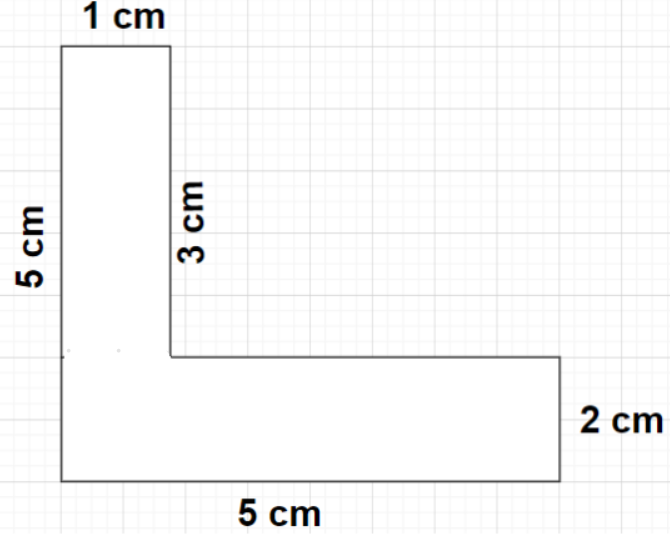
Find the area of the following figure.
Answer
 Verified
654.6k+ views
Hint: Here, we will proceed by naming the points required in the given figure and we will join two points in order to convert the L-shaped given figure into two rectangles. Then, use the formula i.e., Area of rectangle = (Length of rectangle)$ \times $(Breadth of rectangle).
Complete step-by-step answer:
The given figure can be divided into two rectangles by joining the points A and E by a straight line after every point is named as shown in the second figure drawn.
Here, BG = 5 cm, EF = AG = 3 cm, AB = BG – AG = 5 – 3 = 2 cm, BC = AD = 5 cm, CD = 2 cm, GF = AE = 1 cm
As we know that area of any rectangle is given by
Area of rectangle = (Length of rectangle)$ \times $(Breadth of rectangle) $ \to (1)$
Using the formula given by equation (1), we can write
Area of rectangle ABCD = (BC)$ \times $(AB) = $5 \times 2 = 10{\text{ c}}{{\text{m}}^2}$
Again using the formula given by equation (1), we can write
Area of rectangle AEFG = (AE)$ \times $(AG) = $1 \times 3 = 3{\text{ c}}{{\text{m}}^2}$
Area of the complete figure = Area of rectangle ABCD + Area of rectangle AEFG
$ \Rightarrow $Area of the complete figure = 10+3 = 13 ${\text{c}}{{\text{m}}^2}$
Therefore, the area of the given figure is 13 sq. centimetres.
Note: In this particular problem, instead of joining points A and E we can also draw a line segment from point E to the line BC such that this line segment is perpendicular to line BC and name that meeting point as H. This will also result in dividing the given L-shaped figure into two rectangles i.e., rectangle HCDE and rectangle GBHF.
Complete step-by-step answer:
The given figure can be divided into two rectangles by joining the points A and E by a straight line after every point is named as shown in the second figure drawn.
Here, BG = 5 cm, EF = AG = 3 cm, AB = BG – AG = 5 – 3 = 2 cm, BC = AD = 5 cm, CD = 2 cm, GF = AE = 1 cm
As we know that area of any rectangle is given by
Area of rectangle = (Length of rectangle)$ \times $(Breadth of rectangle) $ \to (1)$
Using the formula given by equation (1), we can write
Area of rectangle ABCD = (BC)$ \times $(AB) = $5 \times 2 = 10{\text{ c}}{{\text{m}}^2}$
Again using the formula given by equation (1), we can write
Area of rectangle AEFG = (AE)$ \times $(AG) = $1 \times 3 = 3{\text{ c}}{{\text{m}}^2}$
Area of the complete figure = Area of rectangle ABCD + Area of rectangle AEFG
$ \Rightarrow $Area of the complete figure = 10+3 = 13 ${\text{c}}{{\text{m}}^2}$
Therefore, the area of the given figure is 13 sq. centimetres.
Note: In this particular problem, instead of joining points A and E we can also draw a line segment from point E to the line BC such that this line segment is perpendicular to line BC and name that meeting point as H. This will also result in dividing the given L-shaped figure into two rectangles i.e., rectangle HCDE and rectangle GBHF.
Recently Updated Pages
Master Class 11 English: Engaging Questions & Answers for Success

Master Class 11 Social Science: Engaging Questions & Answers for Success
Master Class 11 Maths: Engaging Questions & Answers for Success
Master Class 11 Biology: Engaging Questions & Answers for Success
Master Class 11 Physics: Engaging Questions & Answers for Success
Master Class 11 Chemistry: Engaging Questions & Answers for Success
Trending doubts
Explain the Treaty of Vienna of 1815 class 10 social science CBSE
What is the Total Duration of Football Match?
First Cotton Mill of India
In which year voting age was reduced from 21 to 18?
10 examples of evaporation in daily life with explanations
What planets have no moons Which one has only one moon class 10 physics CBSE