




How do you find the area of a Parallelogram without the height?
Answer
 Verified
594k+ views
Hint: Here, we will use the Trigonometric Ratio of sine to find the height of the triangle, and by using the area of the triangle we will find the area of the congruent triangle in a Parallelogram. By using the area of the congruent triangles, we will find the area of the Parallelogram.
Formula Used:
We will use the following formula:
1. Area of a triangle is given by the formula \[ = \dfrac{1}{2}b \times h\] sq. units
2. Trigonometric Ratio: \[\sin \theta = \dfrac{{{\rm{Opp}}}}{{{\rm{Hyp}}}}\]
Complete Step by Step Solution:
We will find the area of the Parallelogram without the height.
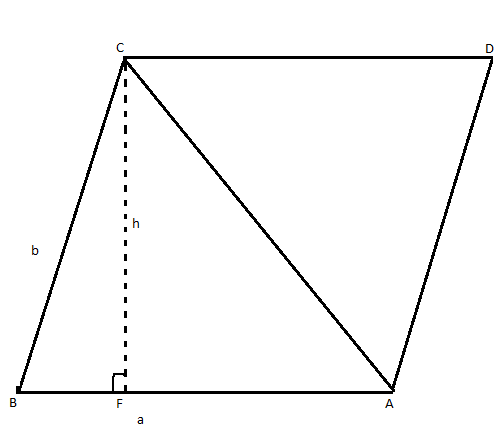
Let ABCD be a Parallelogram. Let \[AB = a;BC = b;\] be the sides of the Parallelogram and\[h\] be the height of the Parallelogram.
We are given that the height is unknown. Now, we will find the height of the Parallelogram by using the Area of the Triangle.
Now, we will find the height of the parallelogram by using the area of the triangles.
Trigonometric Ratio: \[\sin \theta = \dfrac{{Opp}}{{Hyp}}\]
Now, by using trigonometric ratio in the right angle triangle, we get
\[\sin B = \dfrac{{CF}}{{BC}}\]
By substituting the known values, we get
\[ \Rightarrow \sin B = \dfrac{h}{b}\]
Multiplying \[b\] on both sides, we get
\[ \Rightarrow h = b\sin B\]
Substituting the height and base in the area of the triangle, we get
Area of the Triangle \[ = \dfrac{1}{2} \times a \times b\sin B\]sq. units
We know that the diagonal of a Parallelogram divides the Parallelogram into two congruent triangles. Thus, the Area of the Parallelogram is twice the area of the triangle. Thus, we get
\[ \Rightarrow \] Area of the Parallelogram \[ = 2 \times \] Area of the Triangle sq. units
Now, by substituting the area of the triangle, we get
\[ \Rightarrow \] Area of the Parallelogram \[ = 2 \times \dfrac{1}{2} \times a \times b\sin B\] sq. units
Multiplying the terms, we get
\[ \Rightarrow \] Area of the Parallelogram \[ = a \times b\sin B\] sq. units
Therefore, the area of the Parallelogram is \[ab\sin B\] sq. units when the height is unknown.
Note:
We know that the Area of a Parallelogram is the region occupied by a Parallelogram in a two- dimensional Plane. We can also find the area of the Parallelogram by using the area of the Parallelogram even though height is not unknown.
We know that Area of a Parallelogram \[ = bh\] sq. units
Substituting the height and base in the area of the triangle, we get
\[ \Rightarrow \] Area of a Parallelogram \[ = ab\sin B\] sq. units
Therefore, the area of the Parallelogram is \[ab\sin B\] sq. units when the height is unknown.
Formula Used:
We will use the following formula:
1. Area of a triangle is given by the formula \[ = \dfrac{1}{2}b \times h\] sq. units
2. Trigonometric Ratio: \[\sin \theta = \dfrac{{{\rm{Opp}}}}{{{\rm{Hyp}}}}\]
Complete Step by Step Solution:
We will find the area of the Parallelogram without the height.
Let ABCD be a Parallelogram. Let \[AB = a;BC = b;\] be the sides of the Parallelogram and\[h\] be the height of the Parallelogram.
We are given that the height is unknown. Now, we will find the height of the Parallelogram by using the Area of the Triangle.
Now, we will find the height of the parallelogram by using the area of the triangles.
Trigonometric Ratio: \[\sin \theta = \dfrac{{Opp}}{{Hyp}}\]
Now, by using trigonometric ratio in the right angle triangle, we get
\[\sin B = \dfrac{{CF}}{{BC}}\]
By substituting the known values, we get
\[ \Rightarrow \sin B = \dfrac{h}{b}\]
Multiplying \[b\] on both sides, we get
\[ \Rightarrow h = b\sin B\]
Substituting the height and base in the area of the triangle, we get
Area of the Triangle \[ = \dfrac{1}{2} \times a \times b\sin B\]sq. units
We know that the diagonal of a Parallelogram divides the Parallelogram into two congruent triangles. Thus, the Area of the Parallelogram is twice the area of the triangle. Thus, we get
\[ \Rightarrow \] Area of the Parallelogram \[ = 2 \times \] Area of the Triangle sq. units
Now, by substituting the area of the triangle, we get
\[ \Rightarrow \] Area of the Parallelogram \[ = 2 \times \dfrac{1}{2} \times a \times b\sin B\] sq. units
Multiplying the terms, we get
\[ \Rightarrow \] Area of the Parallelogram \[ = a \times b\sin B\] sq. units
Therefore, the area of the Parallelogram is \[ab\sin B\] sq. units when the height is unknown.
Note:
We know that the Area of a Parallelogram is the region occupied by a Parallelogram in a two- dimensional Plane. We can also find the area of the Parallelogram by using the area of the Parallelogram even though height is not unknown.
We know that Area of a Parallelogram \[ = bh\] sq. units
Substituting the height and base in the area of the triangle, we get
\[ \Rightarrow \] Area of a Parallelogram \[ = ab\sin B\] sq. units
Therefore, the area of the Parallelogram is \[ab\sin B\] sq. units when the height is unknown.
Recently Updated Pages
Master Class 11 English: Engaging Questions & Answers for Success

Master Class 11 Social Science: Engaging Questions & Answers for Success
Master Class 11 Maths: Engaging Questions & Answers for Success
Master Class 11 Biology: Engaging Questions & Answers for Success
Master Class 11 Physics: Engaging Questions & Answers for Success
Master Class 11 Chemistry: Engaging Questions & Answers for Success
Trending doubts
Define Potential, Developed, Stock and Reserved resources
Identify the plural form of the word child from the class 10 english CBSE
Draw a circuit diagram showing the cell switch and class 10 physics CBSE
Draw a labelled diagram of the excretory system of class 10 biology CBSE
Write a letter to the newspaper editor highlighting class 10 english CBSE
Fill the blanks with proper collective nouns 1 A of class 10 english CBSE