




Find tension in the thread as shown in diagram.
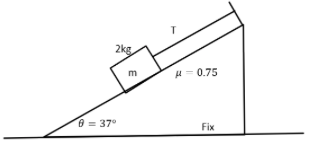
A) $12\,N$
B) $4\,N$
C) $0\,N$
D) $16\,N$
Answer
 Verified
590.1k+ views
Hint:You can solve this question by first taking the components of the weight of the box or object which is on the slope, then finding the friction acting and then finding the difference between friction and the component of weight acting along the slope as the Tension of the string.
Complete step by step answer:
We will be proceeding with the solution exactly as told in the hint section of the solution to the question.
Firstly, let us assume the acceleration due to gravity as $10\,m{s^{ - 2}}$ to make our calculations easier.
Now, let’s find the weight of the block:
$W = mg = 2 \times 10 = 20\,N$
As the mass of the box is given as $2\,kg$
Now, we know that there are two components of the weight acting, one along the slope and another normal to the slope, which can be given as:
${W_{al}} = W\sin \theta $ (along the slope)
${W_n} = W\cos \theta $ (along the normal to the surface)
We know that
$
\cos {37^ \circ } = \dfrac{4}{5} \\
\sin {37^ \circ } = \dfrac{3}{5} \\
$
So, we substituting in the values, we get:
$
{W_{al}} = 12\,N \\
{W_n} = 16\,N \\
$
We already know the formula of finding out the friction acting between a surface and an object as:
$f = {F_n} \times \mu $
We have already found out the value of the force acting along the normal to the surface, and the value of $\mu $ is given in the question as $0.75$
So, $f = 16 \times 0.75 = 12\,N$
Now, to find the net force acting on the box along the slope, we must add friction acting and the component of weight along the slope:
${F_{net}} = {W_{al}} + f$
We can clearly observe that the friction is acting upwards while the weight is acting downwards the slope, so:
$
{F_{net}} = 12 + \left( { - 12} \right) \\
{F_{net}} = 0\,N \\
$
Since there is not net force acting on the box after the consideration of friction and weight, there is no need for tension in the string, that is:
$T = 0$
So, option (C) is the correct answer.
Note:Many students take the wrong components of weight along the slope and normal to the surface of the slope, and thus, get wrong results for the values of friction, and thus, tension in the string.
Complete step by step answer:
We will be proceeding with the solution exactly as told in the hint section of the solution to the question.
Firstly, let us assume the acceleration due to gravity as $10\,m{s^{ - 2}}$ to make our calculations easier.
Now, let’s find the weight of the block:
$W = mg = 2 \times 10 = 20\,N$
As the mass of the box is given as $2\,kg$
Now, we know that there are two components of the weight acting, one along the slope and another normal to the slope, which can be given as:
${W_{al}} = W\sin \theta $ (along the slope)
${W_n} = W\cos \theta $ (along the normal to the surface)
We know that
$
\cos {37^ \circ } = \dfrac{4}{5} \\
\sin {37^ \circ } = \dfrac{3}{5} \\
$
So, we substituting in the values, we get:
$
{W_{al}} = 12\,N \\
{W_n} = 16\,N \\
$
We already know the formula of finding out the friction acting between a surface and an object as:
$f = {F_n} \times \mu $
We have already found out the value of the force acting along the normal to the surface, and the value of $\mu $ is given in the question as $0.75$
So, $f = 16 \times 0.75 = 12\,N$
Now, to find the net force acting on the box along the slope, we must add friction acting and the component of weight along the slope:
${F_{net}} = {W_{al}} + f$
We can clearly observe that the friction is acting upwards while the weight is acting downwards the slope, so:
$
{F_{net}} = 12 + \left( { - 12} \right) \\
{F_{net}} = 0\,N \\
$
Since there is not net force acting on the box after the consideration of friction and weight, there is no need for tension in the string, that is:
$T = 0$
So, option (C) is the correct answer.
Note:Many students take the wrong components of weight along the slope and normal to the surface of the slope, and thus, get wrong results for the values of friction, and thus, tension in the string.
Recently Updated Pages
Basicity of sulphurous acid and sulphuric acid are

Master Class 11 Business Studies: Engaging Questions & Answers for Success
Master Class 11 Computer Science: Engaging Questions & Answers for Success
Master Class 11 Economics: Engaging Questions & Answers for Success
Master Class 11 Social Science: Engaging Questions & Answers for Success
Master Class 11 English: Engaging Questions & Answers for Success
Trending doubts
One Metric ton is equal to kg A 10000 B 1000 C 100 class 11 physics CBSE
The largest wind power cluster is located in the state class 11 social science CBSE
Explain zero factorial class 11 maths CBSE
State and prove Bernoullis theorem class 11 physics CBSE
What steps did the French revolutionaries take to create class 11 social science CBSE
Which among the following are examples of coming together class 11 social science CBSE