




How do you find $\sin \left( \dfrac{-pi}{2} \right)$ ?
Answer
 Verified
597k+ views
Hint: Using trigonometric functions, we have to apply the trigonometric ratios for the particular angle and find its value. We should know about the trigonometric ratios for different angles. Also, we should know about the even and odd functions. In this question, particularly sine function is used.
Complete step by step answer:
Basic trigonometric functions are:
$\Rightarrow $ Sine (sin)
$\Rightarrow $Cosine (cos)
$\Rightarrow $Tangent (tan)
When we say $\sin \theta $, here $\theta $ means angle in degrees.
Derived functions are:
$\Rightarrow $cosec$\theta $ = $\dfrac{1}{\sin \theta }$
$\Rightarrow $sec$\theta $ = $\dfrac{1}{\cos \theta }$
$\Rightarrow $tan$\theta $ = $\dfrac{\sin \theta }{\cos \theta }$ = $\dfrac{1}{\cot \theta }$
$\Rightarrow $cot$\theta $ = $\dfrac{1}{\tan \theta }$ = $\dfrac{\cos \theta }{\sin \theta }$
You know what is sin$\theta $? Let’s find out.
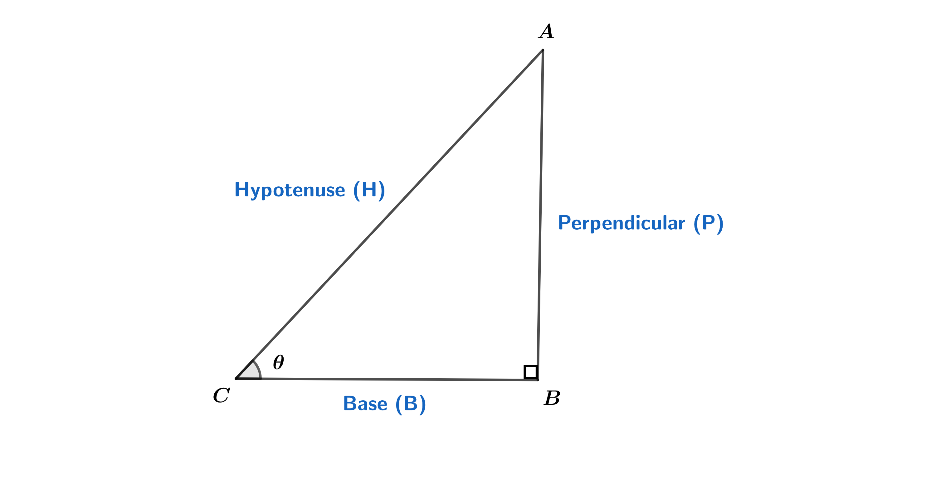
So, from figure, sin$\theta $ = $\dfrac{perpendicular(P)}{hypotenuse(H)}$
Now, let’s see some even and odd functions.
$\Rightarrow $sin(-x) = -sinx
$\Rightarrow $ cos(-x) = cosx
$\Rightarrow $ tan(-x) = -tanx
$\Rightarrow $ cot(-x) = -cotx
$\Rightarrow $ cosec(-x) = -cosecx
$\Rightarrow $sec(-x) = secx
Now, let’s make a table of trigonometric ratios for basic trigonometric functions i.e. sin, cos, tan, cot, sec and cosec.
So, from the trigonometric ratio table, we can see that the value of sin$\theta $ at ${{90}^{\circ }}$is 1.
As we can see in the table, values are given in degrees, but we need the value in radians.
So let’s convert ${{90}^{\circ }}$ to radians.
If we talk about a circle, so 1 revolution about a circle in degrees is ${{360}^{\circ }}$but in radians, it is $2\pi $ radians. So, they both are equal.
$\Rightarrow {{360}^{\circ }}=2\pi $radians
Now, let’s divide $2\pi $ by ${{360}^{\circ }}$:
$\Rightarrow 1=\dfrac{2\pi }{{{360}^{\circ }}}$
$\Rightarrow 1=\dfrac{\pi }{{{180}^{\circ }}}$
Basically, now we will plug in the angle we want to convert units with. So we will multiply with ${{90}^{\circ }}$.
$\Rightarrow \dfrac{\pi }{{{180}^{\circ }}}\times {{90}^{\circ }}$
After cancellation we will get:
$\dfrac{\pi }{2}$ rad
Now, we can say if $\sin \dfrac{\pi }{2}=1$ from the table, then $\sin \left( \dfrac{-\pi }{2} \right)=-1$ by using the even and odd function here:
$\Rightarrow $sin(-x) = -sinx
So, the final answer is: $\sin \left( \dfrac{-\pi }{2} \right)=-1$.
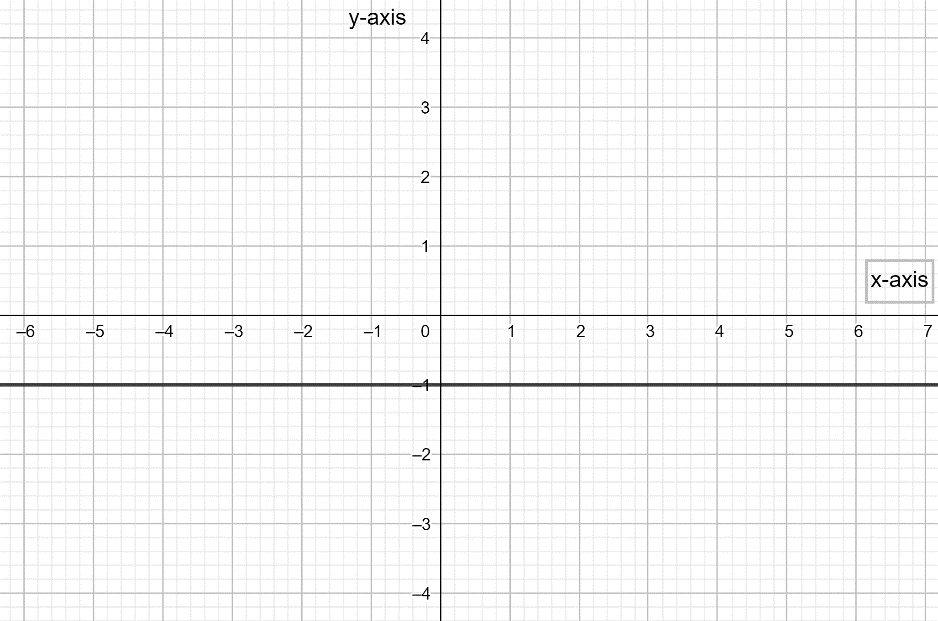
This is the graph of $\sin \left( \dfrac{-\pi }{2} \right)=-1$.
Note: Students must know the conversion of degrees to radians. You should remember all the functions and trigonometric ratios before solving any question related to trigonometry. Formula for conversion of degrees to radians is:
Radians = degrees$\times \dfrac{\pi }{{{180}^{\circ }}}$
Complete step by step answer:
Basic trigonometric functions are:
$\Rightarrow $ Sine (sin)
$\Rightarrow $Cosine (cos)
$\Rightarrow $Tangent (tan)
When we say $\sin \theta $, here $\theta $ means angle in degrees.
Derived functions are:
$\Rightarrow $cosec$\theta $ = $\dfrac{1}{\sin \theta }$
$\Rightarrow $sec$\theta $ = $\dfrac{1}{\cos \theta }$
$\Rightarrow $tan$\theta $ = $\dfrac{\sin \theta }{\cos \theta }$ = $\dfrac{1}{\cot \theta }$
$\Rightarrow $cot$\theta $ = $\dfrac{1}{\tan \theta }$ = $\dfrac{\cos \theta }{\sin \theta }$
You know what is sin$\theta $? Let’s find out.
So, from figure, sin$\theta $ = $\dfrac{perpendicular(P)}{hypotenuse(H)}$
Now, let’s see some even and odd functions.
$\Rightarrow $sin(-x) = -sinx
$\Rightarrow $ cos(-x) = cosx
$\Rightarrow $ tan(-x) = -tanx
$\Rightarrow $ cot(-x) = -cotx
$\Rightarrow $ cosec(-x) = -cosecx
$\Rightarrow $sec(-x) = secx
Now, let’s make a table of trigonometric ratios for basic trigonometric functions i.e. sin, cos, tan, cot, sec and cosec.
| Trigonometric ratios(angle $\theta $ in degrees) | ${{0}^{\circ }}$ | ${{30}^{\circ }}$ | ${{45}^{\circ }}$ | ${{60}^{\circ }}$ | ${{90}^{\circ }}$ |
| sin$\theta $ | 0 | $\dfrac{1}{2}$ | $\dfrac{1}{\sqrt{2}}$ | $\dfrac{\sqrt{3}}{2}$ | 1 |
| cos$\theta $ | 1 | $\dfrac{\sqrt{3}}{2}$ | $\dfrac{1}{\sqrt{2}}$ | $\dfrac{1}{2}$ | 0 |
| tan$\theta $ | 0 | $\dfrac{1}{\sqrt{3}}$ | 1 | $\sqrt{3}$ | $\infty $ |
| cosec$\theta $ | $\infty $ | 2 | $\sqrt{2}$ | $\dfrac{2}{\sqrt{3}}$ | 1 |
| sec$\theta $ | 1 | $\dfrac{2}{\sqrt{3}}$ | $\sqrt{2}$ | 2 | $\infty $ |
| cot$\theta $ | $\infty $ | $\sqrt{3}$ | 1 | $\dfrac{1}{\sqrt{3}}$ | 0 |
So, from the trigonometric ratio table, we can see that the value of sin$\theta $ at ${{90}^{\circ }}$is 1.
As we can see in the table, values are given in degrees, but we need the value in radians.
So let’s convert ${{90}^{\circ }}$ to radians.
If we talk about a circle, so 1 revolution about a circle in degrees is ${{360}^{\circ }}$but in radians, it is $2\pi $ radians. So, they both are equal.
$\Rightarrow {{360}^{\circ }}=2\pi $radians
Now, let’s divide $2\pi $ by ${{360}^{\circ }}$:
$\Rightarrow 1=\dfrac{2\pi }{{{360}^{\circ }}}$
$\Rightarrow 1=\dfrac{\pi }{{{180}^{\circ }}}$
Basically, now we will plug in the angle we want to convert units with. So we will multiply with ${{90}^{\circ }}$.
$\Rightarrow \dfrac{\pi }{{{180}^{\circ }}}\times {{90}^{\circ }}$
After cancellation we will get:
$\dfrac{\pi }{2}$ rad
Now, we can say if $\sin \dfrac{\pi }{2}=1$ from the table, then $\sin \left( \dfrac{-\pi }{2} \right)=-1$ by using the even and odd function here:
$\Rightarrow $sin(-x) = -sinx
So, the final answer is: $\sin \left( \dfrac{-\pi }{2} \right)=-1$.
This is the graph of $\sin \left( \dfrac{-\pi }{2} \right)=-1$.
Note: Students must know the conversion of degrees to radians. You should remember all the functions and trigonometric ratios before solving any question related to trigonometry. Formula for conversion of degrees to radians is:
Radians = degrees$\times \dfrac{\pi }{{{180}^{\circ }}}$
Recently Updated Pages
Master Class 12 Economics: Engaging Questions & Answers for Success

Master Class 12 English: Engaging Questions & Answers for Success
Master Class 12 Social Science: Engaging Questions & Answers for Success
Master Class 12 Maths: Engaging Questions & Answers for Success
Master Class 12 Physics: Engaging Questions & Answers for Success
Master Class 9 General Knowledge: Engaging Questions & Answers for Success
Trending doubts
Explain the Treaty of Vienna of 1815 class 10 social science CBSE
Why is it 530 pm in india when it is 1200 afternoon class 10 social science CBSE
What is the full form of POSCO class 10 social science CBSE
Define Potential, Developed, Stock and Reserved resources
Which Country Has the Largest Border with India?
Complete the sentence with the most appropriate word class 10 english CBSE