




Find out how many AU are there in a parsec.
Answer
 Verified
561.3k+ views
Hint: In this question we need to convert parsec into AU. Both parsec and AU (astronomical unit) are units of length and are used to measure large distances e.g. distances between stars and planets are measured in these units. For this conversion we will use the simple unitary method.
Formula used:
$\tan \theta = \dfrac{{perpendicular}}{{base}}$
$1\operatorname{arcsec} = {(\dfrac{1}{{3600}})^o} \times \dfrac{\pi }{{{{180}^o}}}$
Complete step by step answer:
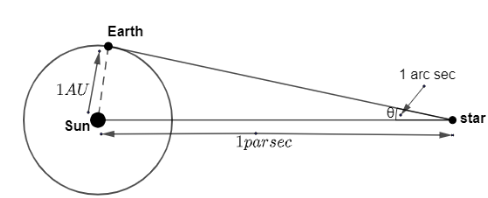
Parsec is defined as the distance at which the radius of orbit of Earth subtends a parallax angle of one arc second and one arc second is $\dfrac{1}{{3600}}$ of a degree.We will convert the degree to radians as ${1^o} = \dfrac{\pi }{{{{180}^o}}}$.An Astronomical Unit (AU) is defined as the distance of Earth from the Sun. However, the actual distance between the Earth and the Sun varies when Earth goes from aphelion to perihelion. Because of this variation, the Astronomical Unit is defined to be equal to \[149,597,870,700\;\] m.
Now, from the diagram, we can say that $\tan \theta = \dfrac{{1AU}}{{1par\sec }}$.As the distance between the Sun and star is very large as compared to the distance between the Sun and the Earth. So, we can approximate $\tan \theta \simeq \theta $ and $\theta $ here is equal to one arc second.
$1\operatorname{arcsec} = \dfrac{{1AU}}{{1par\sec }}$
$\Rightarrow {(\dfrac{1}{{3600}})^o} \times \dfrac{\pi }{{{{180}^o}}} = \dfrac{{1AU}}{{1par\sec }} \\
\therefore 1par\sec = \dfrac{{648,000}}{\pi }AU \\ $
Hence, one parsec corresponds to $\dfrac{{648,000}}{\pi }$ astronomical units.
Note: The word Parsec is derived from the words ‘parallax’ and ‘arc second’. The astronomical unit is mainly used to assess distances within the Solar System or between stars whereas parsec is used to quantify distances beyond the solar system. In light years, parsec is nearly equal to \[3.26\] light years and astronomical units are approximately equal to $8$ light minutes.
Formula used:
$\tan \theta = \dfrac{{perpendicular}}{{base}}$
$1\operatorname{arcsec} = {(\dfrac{1}{{3600}})^o} \times \dfrac{\pi }{{{{180}^o}}}$
Complete step by step answer:
Parsec is defined as the distance at which the radius of orbit of Earth subtends a parallax angle of one arc second and one arc second is $\dfrac{1}{{3600}}$ of a degree.We will convert the degree to radians as ${1^o} = \dfrac{\pi }{{{{180}^o}}}$.An Astronomical Unit (AU) is defined as the distance of Earth from the Sun. However, the actual distance between the Earth and the Sun varies when Earth goes from aphelion to perihelion. Because of this variation, the Astronomical Unit is defined to be equal to \[149,597,870,700\;\] m.
Now, from the diagram, we can say that $\tan \theta = \dfrac{{1AU}}{{1par\sec }}$.As the distance between the Sun and star is very large as compared to the distance between the Sun and the Earth. So, we can approximate $\tan \theta \simeq \theta $ and $\theta $ here is equal to one arc second.
$1\operatorname{arcsec} = \dfrac{{1AU}}{{1par\sec }}$
$\Rightarrow {(\dfrac{1}{{3600}})^o} \times \dfrac{\pi }{{{{180}^o}}} = \dfrac{{1AU}}{{1par\sec }} \\
\therefore 1par\sec = \dfrac{{648,000}}{\pi }AU \\ $
Hence, one parsec corresponds to $\dfrac{{648,000}}{\pi }$ astronomical units.
Note: The word Parsec is derived from the words ‘parallax’ and ‘arc second’. The astronomical unit is mainly used to assess distances within the Solar System or between stars whereas parsec is used to quantify distances beyond the solar system. In light years, parsec is nearly equal to \[3.26\] light years and astronomical units are approximately equal to $8$ light minutes.
Recently Updated Pages
Master Class 11 English: Engaging Questions & Answers for Success

Master Class 11 Social Science: Engaging Questions & Answers for Success
Master Class 11 Maths: Engaging Questions & Answers for Success
Master Class 11 Biology: Engaging Questions & Answers for Success
Master Class 11 Physics: Engaging Questions & Answers for Success
Master Class 11 Chemistry: Engaging Questions & Answers for Success
Trending doubts
One Metric ton is equal to kg A 10000 B 1000 C 100 class 11 physics CBSE
Difference Between Prokaryotic Cells and Eukaryotic Cells
Find the value of the expression given below sin 30circ class 11 maths CBSE
1 ton equals to A 100 kg B 1000 kg C 10 kg D 10000 class 11 physics CBSE
Two of the body parts which do not appear in MRI are class 11 biology CBSE
What are hard magnetic materials class 11 physics CBSE