




Find number of solutions of the equation $ \sin x={{x}^{2}}+x+1 $ .
Answer
 Verified
645.9k+ views
Hint: To solve the question given above, we will first find out the range of the function $ f\left( x \right)={{x}^{2}}+x+1 $ . To find the range, we will find out its maximum value and minimum value as infinite and for an equation $ a{{x}^{2}}+bx+c=0\ as\ -\left( \dfrac{{{b}^{2}}-4ac}{4a} \right) $ . Then, we will find out at what x, $ f\left( x \right) $ us minimum using $ x=\dfrac{-b}{2a} $ . Then, at that value of x, we will check whether the $ \sin x $ is more than the minimum value of $ f\left( x \right) $ or not. On this basis, we will determine how many solutions are there for the above equations.
Complete step-by-step answer:
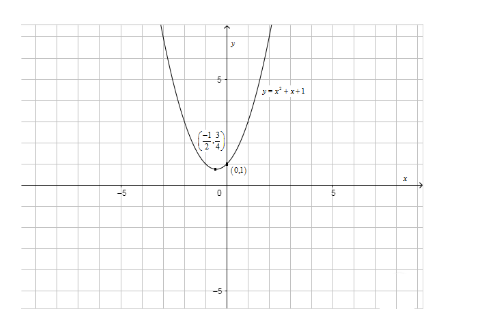
To start with, we will first find out the range of the function $ f\left( x \right)={{x}^{2}}+x+1 $ . Now, to find the range of $ f\left( x \right) $ we will find its maximum value and minimum value. We can clearly see that the maximum value of $ f\left( x \right) $ will be infinite. Now, we know that the minimum value of the equation $ a{{x}^{2}}+bx+c=0\ as\ -\left( \dfrac{{{b}^{2}}-4ac}{4a} \right) $ . In our case, a = 1, b = 1 and c = 1. Thus, minimum value of $ f\left( x \right)=-\left( \dfrac{{{\left( 1 \right)}^{2}}-4\left( 1 \right)\left( 1 \right)}{4} \right) $ . Thus, the minimum value of $ f\left( x \right)=\dfrac{-3}{4} $ . Now, the minimum value of $ f\left( x \right) $ occurs at $ x=\dfrac{-b}{2a} $ . Thus, $ x=\dfrac{-1}{2} $ . Thus, the rough graph of $ y={{x}^{2}}+x+1 $ is:
Now, we have to determine the value of $ \sin x $ at $ x=\dfrac{-1}{2} $ . We know that in $ \left[ \dfrac{-\pi }{2},0 \right) $ , $ \sin x $ is negative i.e. it is not possible for $ \sin x $ to interest $ f\left( x \right) $ in that interval. Also, the maximum value of $ \sin x $ is 1. Thus, the combined graph of $ y=\sin x\ and\ y={{x}^{2}}+x+1 $ is shown below:
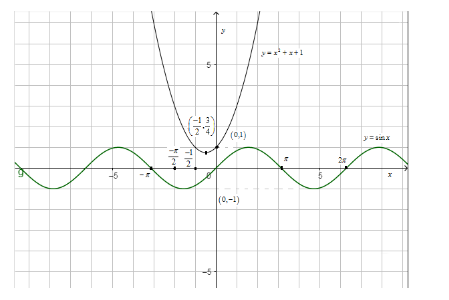
Thus, we can see that both the graphs do not intersect at all. Thus, there will be no solution of $ \sin x={{x}^{2}}+x+1 $ .
Hence, there are 0 solutions of the equation $ \sin x={{x}^{2}}+x+1 $ .
Note: he minima of $ f\left( x \right)={{x}^{2}}+x+1 $ can also be find out by an alternate method as shown below:
We know that if $ f\left( x \right) $ is a quadratic function of the form $ a{{x}^{2}}+bx+c $ , where $ a>0 $ then its minimum value will occur at $ x=\alpha $ where $ \alpha $ is solution of $ f'\left( x \right)=0 $ . Thus, we have:
$ f\left( x \right)={{x}^{2}}+x+1 $
On differentiating both sides, we have:
$ \Rightarrow f'\left( x \right)=2x+1 $
Now, $ f'\left( x \right)=0 $ . So, we have
$ \begin{align}
& \Rightarrow 2x+1=0 \\
& \Rightarrow x=\dfrac{-1}{2} \\
\end{align} $
At $ x=\dfrac{-1}{2} $ , there will be minima. The value of this minima will be $ =f\left( \dfrac{-1}{2} \right) $ . Thus,
$ \begin{align}
& f\left( \dfrac{-1}{2} \right)={{\left( \dfrac{-1}{2} \right)}^{2}}+\left( \dfrac{1}{2} \right)+1 \\
& f\left( \dfrac{-1}{2} \right)=\dfrac{-3}{4}+\dfrac{3}{2}=\dfrac{3}{4} \\
\end{align} $
Complete step-by-step answer:
To start with, we will first find out the range of the function $ f\left( x \right)={{x}^{2}}+x+1 $ . Now, to find the range of $ f\left( x \right) $ we will find its maximum value and minimum value. We can clearly see that the maximum value of $ f\left( x \right) $ will be infinite. Now, we know that the minimum value of the equation $ a{{x}^{2}}+bx+c=0\ as\ -\left( \dfrac{{{b}^{2}}-4ac}{4a} \right) $ . In our case, a = 1, b = 1 and c = 1. Thus, minimum value of $ f\left( x \right)=-\left( \dfrac{{{\left( 1 \right)}^{2}}-4\left( 1 \right)\left( 1 \right)}{4} \right) $ . Thus, the minimum value of $ f\left( x \right)=\dfrac{-3}{4} $ . Now, the minimum value of $ f\left( x \right) $ occurs at $ x=\dfrac{-b}{2a} $ . Thus, $ x=\dfrac{-1}{2} $ . Thus, the rough graph of $ y={{x}^{2}}+x+1 $ is:
Now, we have to determine the value of $ \sin x $ at $ x=\dfrac{-1}{2} $ . We know that in $ \left[ \dfrac{-\pi }{2},0 \right) $ , $ \sin x $ is negative i.e. it is not possible for $ \sin x $ to interest $ f\left( x \right) $ in that interval. Also, the maximum value of $ \sin x $ is 1. Thus, the combined graph of $ y=\sin x\ and\ y={{x}^{2}}+x+1 $ is shown below:
Thus, we can see that both the graphs do not intersect at all. Thus, there will be no solution of $ \sin x={{x}^{2}}+x+1 $ .
Hence, there are 0 solutions of the equation $ \sin x={{x}^{2}}+x+1 $ .
Note: he minima of $ f\left( x \right)={{x}^{2}}+x+1 $ can also be find out by an alternate method as shown below:
We know that if $ f\left( x \right) $ is a quadratic function of the form $ a{{x}^{2}}+bx+c $ , where $ a>0 $ then its minimum value will occur at $ x=\alpha $ where $ \alpha $ is solution of $ f'\left( x \right)=0 $ . Thus, we have:
$ f\left( x \right)={{x}^{2}}+x+1 $
On differentiating both sides, we have:
$ \Rightarrow f'\left( x \right)=2x+1 $
Now, $ f'\left( x \right)=0 $ . So, we have
$ \begin{align}
& \Rightarrow 2x+1=0 \\
& \Rightarrow x=\dfrac{-1}{2} \\
\end{align} $
At $ x=\dfrac{-1}{2} $ , there will be minima. The value of this minima will be $ =f\left( \dfrac{-1}{2} \right) $ . Thus,
$ \begin{align}
& f\left( \dfrac{-1}{2} \right)={{\left( \dfrac{-1}{2} \right)}^{2}}+\left( \dfrac{1}{2} \right)+1 \\
& f\left( \dfrac{-1}{2} \right)=\dfrac{-3}{4}+\dfrac{3}{2}=\dfrac{3}{4} \\
\end{align} $
Recently Updated Pages
Basicity of sulphurous acid and sulphuric acid are

Master Class 12 Economics: Engaging Questions & Answers for Success
Master Class 12 Biology: Engaging Questions & Answers for Success
Master Class 11 English: Engaging Questions & Answers for Success
Master Class 11 Physics: Engaging Questions & Answers for Success
Master Class 11 Computer Science: Engaging Questions & Answers for Success
Trending doubts
Draw a labelled sketch of the human eye class 12 physics CBSE
The chemical formula of tear gas is A CO Cl 2 B C 10 class 12 chemistry CBSE
Draw ray diagrams each showing i myopic eye and ii class 12 physics CBSE
Which are the Top 10 Largest Countries of the World?
Differentiate between homogeneous and heterogeneous class 12 chemistry CBSE
Which is the correct genotypic ratio of mendel dihybrid class 12 biology CBSE