




How do you find cos$\left( \theta \right)$ if sin$\left( \theta \right)$ = $\dfrac{3}{5}$ and $90 < \theta < 180$ ?
Answer
 Verified
565.2k+ views
Hint: In this problem, we will need identities for solving and calculating the value for cos$\left( \theta \right)$ if the value of sin$\left( \theta \right)$ is provided as $\dfrac{3}{5}$. The range implies that in which quadrant the angle will lie. The identities which will be used are:
$\Rightarrow {{\cos }^{2}}x+{{\sin }^{2}}x=1$
$\Rightarrow \cos \theta =\sqrt{1-{{\sin }^{2}}\theta }$
Complete step by step solution:
Now, let’s discuss the question.
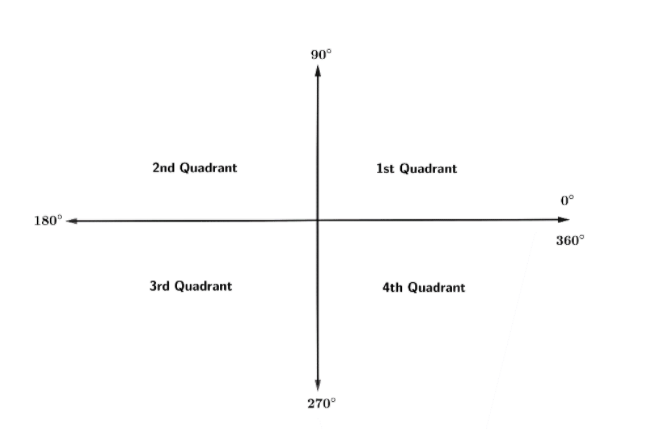
From the given plane, we can say that:
First quadrant consists of the angles which lie in $0 < \theta < 90$. The values of x and y both are positive.
Second quadrant consists of the angles which lie in $90 < \theta < 180$. The values of x are negative whereas y are positive.
Third quadrant consists of the angles which lie in $180 < \theta < 270$. The values of x and y both are negative.
Fourth quadrant consists of the angles which lie in $270 < \theta < 360$. The values of x are positive whereas y are negative.
Let’s see the trigonometric values for sin and cos for different quadrants:
In the given question, the range is given as $90 < \theta < 180$, that means it lies in second quadrant. The value for cos$\left( \theta \right)$ will be negative in this quadrant.
$\Rightarrow $sin$\left( \theta \right)$ = $\dfrac{3}{5}$
As we know that ${{\cos }^{2}}x+{{\sin }^{2}}x=1$, obtain the value for cos$\left( \theta \right)$ from this identity:
$\Rightarrow {{\cos }^{2}}\theta +{{\sin }^{2}}\theta =1$
Take sin value to the other side:
$\Rightarrow {{\cos }^{2}}\theta =1-{{\sin }^{2}}\theta $
Remove the square of cos and take root of the right hand side:
$\Rightarrow \cos \theta =\sqrt{1-{{\sin }^{2}}\theta }$
Put the negative sign as cos$\left( \theta \right)$ is negative in the second quadrant.
$\Rightarrow \cos \theta =-\sqrt{1-{{\sin }^{2}}\theta }$
Now, place the value of sin$\left( \theta \right)$ which is given:
$\Rightarrow \cos \theta =-\sqrt{1-{{\left( \dfrac{3}{5} \right)}^{2}}}$
On solving further:
$\Rightarrow \cos \theta =-\sqrt{1-\dfrac{9}{25}}$
Solve the under root now:
$\Rightarrow \cos \theta =-\sqrt{\dfrac{25-9}{25}}\Leftrightarrow -\sqrt{\dfrac{16}{25}}$
Under root of 16 is 4 and 25 is 5. Remove the under root and obtain the value:
$\therefore \cos \theta =-\dfrac{4}{5}$
This is the final answer.
Note: All the trigonometric identities and functions should be on tips before solving such questions. Also, do remember the square and square roots of the numbers so that there should be no need to find the LCM and then form pairs to check the squares or square root because it consumes a lot of time.
$\Rightarrow {{\cos }^{2}}x+{{\sin }^{2}}x=1$
$\Rightarrow \cos \theta =\sqrt{1-{{\sin }^{2}}\theta }$
Complete step by step solution:
Now, let’s discuss the question.
From the given plane, we can say that:
First quadrant consists of the angles which lie in $0 < \theta < 90$. The values of x and y both are positive.
Second quadrant consists of the angles which lie in $90 < \theta < 180$. The values of x are negative whereas y are positive.
Third quadrant consists of the angles which lie in $180 < \theta < 270$. The values of x and y both are negative.
Fourth quadrant consists of the angles which lie in $270 < \theta < 360$. The values of x are positive whereas y are negative.
Let’s see the trigonometric values for sin and cos for different quadrants:
| Trigonometric function | First quadrant | Second quadrant | Third quadrant | Fourth quadrant |
| sin$\left( \theta \right)$ | +ve | +ve | -ve | -ve |
| cos$\left( \theta \right)$ | +ve | -ve | -ve | +ve |
In the given question, the range is given as $90 < \theta < 180$, that means it lies in second quadrant. The value for cos$\left( \theta \right)$ will be negative in this quadrant.
$\Rightarrow $sin$\left( \theta \right)$ = $\dfrac{3}{5}$
As we know that ${{\cos }^{2}}x+{{\sin }^{2}}x=1$, obtain the value for cos$\left( \theta \right)$ from this identity:
$\Rightarrow {{\cos }^{2}}\theta +{{\sin }^{2}}\theta =1$
Take sin value to the other side:
$\Rightarrow {{\cos }^{2}}\theta =1-{{\sin }^{2}}\theta $
Remove the square of cos and take root of the right hand side:
$\Rightarrow \cos \theta =\sqrt{1-{{\sin }^{2}}\theta }$
Put the negative sign as cos$\left( \theta \right)$ is negative in the second quadrant.
$\Rightarrow \cos \theta =-\sqrt{1-{{\sin }^{2}}\theta }$
Now, place the value of sin$\left( \theta \right)$ which is given:
$\Rightarrow \cos \theta =-\sqrt{1-{{\left( \dfrac{3}{5} \right)}^{2}}}$
On solving further:
$\Rightarrow \cos \theta =-\sqrt{1-\dfrac{9}{25}}$
Solve the under root now:
$\Rightarrow \cos \theta =-\sqrt{\dfrac{25-9}{25}}\Leftrightarrow -\sqrt{\dfrac{16}{25}}$
Under root of 16 is 4 and 25 is 5. Remove the under root and obtain the value:
$\therefore \cos \theta =-\dfrac{4}{5}$
This is the final answer.
Note: All the trigonometric identities and functions should be on tips before solving such questions. Also, do remember the square and square roots of the numbers so that there should be no need to find the LCM and then form pairs to check the squares or square root because it consumes a lot of time.
Recently Updated Pages
Master Class 10 Social Science: Engaging Questions & Answers for Success

Master Class 10 Science: Engaging Questions & Answers for Success
Master Class 10 Maths: Engaging Questions & Answers for Success
Master Class 10 General Knowledge: Engaging Questions & Answers for Success
Master Class 10 Computer Science: Engaging Questions & Answers for Success
Class 10 Question and Answer - Your Ultimate Solutions Guide
Trending doubts
What is the full form of PNG A Petrol Natural Gas B class 10 chemistry CBSE
Explain the Treaty of Vienna of 1815 class 10 social science CBSE
In cricket, how many legal balls are there in a standard over?
Why is there a time difference of about 5 hours between class 10 social science CBSE
Who Won 36 Oscar Awards? Record Holder Revealed
What is the median of the first 10 natural numbers class 10 maths CBSE