




Find area of rhombus ABCD if the length of its diagonal is 126 cm and perimeter is 260 cm.
Answer
 Verified
652.5k+ views
Hint: Use formula to find out the area of rhombus$ = \dfrac{1}{2} \times {d_1} \times {d_2}$, where
${d_1} = $Length of 1st diagonal
${d_2} = $Length of 2nd diagonal
Complete step by step solution:
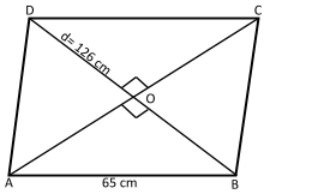
Length of one diagonal $ = 126\,cm$
Perimeter $ = 260\,cm$
Since Perimeter$ = 4 \times side$
$
\Rightarrow side = \dfrac{{perimeter}}{4} \\
= \dfrac{{260}}{4} \\
= 65\,cm \\
$
We know that diagonals of rhombus bisects each other at $90^\circ .$
So, $DO = OB = \dfrac{{126}}{2} = 63\,cm$
Now,
In $\Delta AOB$, we apply Pythagoras theorem,
\[
{(AB)^2} = {(AO)^2} + {(BO)^2} \\
\Rightarrow {(65)^2} = {(AO)^2} + {(63)^2} \\
\Rightarrow 4225 = {(AO)^2} + 3969 \\
\Rightarrow {(AO)^2} = 4225 - 3969 \\
\Rightarrow {(AO)^2} = 256 \\
\Rightarrow AO = \sqrt {256} \\
\Rightarrow AO = \sqrt {16 \times 16} \\
\Rightarrow AO = 16\,cm \\
\]
Since length of $AC = 2AO$
$
\therefore AC = 2 \times 16 \\
= 32\,cm \\
$
Now area of rhombus
$
= \dfrac{1}{2} \times {d_1} \times {d_2} \\
= \dfrac{1}{2} \times 32 \times 126 \\
= 2016\,c{m^2} \\
$
$\therefore $Area of rhombus $ = 2016\,c{m^2}$
Note: Students must be aware of the fact that “Every square is a rhombus but not every rhombus is a square”. Opposite angles of rhombus are equal and diagonals bisect each other at \[90\]degrees whereas in case of a square, measure of each angle is equal to \[90\]degrees.
${d_1} = $Length of 1st diagonal
${d_2} = $Length of 2nd diagonal
Complete step by step solution:
Length of one diagonal $ = 126\,cm$
Perimeter $ = 260\,cm$
Since Perimeter$ = 4 \times side$
$
\Rightarrow side = \dfrac{{perimeter}}{4} \\
= \dfrac{{260}}{4} \\
= 65\,cm \\
$
We know that diagonals of rhombus bisects each other at $90^\circ .$
So, $DO = OB = \dfrac{{126}}{2} = 63\,cm$
Now,
In $\Delta AOB$, we apply Pythagoras theorem,
\[
{(AB)^2} = {(AO)^2} + {(BO)^2} \\
\Rightarrow {(65)^2} = {(AO)^2} + {(63)^2} \\
\Rightarrow 4225 = {(AO)^2} + 3969 \\
\Rightarrow {(AO)^2} = 4225 - 3969 \\
\Rightarrow {(AO)^2} = 256 \\
\Rightarrow AO = \sqrt {256} \\
\Rightarrow AO = \sqrt {16 \times 16} \\
\Rightarrow AO = 16\,cm \\
\]
Since length of $AC = 2AO$
$
\therefore AC = 2 \times 16 \\
= 32\,cm \\
$
Now area of rhombus
$
= \dfrac{1}{2} \times {d_1} \times {d_2} \\
= \dfrac{1}{2} \times 32 \times 126 \\
= 2016\,c{m^2} \\
$
$\therefore $Area of rhombus $ = 2016\,c{m^2}$
Note: Students must be aware of the fact that “Every square is a rhombus but not every rhombus is a square”. Opposite angles of rhombus are equal and diagonals bisect each other at \[90\]degrees whereas in case of a square, measure of each angle is equal to \[90\]degrees.
Recently Updated Pages
Class 10 Question and Answer - Your Ultimate Solutions Guide

Master Class 10 Computer Science: Engaging Questions & Answers for Success
Master Class 10 General Knowledge: Engaging Questions & Answers for Success
Master Class 12 Economics: Engaging Questions & Answers for Success
Master Class 12 Social Science: Engaging Questions & Answers for Success
Master Class 12 English: Engaging Questions & Answers for Success
Trending doubts
Explain the Treaty of Vienna of 1815 class 10 social science CBSE
The slogan Jai Hind was given by A Lal Bahadur Shastri class 10 social science CBSE
10 examples of evaporation in daily life with explanations
What is the full form of POSCO class 10 social science CBSE
Identify the feminine form of noun nephew a shenephew class 10 english CBSE
CSIR full form?