




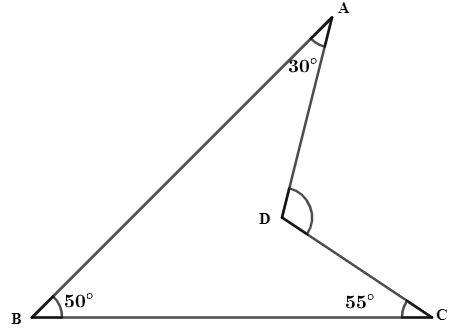
Find $\angle ADC$ from the given figure.
Answer
 Verified
637.5k+ views
Hint:Find the angle ADC (reflex) which is a reflex angle and forming inside the quadrilateral ABCD. Sum of all the angles of a quadrilateral is \[{{360}^{\circ }}\]. And angle around a point is \[{{360}^{\circ }}\] as well. Calculate the angle ADC as required in the question, using above information.
Complete step-by-step answer:
Given diagram in question is
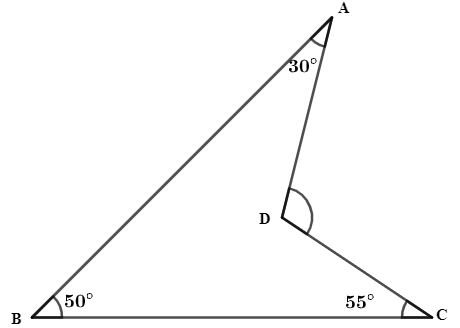
As we know, the sum of all the interior angles of a quadrilateral is \[{{360}^{\circ }}\]. And we observe that ABCD is also a quadrilateral as it has four sides. So, the sum of all the angles of it will be \[{{360}^{\circ }}\] as well. So, we can write the equation as
\[\angle BAD+\angle ABC+\angle BCD+\angle ADC\] (reflex or inside of quadrilateral) = \[{{360}^{\circ }}\]
So, put the values of angles given in the diagram so, we get
\[30+55+50+\angle ADC\ \left( \text{reflex} \right)\ =\ {{360}^{\circ }}\]
\[135+\angle ADC\ \left( \text{reflex} \right)\ =\ {{360}^{\circ }}\]
\[\angle ADC\ \left( \text{reflex} \right)=\ 360-135\]
\[\angle ADC\ \left( \text{reflex} \right)\ =\ {{225}^{\circ }}\]
Hence, angle ADC (reflex) inside the quadrilateral is \[{{225}^{\circ }}\].
Now, as we know that angle formed around a point is \[{{360}^{\circ }}\], as we need to rotate \[{{360}^{\circ }}\]. Hence, the sum of angles ADC (reflex) and ADC (outer of quadrilateral) is \[{{360}^{\circ }}\]. And we need to calculate \[\angle ADC\] (outer) from the problem.
So, we can write equation as
\[\angle ADC\ \left( \text{reflex} \right)+\angle ADC\ \left( \text{outer} \right)\ =\ {{360}^{\circ }}\]
\[{{225}^{\circ }}+\angle ADC\ \left( \text{outer} \right)\ =\ {{360}^{\circ }}\]
\[\angle ADC\ \left( \text{outer} \right)\ =\ {{360}^{\circ }}-{{225}^{\circ }}\]
\[=\ {{135}^{\circ }}\]
Hence, the value of \[\angle ADC\] lying on the outer side of the quadrilateral is \[{{135}^{\circ }}\].
Note: Observing ABCD as a quadrilateral is the key point of the question and take the sum of angles of a quadrilateral as \[{{360}^{\circ }}\] not \[{{180}^{\circ }}\]. Sum of interior angles of n sided polygon is given as
$=\ \left( n-2 \right)\times {{180}^{\circ }}$
Don’t confuse with the reflex angle term used in the solution. It is used to define that angle ADC inside the quadrilateral has higher angle than \[{{180}^{\circ }}\], as Reflex angle is defined as angles between \[{{180}^{\circ }}\] and \[{{360}^{\circ }}\] are reflex angles.
Complete step-by-step answer:
Given diagram in question is
As we know, the sum of all the interior angles of a quadrilateral is \[{{360}^{\circ }}\]. And we observe that ABCD is also a quadrilateral as it has four sides. So, the sum of all the angles of it will be \[{{360}^{\circ }}\] as well. So, we can write the equation as
\[\angle BAD+\angle ABC+\angle BCD+\angle ADC\] (reflex or inside of quadrilateral) = \[{{360}^{\circ }}\]
So, put the values of angles given in the diagram so, we get
\[30+55+50+\angle ADC\ \left( \text{reflex} \right)\ =\ {{360}^{\circ }}\]
\[135+\angle ADC\ \left( \text{reflex} \right)\ =\ {{360}^{\circ }}\]
\[\angle ADC\ \left( \text{reflex} \right)=\ 360-135\]
\[\angle ADC\ \left( \text{reflex} \right)\ =\ {{225}^{\circ }}\]
Hence, angle ADC (reflex) inside the quadrilateral is \[{{225}^{\circ }}\].
Now, as we know that angle formed around a point is \[{{360}^{\circ }}\], as we need to rotate \[{{360}^{\circ }}\]. Hence, the sum of angles ADC (reflex) and ADC (outer of quadrilateral) is \[{{360}^{\circ }}\]. And we need to calculate \[\angle ADC\] (outer) from the problem.
So, we can write equation as
\[\angle ADC\ \left( \text{reflex} \right)+\angle ADC\ \left( \text{outer} \right)\ =\ {{360}^{\circ }}\]
\[{{225}^{\circ }}+\angle ADC\ \left( \text{outer} \right)\ =\ {{360}^{\circ }}\]
\[\angle ADC\ \left( \text{outer} \right)\ =\ {{360}^{\circ }}-{{225}^{\circ }}\]
\[=\ {{135}^{\circ }}\]
Hence, the value of \[\angle ADC\] lying on the outer side of the quadrilateral is \[{{135}^{\circ }}\].
Note: Observing ABCD as a quadrilateral is the key point of the question and take the sum of angles of a quadrilateral as \[{{360}^{\circ }}\] not \[{{180}^{\circ }}\]. Sum of interior angles of n sided polygon is given as
$=\ \left( n-2 \right)\times {{180}^{\circ }}$
Don’t confuse with the reflex angle term used in the solution. It is used to define that angle ADC inside the quadrilateral has higher angle than \[{{180}^{\circ }}\], as Reflex angle is defined as angles between \[{{180}^{\circ }}\] and \[{{360}^{\circ }}\] are reflex angles.
Recently Updated Pages
Master Class 12 Business Studies: Engaging Questions & Answers for Success

Master Class 12 Biology: Engaging Questions & Answers for Success
Master Class 12 Chemistry: Engaging Questions & Answers for Success
Class 12 Question and Answer - Your Ultimate Solutions Guide
Master Class 11 Social Science: Engaging Questions & Answers for Success
Master Class 11 English: Engaging Questions & Answers for Success
Trending doubts
Explain the Treaty of Vienna of 1815 class 10 social science CBSE
Which Indian city is known as the "City of Victory"?
Which instrument is used to measure the Blood Pressure?
Who Won 36 Oscar Awards? Record Holder Revealed
What is the median of the first 10 natural numbers class 10 maths CBSE
Why is it 530 pm in india when it is 1200 afternoon class 10 social science CBSE