




How do you find all the zeros of the function $f\left( x \right)=4{{x}^{2}}+29x+30$?
Answer
 Verified
607.8k+ views
Hint: For this problem we need to calculate the roots or zeros of the given function. We can observe that the given function is a quadratic equation. We have so many methods which are used to calculate the roots of the quadratic equation like completing squares, factorization, and quadratic formula. For this particular problem we are going to use the quadratic formula method. This method says that the roots of the quadratic equation $a{{x}^{2}}+bx+c=0$ are given by $x=\dfrac{-b\pm \sqrt{{{b}^{2}}-4ac}}{2a}$. So first we will compare the given equation with $a{{x}^{2}}+bx+c=0$ and use the formula $x=\dfrac{-b\pm \sqrt{{{b}^{2}}-4ac}}{2a}$ to get the roots of the given equation.
Complete step by step solution:
Given that, $f\left( x \right)=4{{x}^{2}}+29x+30$.
Comparing the above quadratic equation with standard form of the quadratic equation which is $a{{x}^{2}}+bx+c=0$, then we will get
$a=4$, $b=29$, $c=30$.
The method quadratic formula says that the roots of the quadratic equation $a{{x}^{2}}+bx+c=0$ are given by $x=\dfrac{-b\pm \sqrt{{{b}^{2}}-4ac}}{2a}$. From this formula the roots of the given quadratic equation can be calculated as
$\Rightarrow x=\dfrac{-\left( 29 \right)\pm \sqrt{{{\left( 29 \right)}^{2}}-4\left( 4 \right)\left( 30 \right)}}{2\left( 4 \right)}$
Simplifying the above equation, then we will get
$\begin{align}
& \Rightarrow x=\dfrac{-29\pm \sqrt{841-480}}{8} \\
& \Rightarrow x=\dfrac{-29\pm \sqrt{361}}{8} \\
\end{align}$
In the above equation, we have the value $\sqrt{361}$. We can write the value $361$ as $19\times 19$. Now the value $\sqrt{361}$ will be $\sqrt{361}=\sqrt{{{19}^{2}}}=19$. Substituting this value in the above equation, then we will get
$\begin{align}
& \Rightarrow x=\dfrac{-29\pm 19}{8} \\
& \Rightarrow x=\dfrac{-29+19}{8}\text{ or }\dfrac{-29-19}{8} \\
& \Rightarrow x=\dfrac{-10}{8}\text{ or }\dfrac{-48}{8} \\
& \Rightarrow x=-\dfrac{5}{4}\text{ or }-6 \\
\end{align}$
Hence the roots of the given equation $f\left( x \right)=4{{x}^{2}}+29x+30$ are $x=-6,-\dfrac{5}{4}$.
Note:
We can also calculate the roots of the given equation by plotting the graph of the given equation. When we plot the graph of the given equation in coordinate system then we will get
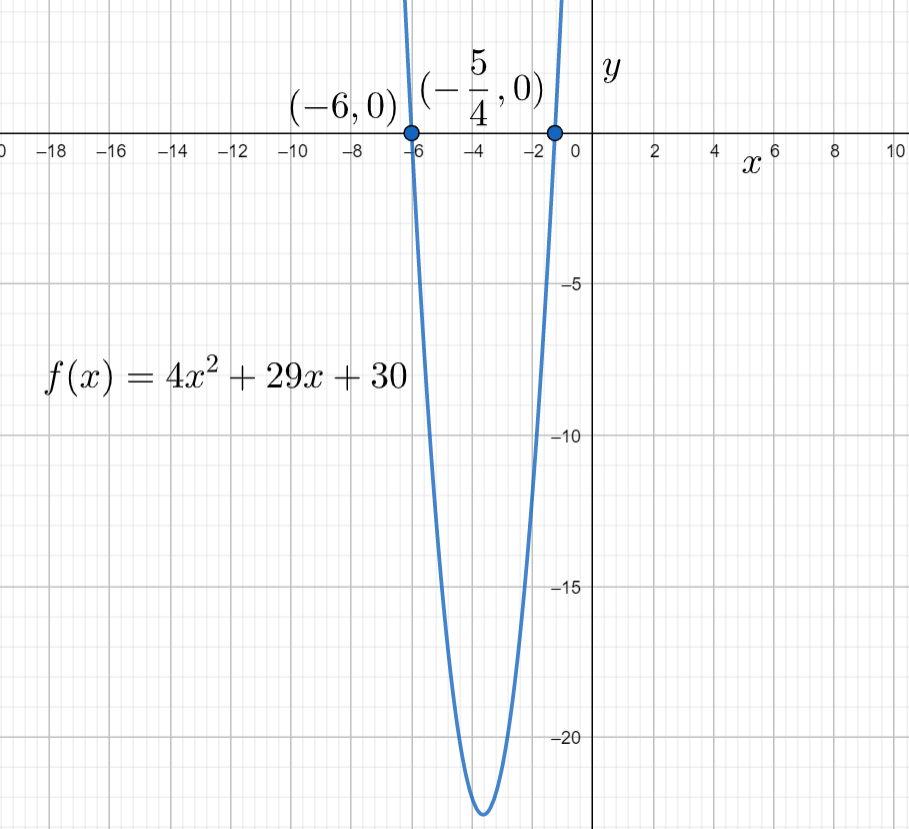
From the above graph also, we can say that the roots of the equation as $x=-6,-\dfrac{5}{4}$.
Complete step by step solution:
Given that, $f\left( x \right)=4{{x}^{2}}+29x+30$.
Comparing the above quadratic equation with standard form of the quadratic equation which is $a{{x}^{2}}+bx+c=0$, then we will get
$a=4$, $b=29$, $c=30$.
The method quadratic formula says that the roots of the quadratic equation $a{{x}^{2}}+bx+c=0$ are given by $x=\dfrac{-b\pm \sqrt{{{b}^{2}}-4ac}}{2a}$. From this formula the roots of the given quadratic equation can be calculated as
$\Rightarrow x=\dfrac{-\left( 29 \right)\pm \sqrt{{{\left( 29 \right)}^{2}}-4\left( 4 \right)\left( 30 \right)}}{2\left( 4 \right)}$
Simplifying the above equation, then we will get
$\begin{align}
& \Rightarrow x=\dfrac{-29\pm \sqrt{841-480}}{8} \\
& \Rightarrow x=\dfrac{-29\pm \sqrt{361}}{8} \\
\end{align}$
In the above equation, we have the value $\sqrt{361}$. We can write the value $361$ as $19\times 19$. Now the value $\sqrt{361}$ will be $\sqrt{361}=\sqrt{{{19}^{2}}}=19$. Substituting this value in the above equation, then we will get
$\begin{align}
& \Rightarrow x=\dfrac{-29\pm 19}{8} \\
& \Rightarrow x=\dfrac{-29+19}{8}\text{ or }\dfrac{-29-19}{8} \\
& \Rightarrow x=\dfrac{-10}{8}\text{ or }\dfrac{-48}{8} \\
& \Rightarrow x=-\dfrac{5}{4}\text{ or }-6 \\
\end{align}$
Hence the roots of the given equation $f\left( x \right)=4{{x}^{2}}+29x+30$ are $x=-6,-\dfrac{5}{4}$.
Note:
We can also calculate the roots of the given equation by plotting the graph of the given equation. When we plot the graph of the given equation in coordinate system then we will get
From the above graph also, we can say that the roots of the equation as $x=-6,-\dfrac{5}{4}$.
Recently Updated Pages
Class 10 Question and Answer - Your Ultimate Solutions Guide

Master Class 10 Computer Science: Engaging Questions & Answers for Success
Master Class 12 Economics: Engaging Questions & Answers for Success
Master Class 12 Social Science: Engaging Questions & Answers for Success
Master Class 12 English: Engaging Questions & Answers for Success
Master Class 12 Maths: Engaging Questions & Answers for Success
Trending doubts
Explain the Treaty of Vienna of 1815 class 10 social science CBSE
The slogan Jai Hind was given by A Lal Bahadur Shastri class 10 social science CBSE
10 examples of evaporation in daily life with explanations
What is the full form of POSCO class 10 social science CBSE
Identify the feminine form of noun nephew a shenephew class 10 english CBSE
CSIR full form?