




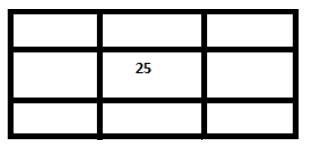
Fill the squares with all the numbers from \[21\] to\[29\]. Given the total of each side is \[75\].
Answer
 Verified
619.5k+ views
Hint:
As we are given that the sum of the numbers is\[75\], we are going to take the two numbers between \[21\] to \[29\] and then subtract their sum from \[75\]and so on. Taking the numbers column wise, we need to check the total row wise too.
Complete step by step solution:
It is given that the sum of each row and column is\[75\]and we can use the numbers from \[21\]to\[29\].
Considering the first row, take two numbers for the first two squares as: \[26\]and\[27\]. For filling the third square, we subtract the sum of these two squares from\[75\]. i.e.
\[\begin{align}
& 75-\left( 26+27 \right) \\
& \Rightarrow 75-53 \\
& \Rightarrow 22 \\
\end{align}\]
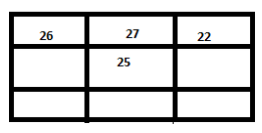
Now only, the numbers \[23,24,28,29\] can be filled.
Now taking second row, in which second square is already filled with\[25\], if we take \[21\] in the first square of row two, then third square is filled with:
\[\begin{align}
& 75-\left( 25+21 \right) \\
& \Rightarrow 75-46 \\
& \Rightarrow 29 \\
\end{align}\]
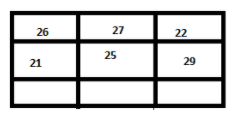
Considering the third and the final row, for this the only numbers that are left are \[23,24,28\]
Now we have to check the sum column wise too.
So, in first box:
\[\begin{align}
& 75-\left( 26+21 \right) \\
& \Rightarrow 75-47 \\
& \Rightarrow 28 \\
\end{align}\]
In second:
\[\begin{align}
& 75-\left( 27+25 \right) \\
& \Rightarrow 75-52 \\
& \Rightarrow 23 \\
\end{align}\]
In third:
\[\begin{align}
& 75-\left( 29+22 \right) \\
& \Rightarrow 75-51 \\
& \Rightarrow 24 \\
\end{align}\]
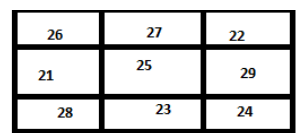
So the complete grid becomes:
Formula used:
Taking the value of two boxes arbitrarily between \[21\]and \[29\] and subtracting them from \[75\]. i.e.
\[75-\left( A1+A2 \right)\]
Where, \[A1\]: value of first square
\[A2\]: value of second square
Note:
It is to be noted that numbers only between \[21\] and \[29\] are to be taken and not anything apart from this range. Also, the sum of the three squares of each row and column as well should be \[75\]. Ignoring any one of them will cause errors.
As we are given that the sum of the numbers is\[75\], we are going to take the two numbers between \[21\] to \[29\] and then subtract their sum from \[75\]and so on. Taking the numbers column wise, we need to check the total row wise too.
Complete step by step solution:
It is given that the sum of each row and column is\[75\]and we can use the numbers from \[21\]to\[29\].
Considering the first row, take two numbers for the first two squares as: \[26\]and\[27\]. For filling the third square, we subtract the sum of these two squares from\[75\]. i.e.
\[\begin{align}
& 75-\left( 26+27 \right) \\
& \Rightarrow 75-53 \\
& \Rightarrow 22 \\
\end{align}\]
Now only, the numbers \[23,24,28,29\] can be filled.
Now taking second row, in which second square is already filled with\[25\], if we take \[21\] in the first square of row two, then third square is filled with:
\[\begin{align}
& 75-\left( 25+21 \right) \\
& \Rightarrow 75-46 \\
& \Rightarrow 29 \\
\end{align}\]
Considering the third and the final row, for this the only numbers that are left are \[23,24,28\]
Now we have to check the sum column wise too.
So, in first box:
\[\begin{align}
& 75-\left( 26+21 \right) \\
& \Rightarrow 75-47 \\
& \Rightarrow 28 \\
\end{align}\]
In second:
\[\begin{align}
& 75-\left( 27+25 \right) \\
& \Rightarrow 75-52 \\
& \Rightarrow 23 \\
\end{align}\]
In third:
\[\begin{align}
& 75-\left( 29+22 \right) \\
& \Rightarrow 75-51 \\
& \Rightarrow 24 \\
\end{align}\]
So the complete grid becomes:
Formula used:
Taking the value of two boxes arbitrarily between \[21\]and \[29\] and subtracting them from \[75\]. i.e.
\[75-\left( A1+A2 \right)\]
Where, \[A1\]: value of first square
\[A2\]: value of second square
Note:
It is to be noted that numbers only between \[21\] and \[29\] are to be taken and not anything apart from this range. Also, the sum of the three squares of each row and column as well should be \[75\]. Ignoring any one of them will cause errors.

Recently Updated Pages
Master Class 10 Computer Science: Engaging Questions & Answers for Success

Master Class 12 Physics: Engaging Questions & Answers for Success
Master Class 12 Social Science: Engaging Questions & Answers for Success
Master Class 12 English: Engaging Questions & Answers for Success
Master Class 12 Maths: Engaging Questions & Answers for Success
Master Class 12 Business Studies: Engaging Questions & Answers for Success
Trending doubts
100 million is equal to begingathered A 1 crore B -class-7-maths-CBSE
Full Form of IASDMIPSIFSIRSPOLICE class 7 social science CBSE
List of coprime numbers from 1 to 100 class 7 maths CBSE
The plural of Chief is Chieves A True B False class 7 english CBSE
What is the use of kink in a clinical thermometer class 7 physics CBSE
Fill in the blank with the most appropriate word What class 7 english CBSE