




Fill in the blanks: The equation of mirror formula is _______ .
Answer
 Verified
547.2k+ views
Hint:In physics, generally we use spherical mirrors and especially concave spherical mirror which is a converging mirror and other one is convex mirror which is a diverging mirror which means when light rays falls on reflecting surface of mirror rays gets converged and diverged.
Complete answer:
Firstly we must understand the sign conventions and various parameters which define the mirror formula. Mirror formula is given as,
$\dfrac{1}{f} = \dfrac{1}{v} + \dfrac{1}{u}$
Here, $f$ is denoted for focal length which is the distance between pole and focus of a concave or convex mirror. $v$ Is denoted for image distance which is measured from pole to the point where image of an object is formed. $u$ Is denoted for object distance which is measured as from pole to the point where the object is placed.
Sign convention: The distances are always measured from the pole of mirrors.Distances measured in the direction of incident ray are taken as positive and the distances measured along the direction opposite of incident ray is always taken as negative.Let us take a simple example of concave mirror to understand this
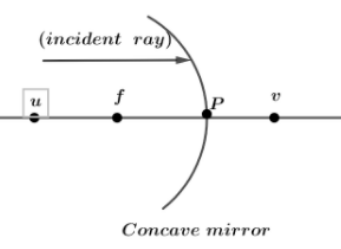
Here image distance measured from pole $P$ is in the direction of incident ray hence will be taken as positive but focal length and object distance will be taken as positive.
Hence, the equation of mirror formula is $\dfrac{1}{f} = \dfrac{1}{v} + \dfrac{1}{u}$.
Note:The reflecting part of the concave spherical mirror is that which caves inwards and the reflecting part of convex spherical mirror is one which caves outwards. In convex mirror focal length $f$ is positive and object distance $u$ is taken as negative.
Complete answer:
Firstly we must understand the sign conventions and various parameters which define the mirror formula. Mirror formula is given as,
$\dfrac{1}{f} = \dfrac{1}{v} + \dfrac{1}{u}$
Here, $f$ is denoted for focal length which is the distance between pole and focus of a concave or convex mirror. $v$ Is denoted for image distance which is measured from pole to the point where image of an object is formed. $u$ Is denoted for object distance which is measured as from pole to the point where the object is placed.
Sign convention: The distances are always measured from the pole of mirrors.Distances measured in the direction of incident ray are taken as positive and the distances measured along the direction opposite of incident ray is always taken as negative.Let us take a simple example of concave mirror to understand this
Here image distance measured from pole $P$ is in the direction of incident ray hence will be taken as positive but focal length and object distance will be taken as positive.
Hence, the equation of mirror formula is $\dfrac{1}{f} = \dfrac{1}{v} + \dfrac{1}{u}$.
Note:The reflecting part of the concave spherical mirror is that which caves inwards and the reflecting part of convex spherical mirror is one which caves outwards. In convex mirror focal length $f$ is positive and object distance $u$ is taken as negative.
Recently Updated Pages
Master Class 12 Business Studies: Engaging Questions & Answers for Success

Master Class 12 Biology: Engaging Questions & Answers for Success
Master Class 12 Chemistry: Engaging Questions & Answers for Success
Class 12 Question and Answer - Your Ultimate Solutions Guide
Master Class 11 Social Science: Engaging Questions & Answers for Success
Master Class 11 English: Engaging Questions & Answers for Success
Trending doubts
Explain the Treaty of Vienna of 1815 class 10 social science CBSE
Which Indian city is known as the "City of Victory"?
Which instrument is used to measure the Blood Pressure?
Who Won 36 Oscar Awards? Record Holder Revealed
What is the median of the first 10 natural numbers class 10 maths CBSE
Why is it 530 pm in india when it is 1200 afternoon class 10 social science CBSE