




Fill in the blanks:
1 million = ……………….. hundred thousand.
Answer
 Verified
632.1k+ views
Hint: We need to follow the conversions of the decimal number system from the International to the Indian decimal system in powers of 10 from one number to another . While million belongs to the International number system, hundred thousand belong to the Indian number system.
Complete step-by-step answer:
In this question, we need to find out the relation between million and hundred thousand. While million is a number in the International system, hundred thousand is a number in the Indian number system. Now let us understand the conversion of International decimal system to Indian decimal number system:
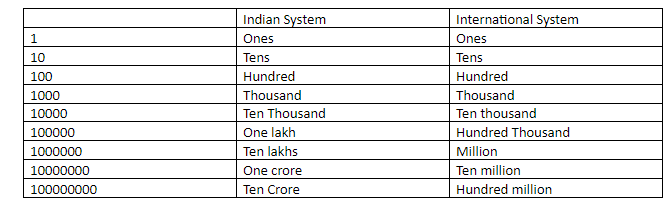
So, clearly from the table,
1lakh = 1 followed by 5 zeroes, 1 lakh $ = 100000$
And, 1 million = ten lacs, which means 1 lac multiplied with 10.
That is, $100000 \times 10$ , which will become 1 followed by 6 zeroes,
so 1 million $ = 1000000$
Which can also be written as 1000,000 that is thousand thousands according to the international number system.
Or, in the Indian System as 10,00,000 which is Ten hundred thoudred thousand.
Therefore we conclude that 1 million as per the International system is the same as Ten hundred thousand as per the Indian system.
Hence, 1 million = …Ten…. hundred thousand.
So we will fill the blank with the word Ten.
Note: We have to be extra cautious while putting the zeroes during the conversion of the international number to the Indian number system, since the misplacement of even one zero will change the number completely. Also, we need to be careful with the placing of periods in different number systems. While in the International system the periods are placed at intervals of every three places going left, starting with the hundreds place on the right ; the Indian system places only the first period after the hundreds place starting from right, going to left; the subsequent periods are placed at an interval of two decimal places each towards left after the hundredths place. For example a number say, 234156 when written in the international system will be written as 234,156 while in the Indian system it will be written as 2,34,156.
Complete step-by-step answer:
In this question, we need to find out the relation between million and hundred thousand. While million is a number in the International system, hundred thousand is a number in the Indian number system. Now let us understand the conversion of International decimal system to Indian decimal number system:
So, clearly from the table,
1lakh = 1 followed by 5 zeroes, 1 lakh $ = 100000$
And, 1 million = ten lacs, which means 1 lac multiplied with 10.
That is, $100000 \times 10$ , which will become 1 followed by 6 zeroes,
so 1 million $ = 1000000$
Which can also be written as 1000,000 that is thousand thousands according to the international number system.
Or, in the Indian System as 10,00,000 which is Ten hundred thoudred thousand.
Therefore we conclude that 1 million as per the International system is the same as Ten hundred thousand as per the Indian system.
Hence, 1 million = …Ten…. hundred thousand.
So we will fill the blank with the word Ten.
Note: We have to be extra cautious while putting the zeroes during the conversion of the international number to the Indian number system, since the misplacement of even one zero will change the number completely. Also, we need to be careful with the placing of periods in different number systems. While in the International system the periods are placed at intervals of every three places going left, starting with the hundreds place on the right ; the Indian system places only the first period after the hundreds place starting from right, going to left; the subsequent periods are placed at an interval of two decimal places each towards left after the hundredths place. For example a number say, 234156 when written in the international system will be written as 234,156 while in the Indian system it will be written as 2,34,156.

Recently Updated Pages
Master Class 11 English: Engaging Questions & Answers for Success

Master Class 11 Social Science: Engaging Questions & Answers for Success
Master Class 11 Maths: Engaging Questions & Answers for Success
Master Class 11 Biology: Engaging Questions & Answers for Success
Master Class 11 Physics: Engaging Questions & Answers for Success
Master Class 11 Chemistry: Engaging Questions & Answers for Success
Trending doubts
What is the name of the river that flows through Paris?
How many millions make a billion class 6 maths CBSE
Give 10 examples for herbs , shrubs , climbers , creepers
What is the term for study of stars? A) Astronomy B) Astrology
What is the opposite gender of Gander class 6 english CBSE
What are the main physical divisions of India class 6 social science CBSE