




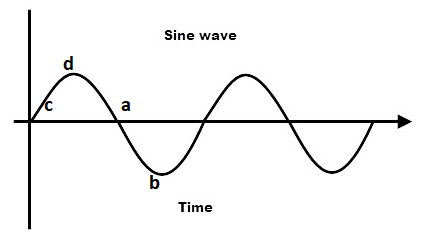
Figure shows a snapshot for a travelling sine wave along a string. Four elemental portions a,b,c and d are indicated on the string. The elemental portion which has maximum potential energy is/are
Answer
 Verified
520.8k+ views
Hint : A wave is a propagating dynamic disturbance (change from equilibrium) of one or more quantities in physics, mathematics, and related fields, often represented by a wave equation. At least two field concentrations in the wave medium are present in physical waves. Periodic waves occur as quantities oscillate continuously around an equilibrium (resting) value at a certain frequency.
Formula used:
${u_p} = \dfrac{1}{2} \times p \times {v^2} \times {\left( {\dfrac{{\partial y}}{{\partial x}}} \right)^2}$
${u_p}$ = potential energy
P = momentum
V= velocity
$\left( {\dfrac{{\partial y}}{{\partial x}}} \right) = $slope
Complete step-by-step solution:
Potential energy is the energy that an object holds due to its location in relation to other objects, internal pressures, electric charge, or other causes.
The gravitational potential energy of an object, which is determined by its density and distance from another object's centre of mass, the elastic potential energy of an extended spring, and the electric potential energy of an electric charge in an electric field are all examples of potential energy. The joule, denoted by the letter J in the International System of Units (SI), is the SI's energy unit.
We know that the potential energy at volume is
${u_p} = \dfrac{1}{2} \times p \times {v^2} \times {\left( {\dfrac{{\partial y}}{{\partial x}}} \right)^2}$
We know that the potential energy is proportional to the square of the slope of the wave graph.
$m = \dfrac{{dy}}{{dx}}$
The slope is maximum here at point a, m = $\infty $
Hence at point a the potential energy is maximum.
Note: Since the role of possible forces working on a body moving from a start to an end position is determined solely by these two positions and not by the body's direction, a feature known as potential can be measured at these two positions to assess this work.
Formula used:
${u_p} = \dfrac{1}{2} \times p \times {v^2} \times {\left( {\dfrac{{\partial y}}{{\partial x}}} \right)^2}$
${u_p}$ = potential energy
P = momentum
V= velocity
$\left( {\dfrac{{\partial y}}{{\partial x}}} \right) = $slope
Complete step-by-step solution:
Potential energy is the energy that an object holds due to its location in relation to other objects, internal pressures, electric charge, or other causes.
The gravitational potential energy of an object, which is determined by its density and distance from another object's centre of mass, the elastic potential energy of an extended spring, and the electric potential energy of an electric charge in an electric field are all examples of potential energy. The joule, denoted by the letter J in the International System of Units (SI), is the SI's energy unit.
We know that the potential energy at volume is
${u_p} = \dfrac{1}{2} \times p \times {v^2} \times {\left( {\dfrac{{\partial y}}{{\partial x}}} \right)^2}$
We know that the potential energy is proportional to the square of the slope of the wave graph.
$m = \dfrac{{dy}}{{dx}}$
The slope is maximum here at point a, m = $\infty $
Hence at point a the potential energy is maximum.
Note: Since the role of possible forces working on a body moving from a start to an end position is determined solely by these two positions and not by the body's direction, a feature known as potential can be measured at these two positions to assess this work.
Recently Updated Pages
Master Class 11 Business Studies: Engaging Questions & Answers for Success

Master Class 11 Computer Science: Engaging Questions & Answers for Success
Master Class 11 Economics: Engaging Questions & Answers for Success
Master Class 11 Social Science: Engaging Questions & Answers for Success
Master Class 11 English: Engaging Questions & Answers for Success
Master Class 11 Chemistry: Engaging Questions & Answers for Success
Trending doubts
Draw a diagram of nephron and explain its structur class 11 biology CBSE
Explain zero factorial class 11 maths CBSE
Chemical formula of Bleaching powder is A Ca2OCl2 B class 11 chemistry CBSE
Name the part of the brain responsible for the precision class 11 biology CBSE
The growth of tendril in pea plants is due to AEffect class 11 biology CBSE
One Metric ton is equal to kg A 10000 B 1000 C 100 class 11 physics CBSE