




Figure shows a small concave mirror with \[CP\] as its principal axis. A ray $XY$ is inclined to the mirror. Which of the four rays can be the reflected ray?
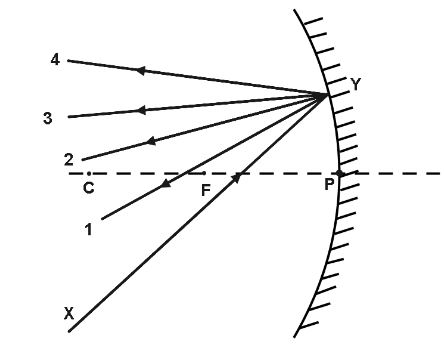
A. $1$
B. $2$
C. $3$
D. $4$
Answer
 Verified
495.9k+ views
Hint: We know every reflecting surface follows the laws of reflection whether it is a plane mirror or a spherical mirror. These are the laws of reflection: The angle of incidence is equal to the angle of reflection second, all three rays, incident, normal, and reflected, are in the same plane and the third one the incident and reflected rays are on opposite sides of the normal.
Complete step by step answer:
We know if a ray of light comes from infinity parallel to the principal axis, it always passes through the focus of the mirror. If a ray of light passes through the centre of curvature, the reflected ray always retraces its path through the centre of curvature. So, here the rays through the centre of curvature act as normal to a tangent plane at the mirror. Now, if we retrace the path for the reflected ray of the ray as in the question, we can notice that the reflected ray would be somewhere above the parallel principal axis i.e., ray number $4$ .
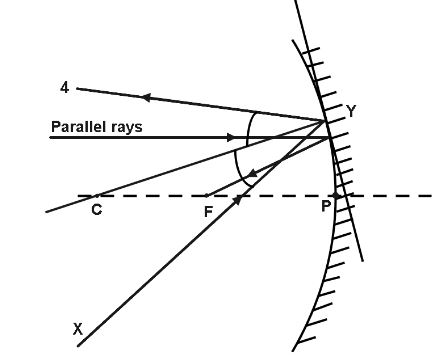
Hence, option D is the correct option.
Note: In order to get the desired result, we always need to follow the ray diagram by the use of laws of reflection. Laws of reflection in the case of mirrors are quite important because we need the tangent on the mirror acting as a plane to get all the three rays i.e., incident, reflected ray and the normal.
Complete step by step answer:
We know if a ray of light comes from infinity parallel to the principal axis, it always passes through the focus of the mirror. If a ray of light passes through the centre of curvature, the reflected ray always retraces its path through the centre of curvature. So, here the rays through the centre of curvature act as normal to a tangent plane at the mirror. Now, if we retrace the path for the reflected ray of the ray as in the question, we can notice that the reflected ray would be somewhere above the parallel principal axis i.e., ray number $4$ .
Hence, option D is the correct option.
Note: In order to get the desired result, we always need to follow the ray diagram by the use of laws of reflection. Laws of reflection in the case of mirrors are quite important because we need the tangent on the mirror acting as a plane to get all the three rays i.e., incident, reflected ray and the normal.
Recently Updated Pages
Master Class 10 Social Science: Engaging Questions & Answers for Success

Master Class 10 Science: Engaging Questions & Answers for Success
Master Class 10 Maths: Engaging Questions & Answers for Success
Master Class 10 General Knowledge: Engaging Questions & Answers for Success
Master Class 10 Computer Science: Engaging Questions & Answers for Success
Class 10 Question and Answer - Your Ultimate Solutions Guide
Trending doubts
What is the full form of PNG A Petrol Natural Gas B class 10 chemistry CBSE
Explain the Treaty of Vienna of 1815 class 10 social science CBSE
In cricket, how many legal balls are there in a standard over?
Why is there a time difference of about 5 hours between class 10 social science CBSE
Who Won 36 Oscar Awards? Record Holder Revealed
What is the median of the first 10 natural numbers class 10 maths CBSE