




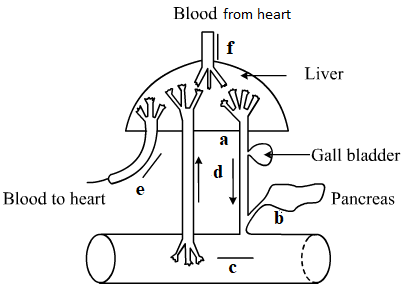
Figure of liver shows entry and exit of structures-a, b, c, d, e and f. Choose the correct combination.
A. a-hepatic portal vein, e-hepatic vein
B. c-intestine, f- hepatic portal vein
C. d-hepatic portal vein, f-hepatic vein
D. b-pancreatic artery, e-hepatic artery
E. d-hepatic portal vein, e-hepatic vein
Answer
 Verified
526.5k+ views
Hint: The liver has two lobes: a larger right lobe and a smaller left lobe. It is generally triangular in shape. The falciform ligament, a band of tissue that maintains the diaphragm attached, separates the lobes. Glisson's capsule is a fibrous tissue layer that surrounds the outside of the liver. The liver is traditionally divided into four lobes: left, right, caudate, and quadrate lobes. The lobes are further divided into lobules, which are the liver's functional components.
Complete answer:
Option A: The hepatic portal vein delivers blood to the liver from the gastrointestinal tract and the spleen. Hepatic veins are blood vessels that drain deoxygenated blood from the liver into the inferior vena cava.
So, option A is not correct.
Option B: Small ducts (tubes) link these lobules to form the common hepatic duct, which connects to bigger ducts. The bile produced by the liver cells is transported to the gallbladder and duodenum (the first part of the small intestine) via the common hepatic duct.
So, option B is not correct.
Option C: The hepatic portal vein transports blood from the gastrointestinal system and the spleen to the liver. The blood arteries that drain deoxygenated blood from the liver into the inferior vena cava are known as hepatic veins.
So, option C is correct.
Option D: The pancreatic branches, also known as pancreatic arteries, are a group of tiny vessels that branch from the splenic artery as it runs behind the pancreas' top border, supplying the organ's body and tail.
So, option D is not correct.
Option E: The hepatic portal vein transports blood to the liver from the spleen and gastrointestinal system. It is normally created by the joining of the superior mesenteric and splenic veins behind the upper margin of the pancreas head, and it is three to four inches long.
So, this option is not correct.
Therefore, Option C is the correct answer.
Note:
The liver receives blood from two separate sources, including the following:
The hepatic artery brings oxygenated blood in.
The hepatic portal vein brings nutrient-rich blood in.
Functions of liver are-
Bile production, which aids in the removal of waste and the breakdown of fats in the small intestine during digestion.
Certain proteins are produced for blood plasma.
Cholesterol and specific proteins are produced to aid in the transport of fats throughout the body.
Amino acid levels in the blood, which are the building blocks of proteins, are regulated.
Hemoglobin is processed to make use of its iron content (the liver stores iron)
The process of converting toxic ammonia to urea (urea is an end product of protein metabolism and is excreted in the urine)
Getting rid of drugs and other toxic compounds from the blood
Controlling blood clotting
Making immune factors and eliminating bacteria from the bloodstream to fight illnesses
Bilirubin clearance, including from red blood cells. The skin and eyes turn yellow when there is a buildup of bilirubin.
Complete answer:
Option A: The hepatic portal vein delivers blood to the liver from the gastrointestinal tract and the spleen. Hepatic veins are blood vessels that drain deoxygenated blood from the liver into the inferior vena cava.
So, option A is not correct.
Option B: Small ducts (tubes) link these lobules to form the common hepatic duct, which connects to bigger ducts. The bile produced by the liver cells is transported to the gallbladder and duodenum (the first part of the small intestine) via the common hepatic duct.
So, option B is not correct.
Option C: The hepatic portal vein transports blood from the gastrointestinal system and the spleen to the liver. The blood arteries that drain deoxygenated blood from the liver into the inferior vena cava are known as hepatic veins.
So, option C is correct.
Option D: The pancreatic branches, also known as pancreatic arteries, are a group of tiny vessels that branch from the splenic artery as it runs behind the pancreas' top border, supplying the organ's body and tail.
So, option D is not correct.
Option E: The hepatic portal vein transports blood to the liver from the spleen and gastrointestinal system. It is normally created by the joining of the superior mesenteric and splenic veins behind the upper margin of the pancreas head, and it is three to four inches long.
So, this option is not correct.
Therefore, Option C is the correct answer.
Note:
The liver receives blood from two separate sources, including the following:
The hepatic artery brings oxygenated blood in.
The hepatic portal vein brings nutrient-rich blood in.
Functions of liver are-
Bile production, which aids in the removal of waste and the breakdown of fats in the small intestine during digestion.
Certain proteins are produced for blood plasma.
Cholesterol and specific proteins are produced to aid in the transport of fats throughout the body.
Amino acid levels in the blood, which are the building blocks of proteins, are regulated.
Hemoglobin is processed to make use of its iron content (the liver stores iron)
The process of converting toxic ammonia to urea (urea is an end product of protein metabolism and is excreted in the urine)
Getting rid of drugs and other toxic compounds from the blood
Controlling blood clotting
Making immune factors and eliminating bacteria from the bloodstream to fight illnesses
Bilirubin clearance, including from red blood cells. The skin and eyes turn yellow when there is a buildup of bilirubin.
Recently Updated Pages
Master Class 11 Social Science: Engaging Questions & Answers for Success

Master Class 11 Physics: Engaging Questions & Answers for Success
Master Class 11 Maths: Engaging Questions & Answers for Success
Master Class 11 Economics: Engaging Questions & Answers for Success
Master Class 11 Computer Science: Engaging Questions & Answers for Success
Master Class 11 Chemistry: Engaging Questions & Answers for Success
Trending doubts
One Metric ton is equal to kg A 10000 B 1000 C 100 class 11 physics CBSE
There are 720 permutations of the digits 1 2 3 4 5 class 11 maths CBSE
1 Quintal is equal to a 110 kg b 10 kg c 100kg d 1000 class 11 physics CBSE
State and prove Bernoullis theorem class 11 physics CBSE
Difference Between Prokaryotic Cells and Eukaryotic Cells
Discuss the various forms of bacteria class 11 biology CBSE