




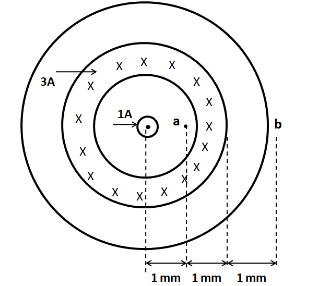
Figure given in the question is a cross sectional view of a coaxial cable. The centre conductor is surrounded by a rubber layer, which is surrounded by an outer conductor, which is surrounded by another rubber layer. The current in the inner conductor is $ 1.0{\text{ A}} $ out of the page, and the current in the outer conductor is $ 3.0{\text{ A}} $ into the page. Determine the magnitude and direction of the magnetic of the magnetic field at points a and b.
Answer
 Verified
572.1k+ views
Hint : To solve this question, we need to use the Ampere’s circuital law. As the current distribution is symmetric, so this method would be the most convenient.
Formula used: $ \oint {B \bullet dl = {\mu _0}I} $
where B is the magnetic field, I is the current flowing through the conductor, and $ {\mu _0} $ is the permittivity of free space.
Complete step by step answer
We know that the Ampere’s circuital law is given by
$ \oint {B \bullet dl = {\mu _0}I} $ ………………..(1)
So, we need to find the current enclosed within the surface enclosed by the boundary around the points.
For point a:
At the point a, we draw an imaginary circle of radius $ {r_a} = 1mm $ as shown in the below diagram.
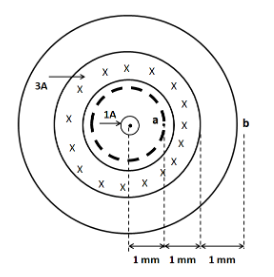
As we can see in the diagram, the current enclosed inside the region of this circle is
$ I = 1A $ (Outwards $ \bullet $ )
From equation (1)
$ \oint {{B_a} \bullet dl = {\mu _0}(1)} $
As the current distribution is symmetrical around the region, so the magnetic field $ {B_a} $ is constant around the circle. So, it can be taken out of the integral.
Thus, we have
$ {B_a}\oint {dl = {\mu _0}(1)} $
$ {B_a}(2\pi {r_a}) = {\mu _0} $
As $ {r_a} = 1mm = {10^{ - 3}}m $ , we have
$ {B_a}(2\pi \times {10^{ - 3}}) = {\mu _0} $
$ {B_a} = \dfrac{{{\mu _0}}}{{2\pi }} \times {10^3} $
We know that $ {\mu _0} = 4\pi \times {10^{ - 7}} $
$ {B_a} = \dfrac{{4\pi \times {{10}^{ - 7}}}}{{2\pi }} \times {10^3} $
$ {B_a} = 2 \times {10^{ - 4}}T $
Hence, the magnetic field at point a is $ 2 \times {10^{ - 4}}T $
As the net current enclosed is in the outward direction, so by the right hand thumb rule, this magnetic field is in an anti-clockwise direction.
For point b:
At point b, we draw an imaginary circle of radius $ {r_b} = 3mm $ as shown in the below diagram.
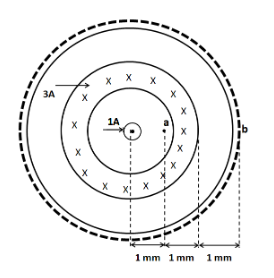
As we can see in the diagram, the current enclosed inside the region of this circle is $ 3A $ $ \otimes $ and $ 1A $ $ \bullet $
So, net current enclosed is
$ I = 3A - 1A $ (Inwards $ \otimes $ )
$ I = 2A $ $ $
From equation (1)
$ \oint {{B_b} \bullet dl = {\mu _0}(2)} $
As the current distribution is symmetrical around the region, so the magnetic field $ {B_b} $ is constant around the circle. So, it can be taken out of the integral.
Thus, we have
$ {B_b}\oint {dl = {\mu _0}(2} ) $
$ {B_b}(2\pi {r_b}) = 2{\mu _0} $
As $ {r_b} = 3mm = 3 \times {10^{ - 3}}m $ , we have
$ {B_b}(2\pi \times 3 \times {10^{ - 3}}) = 2{\mu _0} $
$ {B_a} = \dfrac{{2{\mu _0}}}{{6\pi }} \times {10^3} $
We know that $ {\mu _0} = 4\pi \times {10^{ - 7}} $
$ {B_a} = \dfrac{{2 \times 4\pi \times {{10}^{ - 7}}}}{{6\pi }} \times {10^3} $
$ {B_a} = 1.33 \times {10^{ - 4}}T $
Hence, the magnetic field at point b is $ 1.33 \times {10^{ - 4}}T $
As the net current enclosed is in the inward direction, so by the right hand thumb rule, this magnetic field is in clockwise direction.
Note
The ampere’s circuital law is very much convenient in the case of symmetric current distributions. This is because in these cases the magnetic field becomes constant over the loop of the integration and hence the integration becomes simple. But in the cases of non-symmetric current distributions, the integration may become complex and this method may not be useful.
Formula used: $ \oint {B \bullet dl = {\mu _0}I} $
where B is the magnetic field, I is the current flowing through the conductor, and $ {\mu _0} $ is the permittivity of free space.
Complete step by step answer
We know that the Ampere’s circuital law is given by
$ \oint {B \bullet dl = {\mu _0}I} $ ………………..(1)
So, we need to find the current enclosed within the surface enclosed by the boundary around the points.
For point a:
At the point a, we draw an imaginary circle of radius $ {r_a} = 1mm $ as shown in the below diagram.
As we can see in the diagram, the current enclosed inside the region of this circle is
$ I = 1A $ (Outwards $ \bullet $ )
From equation (1)
$ \oint {{B_a} \bullet dl = {\mu _0}(1)} $
As the current distribution is symmetrical around the region, so the magnetic field $ {B_a} $ is constant around the circle. So, it can be taken out of the integral.
Thus, we have
$ {B_a}\oint {dl = {\mu _0}(1)} $
$ {B_a}(2\pi {r_a}) = {\mu _0} $
As $ {r_a} = 1mm = {10^{ - 3}}m $ , we have
$ {B_a}(2\pi \times {10^{ - 3}}) = {\mu _0} $
$ {B_a} = \dfrac{{{\mu _0}}}{{2\pi }} \times {10^3} $
We know that $ {\mu _0} = 4\pi \times {10^{ - 7}} $
$ {B_a} = \dfrac{{4\pi \times {{10}^{ - 7}}}}{{2\pi }} \times {10^3} $
$ {B_a} = 2 \times {10^{ - 4}}T $
Hence, the magnetic field at point a is $ 2 \times {10^{ - 4}}T $
As the net current enclosed is in the outward direction, so by the right hand thumb rule, this magnetic field is in an anti-clockwise direction.
For point b:
At point b, we draw an imaginary circle of radius $ {r_b} = 3mm $ as shown in the below diagram.
As we can see in the diagram, the current enclosed inside the region of this circle is $ 3A $ $ \otimes $ and $ 1A $ $ \bullet $
So, net current enclosed is
$ I = 3A - 1A $ (Inwards $ \otimes $ )
$ I = 2A $ $ $
From equation (1)
$ \oint {{B_b} \bullet dl = {\mu _0}(2)} $
As the current distribution is symmetrical around the region, so the magnetic field $ {B_b} $ is constant around the circle. So, it can be taken out of the integral.
Thus, we have
$ {B_b}\oint {dl = {\mu _0}(2} ) $
$ {B_b}(2\pi {r_b}) = 2{\mu _0} $
As $ {r_b} = 3mm = 3 \times {10^{ - 3}}m $ , we have
$ {B_b}(2\pi \times 3 \times {10^{ - 3}}) = 2{\mu _0} $
$ {B_a} = \dfrac{{2{\mu _0}}}{{6\pi }} \times {10^3} $
We know that $ {\mu _0} = 4\pi \times {10^{ - 7}} $
$ {B_a} = \dfrac{{2 \times 4\pi \times {{10}^{ - 7}}}}{{6\pi }} \times {10^3} $
$ {B_a} = 1.33 \times {10^{ - 4}}T $
Hence, the magnetic field at point b is $ 1.33 \times {10^{ - 4}}T $
As the net current enclosed is in the inward direction, so by the right hand thumb rule, this magnetic field is in clockwise direction.
Note
The ampere’s circuital law is very much convenient in the case of symmetric current distributions. This is because in these cases the magnetic field becomes constant over the loop of the integration and hence the integration becomes simple. But in the cases of non-symmetric current distributions, the integration may become complex and this method may not be useful.
Recently Updated Pages
Basicity of sulphurous acid and sulphuric acid are

Master Class 12 English: Engaging Questions & Answers for Success
Master Class 12 Social Science: Engaging Questions & Answers for Success
Master Class 12 Maths: Engaging Questions & Answers for Success
Master Class 12 Economics: Engaging Questions & Answers for Success
Master Class 12 Physics: Engaging Questions & Answers for Success
Trending doubts
Which are the Top 10 Largest Countries of the World?
Draw a labelled sketch of the human eye class 12 physics CBSE
Draw ray diagrams each showing i myopic eye and ii class 12 physics CBSE
Give 10 examples of unisexual and bisexual flowers
Give simple chemical tests to distinguish between the class 12 chemistry CBSE
Define Vant Hoff factor How is it related to the degree class 12 chemistry CBSE