




Family Fabaceae belongs to series
(a) Inferae
(b) Thalamiflorae
(c) Calyciflorae
(d) Disciflorae
Answer
 Verified
622.5k+ views
Hint: The seeded plants are classified into three different classes and they are Dicotyledonae, Gymnospermae, and Monocotyledonae. The English botanists Sir Joseph Dalton Hooker (1817 to 1911) and George Bentham (1800 to 1884) proposed this classification.
Complete answer:
The first class Dicotyledonae has seeds containing two cotyledons and the leaves appear to have reticulate venation. The flowers may be tetramerous (having four members in various floral whorls) or pentamerous (having five members in various floral whorls) . This is further subdivided into Polypetalae, Gamopetalae, and Monochlamydeae. The Polypetalae have flowers with free petals and the calyx and corolla are distinct. This includes three series and they are Thalamiflorae, Disciflorae, and Calyciflorae. The Thalamiflorae plant flowers have a dome or conical thalamus and the ovary is superior. This has 6 orders and 34 families. The Disciflorae has plants with the flowers having prominent disc-shaped thalamus placed below the ovary. This includes 4 orders and 23 families. The Calyciflorae has plants with flowers that have cup-shaped thalamus and the ovary can be superior, inferior, or sometimes half inferior. This is divided into 5 orders and 27 families with the family Fabaceae being included in the order Rosales.
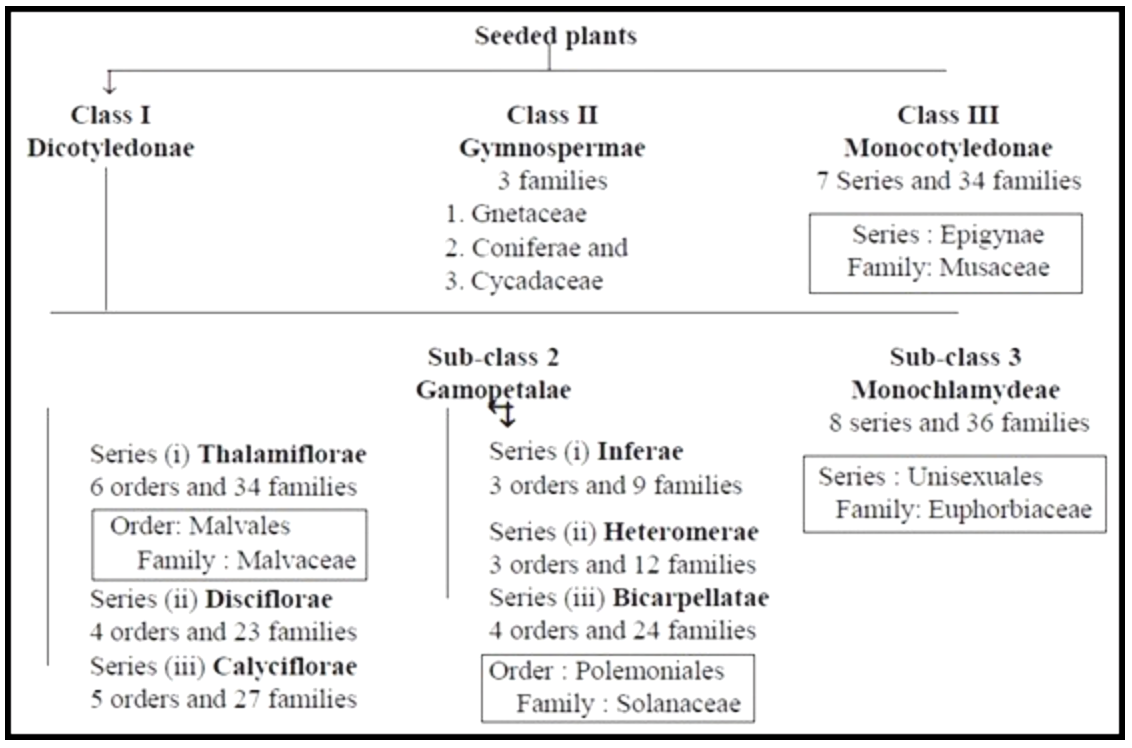
So, the correct answer is ‘(c) Calyciflorae'.
Note: Fabaceae is also known as the Leguminosae is a pea family of flowering plants and is the third-largest family among the angiosperms. It includes more than 700 genera and 20,000 species of vines, trees, herbs, and shrubs distributed worldwide. They are mostly tropical and some occur in temperate regions. Some commercial species are soybeans, peanuts, and garden peas. The leaves of these plants are pinnately compound and sometimes trifoliate or palmate.
Complete answer:
The first class Dicotyledonae has seeds containing two cotyledons and the leaves appear to have reticulate venation. The flowers may be tetramerous (having four members in various floral whorls) or pentamerous (having five members in various floral whorls) . This is further subdivided into Polypetalae, Gamopetalae, and Monochlamydeae. The Polypetalae have flowers with free petals and the calyx and corolla are distinct. This includes three series and they are Thalamiflorae, Disciflorae, and Calyciflorae. The Thalamiflorae plant flowers have a dome or conical thalamus and the ovary is superior. This has 6 orders and 34 families. The Disciflorae has plants with the flowers having prominent disc-shaped thalamus placed below the ovary. This includes 4 orders and 23 families. The Calyciflorae has plants with flowers that have cup-shaped thalamus and the ovary can be superior, inferior, or sometimes half inferior. This is divided into 5 orders and 27 families with the family Fabaceae being included in the order Rosales.
So, the correct answer is ‘(c) Calyciflorae'.
Note: Fabaceae is also known as the Leguminosae is a pea family of flowering plants and is the third-largest family among the angiosperms. It includes more than 700 genera and 20,000 species of vines, trees, herbs, and shrubs distributed worldwide. They are mostly tropical and some occur in temperate regions. Some commercial species are soybeans, peanuts, and garden peas. The leaves of these plants are pinnately compound and sometimes trifoliate or palmate.
Recently Updated Pages
Master Class 11 English: Engaging Questions & Answers for Success

Master Class 11 Social Science: Engaging Questions & Answers for Success
Master Class 11 Maths: Engaging Questions & Answers for Success
Master Class 11 Chemistry: Engaging Questions & Answers for Success
Master Class 11 Biology: Engaging Questions & Answers for Success
Master Class 11 Physics: Engaging Questions & Answers for Success
Trending doubts
One Metric ton is equal to kg A 10000 B 1000 C 100 class 11 physics CBSE
Difference Between Prokaryotic Cells and Eukaryotic Cells
Find the value of the expression given below sin 30circ class 11 maths CBSE
1 ton equals to A 100 kg B 1000 kg C 10 kg D 10000 class 11 physics CBSE
Two of the body parts which do not appear in MRI are class 11 biology CBSE
Draw a diagram of nephron and explain its structur class 11 biology CBSE