




What is Facilitated diffusion? How is symport transport different from antiport transport?
Answer
 Verified
525.9k+ views
Hint: Transport in membranes deals with the movement of materials across the membranes of cells. Transport is a necessity for the cells for the uptake of nutrients. This activity along with the movement of ions and other molecules is offered by proteins and protein complexes, which are highly specific for the compounds they move. This selective movement and ions’ lower permeability across the lipid bilayer aid in maintaining the osmotic balance of the cell.
Complete answer
Other names for the facilitated diffusion are facilitated transport and passive-mediated transport. It is opposed to active transport and is a process of spontaneous passive transport of ions or molecules across a biological membrane through specific transmembrane integral proteins. It occurs when the driving factor for the movement is diffusion.
The driving force for facilitated diffusion is concentration. The materials move from a side of higher concentration to a side of lower concentration and by the end of the process, the concentration of materials on both sides are equal. Red blood cells acquiring glucose is an example of facilitated diffusion.
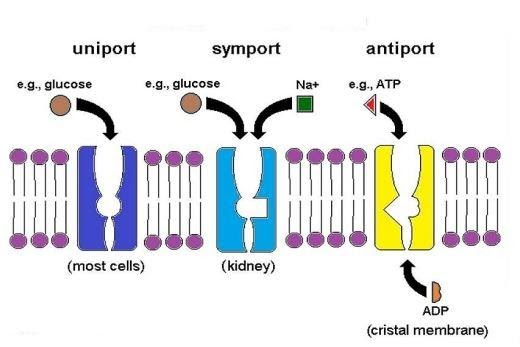
Fig.: Symport, Antiport and Uniport modes of Transport
Note:
Both symporter and antiporter act as cotransporters and are a type of secondary active transport. Uniport is an integral membrane protein, where transport of only one molecule is involved. Carrier proteins are involved in primary active transport, whereas transmembrane proteins are involved in secondary active transport. The antiporter transport substrates in two directions, whereas both uniporter and symporter transport molecules in a single direction.
Complete answer
Other names for the facilitated diffusion are facilitated transport and passive-mediated transport. It is opposed to active transport and is a process of spontaneous passive transport of ions or molecules across a biological membrane through specific transmembrane integral proteins. It occurs when the driving factor for the movement is diffusion.
The driving force for facilitated diffusion is concentration. The materials move from a side of higher concentration to a side of lower concentration and by the end of the process, the concentration of materials on both sides are equal. Red blood cells acquiring glucose is an example of facilitated diffusion.
Fig.: Symport, Antiport and Uniport modes of Transport
| Symport Transport | Antiport Transport |
| A symporter is an integral membrane protein. It is involved in the transport of various kinds of molecules across the cell membrane. As two molecules travel in the same direction in relation to each other, the transporter is called a symporter | An antiporter is also an integral membrane protein, but two molecules travel in opposite directions in relation to each other. |
| Sodium sugar pump and hydrogen sugar pump are involved in the symport transport system. | Sodium potassium pump and sodium-calcium exchanger are involved in the anti-port transport system. |
Note:
Both symporter and antiporter act as cotransporters and are a type of secondary active transport. Uniport is an integral membrane protein, where transport of only one molecule is involved. Carrier proteins are involved in primary active transport, whereas transmembrane proteins are involved in secondary active transport. The antiporter transport substrates in two directions, whereas both uniporter and symporter transport molecules in a single direction.
Recently Updated Pages
Master Class 11 English: Engaging Questions & Answers for Success

Master Class 11 Social Science: Engaging Questions & Answers for Success
Master Class 11 Maths: Engaging Questions & Answers for Success
Master Class 11 Biology: Engaging Questions & Answers for Success
Master Class 11 Physics: Engaging Questions & Answers for Success
Master Class 11 Chemistry: Engaging Questions & Answers for Success
Trending doubts
One Metric ton is equal to kg A 10000 B 1000 C 100 class 11 physics CBSE
Difference Between Prokaryotic Cells and Eukaryotic Cells
Find the value of the expression given below sin 30circ class 11 maths CBSE
1 ton equals to A 100 kg B 1000 kg C 10 kg D 10000 class 11 physics CBSE
Two of the body parts which do not appear in MRI are class 11 biology CBSE
What are hard magnetic materials class 11 physics CBSE