




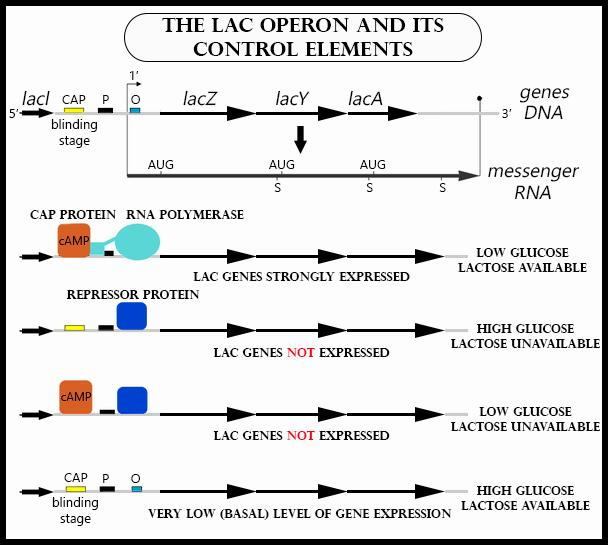
Explain the working of the lac operon with diagrammatic representation.
Answer
 Verified
672.3k+ views
Hint: Operon refers to a set of functional genes (Transcription unit) required for the production of enzymes. They have a single promoter region. In operon the genes encode proteins that allow the bacteria to use lactose as an energy source.
Complete Answer:
The concept of Lac operon was given by Francois Jacob and Jacques Monod. Lac operon is an operon present predominantly in the prokaryotes like E. coli. It was the first gene regulatory process to be discovered in bacteria. It is associated with the regulation of lactose i.e. transport and metabolism.
-It consists of an operator, promoter, three structural genes, z, y, a, and a terminator.
-The three structural genes lacZ, lacY, lacA code for beta-galactosidase, galactoside permease, and galactoside acetyltransferase, respectively.
-The enzyme RNA polymerase binds to the promoter region (at 3’ end of template strand) and moves downstream, forming the desirable protein.
-The enzyme beta-galactosidase is responsible for the breakdown of disaccharide lactose into glucose and galactose. Permease is a cell membrane protein responsible for the entry of lactose into the cell. Acetyltransferase is responsible for the transfer of the acetyl group from acetyl-CoA to beta galactoside.
-The operon is active only in the presence of lactose.
Note: -Jacob and Monad were awarded the Nobel prize for the discovery of Lac operon in 1965.
-The lac operon remains in ‘off’ position. It means that the operon is negatively inducible due to the presence of a repressor gene i.e. ‘I’ gene. The depression molecule blocks the action of RNA polymerase. The repressor molecule can be removed only by an operator protein (coded by a gene ‘o’).
-The operator present in Lac operon is ‘Allolactose’.
Complete Answer:
The concept of Lac operon was given by Francois Jacob and Jacques Monod. Lac operon is an operon present predominantly in the prokaryotes like E. coli. It was the first gene regulatory process to be discovered in bacteria. It is associated with the regulation of lactose i.e. transport and metabolism.
-It consists of an operator, promoter, three structural genes, z, y, a, and a terminator.
-The three structural genes lacZ, lacY, lacA code for beta-galactosidase, galactoside permease, and galactoside acetyltransferase, respectively.
-The enzyme RNA polymerase binds to the promoter region (at 3’ end of template strand) and moves downstream, forming the desirable protein.
-The enzyme beta-galactosidase is responsible for the breakdown of disaccharide lactose into glucose and galactose. Permease is a cell membrane protein responsible for the entry of lactose into the cell. Acetyltransferase is responsible for the transfer of the acetyl group from acetyl-CoA to beta galactoside.
-The operon is active only in the presence of lactose.
Note: -Jacob and Monad were awarded the Nobel prize for the discovery of Lac operon in 1965.
-The lac operon remains in ‘off’ position. It means that the operon is negatively inducible due to the presence of a repressor gene i.e. ‘I’ gene. The depression molecule blocks the action of RNA polymerase. The repressor molecule can be removed only by an operator protein (coded by a gene ‘o’).
-The operator present in Lac operon is ‘Allolactose’.
Recently Updated Pages
Explain the structure of megasporangium class 12 biology CBSE

Why is chloroform kept in dark coloured bottles class 12 chemistry CBSE
Derive the balancing condition of a Wheatstone bri class 12 physics CBSE
Draw VI characteristics of a pn junction diode Explain class 12 physics CBSE
Is it possible to carry pride in ones language too class 12 english CBSE
In a population at Hardy Weinberg equilibrium the allele class 12 biology CBSE
Trending doubts
Draw a labelled sketch of the human eye class 12 physics CBSE
Which are the Top 10 Largest Countries of the World?
Draw ray diagrams each showing i myopic eye and ii class 12 physics CBSE
One megawatt is equal to how many units of electri class 12 physics CBSE
Which is the correct genotypic ratio of mendel dihybrid class 12 biology CBSE
Give 10 examples of unisexual and bisexual flowers