




Explain the terms:
(a) Enantiomers
(b) Racemisation
Answer
 Verified
655.5k+ views
Hint: In chemistry, enantiomers can be thought of the derivation of two separate words i.e. ‘enantio’ meaning opposite and ‘meros’ meaning part. We can say that enantiomer means each of a pair of molecules which are mirror images of each other. On the other hand, racemization can be defined as the transformation of an optically active substance to an optically inactive mixture of the same amount of the dextrorotatory as well as levorotatory forms.
Complete step by step answer:
Detailed explanation of enantiomers and racemisation:
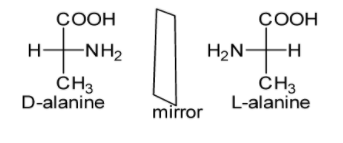
a) Enantiomers: They are the stereoisomers which are non-superimposable mirror images of each other as well as rotate the plane of polarized light via the same angle though different in opposite directions. They possess identical physical characteristics (melting point, density, boiling point, refractive index, etc) excluding the direction of rotation in the plane of polarization. Though, the magnitude of rotation remains the same. They have similar chemical characteristics except those towards chiral reagents. For instance, D-alanine and L-alanine are enantiomers.
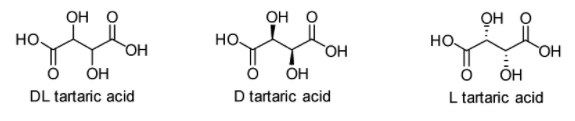
(b) Racemisation: It is a phenomenon in which a racemic mixture is attained from a chiral starting material (s). When an equimolar amount of dextro as well as laevo isomers are mixed together, the resulting mixture or solution becomes optically inactive owing to the external compensation. This resultant mixture is known as the racemic mixture or racemate. In simpler terms, at any given point or time in a reaction, there always exists a 50 : 50 mixture of both enantiomers (known as a racemic mixture) due to the fact that enantiomers are constantly inter-converting. For instance, DL-tartaric acid is considered to be a racemate as it comprises the equimolar proportions of D- and L- isomers.
Note: Enantiomers are the pairs of stereoisomers which are chiral. It should be noted that the two non-identical mirror images belong to a pair of enantiomers. The central atom is known as a chiral centre or we can say stereocenter. On the other hand, racemic mixtures are usually formed when the achiral substances are transformed into chiral ones.
Complete step by step answer:
Detailed explanation of enantiomers and racemisation:
a) Enantiomers: They are the stereoisomers which are non-superimposable mirror images of each other as well as rotate the plane of polarized light via the same angle though different in opposite directions. They possess identical physical characteristics (melting point, density, boiling point, refractive index, etc) excluding the direction of rotation in the plane of polarization. Though, the magnitude of rotation remains the same. They have similar chemical characteristics except those towards chiral reagents. For instance, D-alanine and L-alanine are enantiomers.
(b) Racemisation: It is a phenomenon in which a racemic mixture is attained from a chiral starting material (s). When an equimolar amount of dextro as well as laevo isomers are mixed together, the resulting mixture or solution becomes optically inactive owing to the external compensation. This resultant mixture is known as the racemic mixture or racemate. In simpler terms, at any given point or time in a reaction, there always exists a 50 : 50 mixture of both enantiomers (known as a racemic mixture) due to the fact that enantiomers are constantly inter-converting. For instance, DL-tartaric acid is considered to be a racemate as it comprises the equimolar proportions of D- and L- isomers.
Note: Enantiomers are the pairs of stereoisomers which are chiral. It should be noted that the two non-identical mirror images belong to a pair of enantiomers. The central atom is known as a chiral centre or we can say stereocenter. On the other hand, racemic mixtures are usually formed when the achiral substances are transformed into chiral ones.
Recently Updated Pages
Master Class 12 Physics: Engaging Questions & Answers for Success

Master Class 12 Social Science: Engaging Questions & Answers for Success
Master Class 12 English: Engaging Questions & Answers for Success
Master Class 12 Maths: Engaging Questions & Answers for Success
Master Class 12 Business Studies: Engaging Questions & Answers for Success
Master Class 12 Chemistry: Engaging Questions & Answers for Success
Trending doubts
Draw a labelled sketch of the human eye class 12 physics CBSE
Which are the Top 10 Largest Countries of the World?
Draw ray diagrams each showing i myopic eye and ii class 12 physics CBSE
Which is the correct genotypic ratio of mendel dihybrid class 12 biology CBSE
Which is the strongest oxidising agent out of the following class 12 chemistry CBSE
Differentiate between homogeneous and heterogeneous class 12 chemistry CBSE